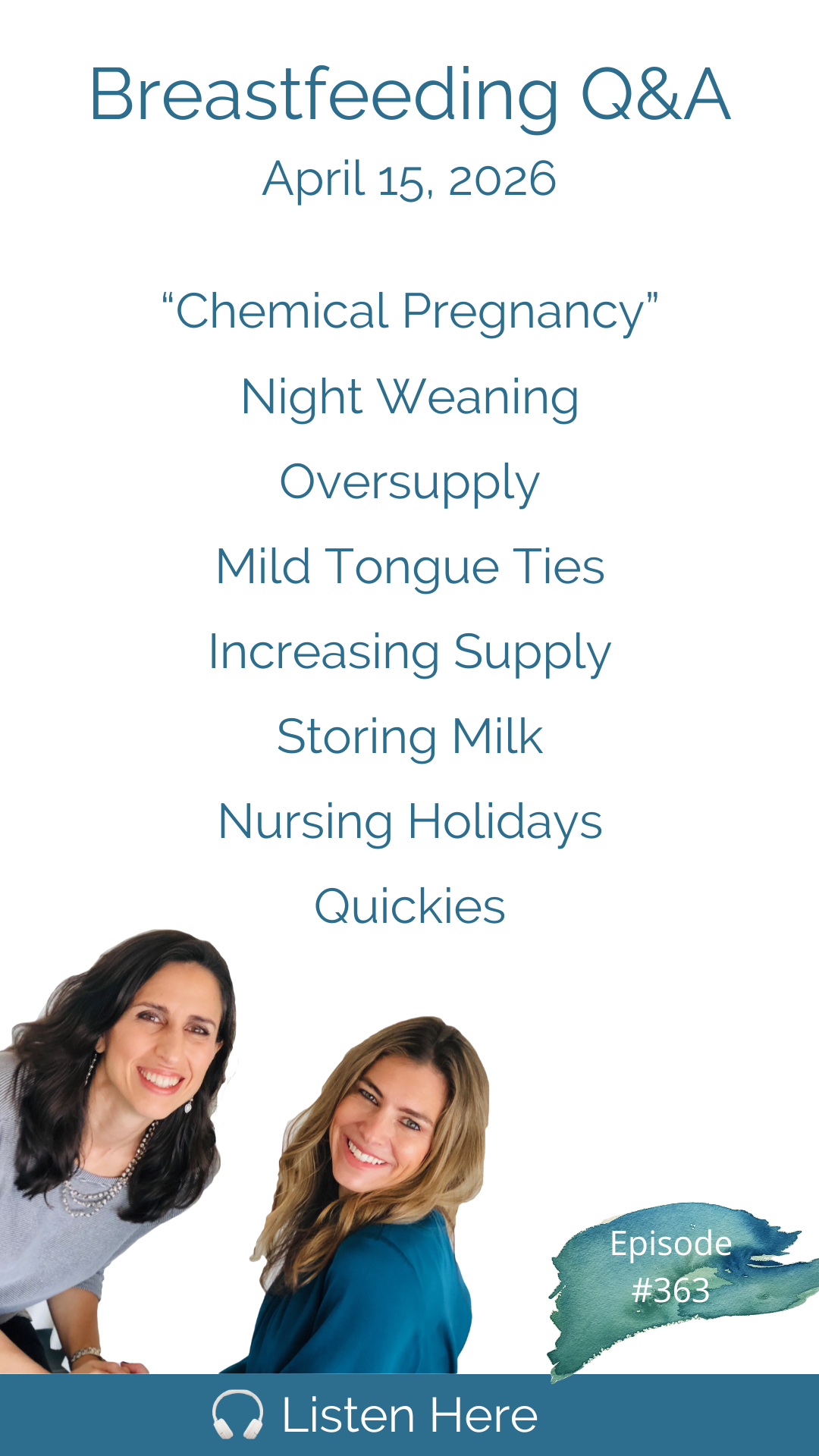
We are back with another breastfeeding-only Q&A episode. In today's conversation, we respond to several listener questions related to nursing, sleep, and fertility after breastfeeding. One mother who is co-sleeping with her 15-month-old, who wakes three to five times per night to nurse, asks how she can help her toddler sleep longer stretches without abruptly stopping breastfeeding. Another listener with a 4.5-month-old who has never taken a bottle is planning to attend a bachelorette party when her baby will be about nine months old and asks how best to prepare. We also hear from a mother who recently weaned her two-year-old and then experienced a very early miscarriage, often called a chemical pregnancy, and wonders whether she should consider hormonal support before trying to conceive again. As for our Quickies: Is it concerning if a 12-week-old drops slightly on the growth curve while still gaining weight, what the issue is with the Boppy pillow for breastfeeding, and can you continue breastfeeding while taking antibiotics for mastitis? We also discuss healing cracked nipples after a tongue-tie release, whether milk will come in normally if you breastfeed during pregnancy, and whether lactation cookies or brewer’s yeast actually increase supply. As also cover oversupply with a second baby, postpartum chills when milk comes in, storing breast milk and keeping pump parts clean on long drives, preventing recurrent mastitis from oversupply, whether a mild tongue tie should be released if breastfeeding is going well, what a “nursing holiday” is and whether it can help supply and latch, and how to help a bottle-fed newborn latch to the breast. Just us on Patreon for our upcoming all-Quickies episode, exclusive to patrons-only. Controversial article we discussed in this episode: My Decision Not to Breastfeed with Elise Hewitt#239 | The Cost of Breastfeeding Versus Formula Feeding with Dr. Rhonda Trust, PhD
**********
Needed <-- this link for 20% off your whole subscription order
DrinkLMNT <-- this link for FREE 8-day supply
Primally Pure: ingredients good for you and the earth. Promo code: DOWNTOBIRTH
Postpartum Soothe: Organic herbal padsicles for healing. Promo code DOWNTOBIRTH
ENERGYBits: <--this link for 20% off
Join Patreon for our exclusive content
IG @downtobirthshow
Call 802-GET-DOWN
Watch full videos of all episodes on YouTube! Please note we don’t provide medical advice. Speak to your licensed provider for all healthcare matters.
I'm Cynthia Overgard, birth educator, advocate for informed consent, and postpartum support specialist. And I'm Trisha Ludwig, certified nurse midwife and international board certified lactation consultant. And this is the Down To Birth Show. Childbirth is something we're made to do. But how do we have our safest and most satisfying experience in today's medical culture? Let's dispel the myths and get down to birth.
Hello and welcome to the April breastfeeding Q and A. All right, we got some good questions, and Trisha, I'm excited to play them for you.
We have about 2000 quickies, so we'll see. We could have a whole episode on quickies today.
Maybe that's what we should do on Patreon, like maybe rather than regular Q and A's that are just private and for our Patreon followers, maybe we should do Patreon quickies, because it would help us to answer more quickies. And for those who are motivated to hear the responses, or they're really excited about quickies because they're really fun, it'd be like a whole event of quickies. That might be a good way for us to answer most quickies, because we do get so many anyway. Just a thought, we can do that.
I like that idea. I think we should do that. Let's try it. Okay. And other news, do you know who Pete Davidson is? No. Me neither. Okay, apparently he has a girlfriend, and his girlfriend's name is Elsie Hewitt. And his girlfriend wrote this big article in, or was interviewed for this big article recently in Elle magazine about her decision not to breastfeed. And one of our followers sent it to us, and I thought, you know, oh, sure, I'll take a look at it. And she asked for our opinion on it. And as I was reading it, I actually felt a little bit of empathy for this woman, you know, she seemed to really be struggling with her decision not to breastfeed. And I understand sometimes that women choose that. But as I was reading it, a few things popped out in the article that I was like, wait a minute. No, no. This is not really resonating with me. And I later found out that this woman has a relationship with the formula company, Bobbie. Unbelievable. So I was feeling for her, like she was being very vulnerable in this article, just carrying all her feelings around why she chose not to breastfeed. I can't even believe, and then, yeah, now I'm like, what?
What? I cannot believe this. So let me just read. It's just everywhere. It's just everywhere. I just heard this week, I just learned that the BBC gets like, I think it was 57 million a year for having basically ties to the UN and like pushing through the media what the UN wants them to push through. And it just, like, is there anything that's safe? So when these celebrities, or whoever these people are, when they come out publicly, you have to wonder, why? And how rare is it for the mainstream to say, oh, we're featuring a celebrity who had a home birth. How cool for her? Or this one, this one—
There's no money behind it. There's no money. But also, there's such a true division comes from the voices that say, don't judge. People can do what they want. It's like, yet no one is judging, but why don't you share the other voices too? Because some women's lives will be changed for the better by hearing some good information, seeing both sides. It's just always the same direction. It's always the same thing, more intervention, more products. I can't believe—did that get out publicly that there's a tie there?
I don't know how far it went or how excited people got about it, but I did hear that connection, and obviously very new about it changed my feelings of, you know, sympathy toward her.
Well, we learned about this on one of our Patreon events. We had another breastfeeding spokesperson who was talking about all the political ties, and Bobbie was—
Deeply. That's exactly—and this, that's exactly who it was, Andrea from Mothering... yes, she is the one who's found this out and dug it up. Yeah. And I was like, wow, wow. Well, let me just read a couple of things that were said in the article. Also, when I started to, you know, already lose a little bit of sympathy for her, she states, “There is an inherent guilt in choosing not to breastfeed.” True, because it is sort of against your own biology and instincts. “That guilt doesn't disappear simply because formula is safe, healthy, and nutritionally complete.” That's when my radar went on.
Wait a minute. Genius marketing. Genius manipulation. Genius PR. That's exactly how to manipulate. “Nutritionally complete.” Well, they take for granted—that's the part they take for granted—and they try to pretend the emphasis is on the guilt. Well done. Bravo. Right, unbelievable. It's just unbelievable. It's so bad to do this to another generation of women. This nonsense.
“Somewhere along the way we've conflated suffering with virtue, as though choosing a harder path is proof of devotion.” Unbelievable.
I can't—this is so frustrating. So now it's about acting like those who want to breastfeed are just suffering warriors, suffering through it. Yeah, we're warriors. I can do this. I know it's hard. I'm a warrior, though. What? This is not at all what this is about. This is—
Well, and you've heard me say before, exclusive breastfeeding is actually far easier than long-term formula feeding. Far easier. So this is not even true.
I mean, they're acting like women who breastfeed are taking one for the team. And yes, it is a major life commitment, but so is having a baby and feeding a baby well. So is also feeding your baby, like period. That's exactly what I was saying.
Breastfeeding is actually easier when it's going well.
This is like when they say to women who opt for a natural or physiologic birth, you don't get a medal for this. You don't have to be a hero. It's like, I haven't met the woman who came from the place of ego. I haven't met the woman who couldn't wait to—I don't know. Like, this is that—it’s like we're on different planets. So they know this. Nice try. They're just trying to control the narrative. Now have a woman who breastfed her children talk about why she did breastfeed. But the fact that there are financial ties is so unethical, I just can't get over this. I don't know why it's surprising. It wasn't—
There was recently an article in The New York Times too about how formula feeding babies was the way to save your marriage or something like that. I didn't read that one, but—
That's outrageous. Yeah. Outrageous. Yeah. I mean, but you see who buys their ads, who pays their bills. Turn on any cable news network after 8 p.m. and you're going to see, I don't know, it feels like 80 or 90% of them are pharmaceutical companies. Obviously, this is who pays the bills. This is why I sincerely believe even smaller podcasts are the best way to get good information, if they have good interview sources, when they're not bound by contracts, financial ties. It's just what we have to avoid. We're so manipulated.
Are any formula companies owned by pharmaceutical companies? Yes, yeah. Well, you know—
Isn't that the majority?
I don't think so. I think so, owned by Nestlé and food companies, larger food companies.
Let's see, major infant formula brands are primarily owned by large pharmaceutical and healthcare companies, with Abbott Laboratories and Reckitt via Mead Johnson dominating the market. Key formula brands owned by pharma include Similac and EleCare, Enfamil, and PurAmino. These are the top formula brands and various store brand formulas produced by Perrigo. These are like the top ones owned by pharma. Of course.
I mean, this is like—and what happens when you don't breastfeed a baby and they don't get the mother's immune system, and they don't get the antibodies, and they don't get her natural immunization—
In the course of months of the babies and the mothers’ lives, healthcare costs increase by billions because—
But who also—their health—who also is going to benefit more from the lack of immunization from their mother? Right?
All right. Well, that was upsetting. Thank you for sharing that. That was very important. And I'm glad Andrea shared that. It's great that they're doing—thank you, Andrea. Yeah, it's good stuff.
All right, on to our questions.
Yeah, you're having fun now.
Okay, good. “Hi. I have a question about co-sleeping and nursing. I have a 15-month-old, and we have co-slept and exclusively breastfed since birth. He's eating solid foods now, but he still nurses a ton, which is okay with me, but he still wakes a lot throughout the night to nurse. He typically doesn't sleep more than two- to four-hour stretches. Typically, I'll get one longer stretch, but he's at least waking three to five times a night. I'm not sure if he's just a light sleeper and he wakes up and he needs help getting back to sleep, or what the problem is, but I have a hard time getting him back to sleep without nursing him to sleep. I would love to get him to sleep longer stretches at night, but I'm not sure what steps to take to get there. He also, oddly, just isn't super interested in food, like I feel like other children are. He eats solid foods, but he still would prefer to nurse. So I'll sit him down for a meal, but he'll still want to nurse like immediately after. But thank you guys for your help.”
I feel like I can relate to this one. This is pretty much exactly where I was with my third child around 14, 15 months, in a pattern of feeding more overnight than during the day, not terribly interested in solid foods, wanting to breastfeed all the time. Also related to just having gotten a bad cold around that time, and of course, when babies don't feel well, they want to breastfeed more. They're going to wake up more at night, and they don't really want to eat solid foods because breast milk is obviously much easier for them when they're congested and sick. And then it kind of can develop into a pattern where they get in the habit of waking up. And it went on for me for several months before I said, I really can't do this anymore. This is really compromising my sanity, because I was just so sleep deprived. So depending on where she is in that process and how she feels, she doesn't have to do anything. But I assume, because she's calling in, that she's feeling like, yeah, I really can't have this continue on. So this is where the gentle sleep support in the night for the baby can be helpful. And trying to eliminate some of those night feeds, I usually recommend trying to eliminate the first one or two night wakings. So if your baby is waking at—you’re going to bed at nine and your baby’s waking at 11 and one—those would be the wakings where you would try not to breastfeed. In my experience, it was always easier to have the dad be with the baby. And I just think it's really, really difficult to try to put your baby back down to sleep when they want the breast. It can be done. I know lots of moms who do actually do it that way. I just found it was easier for me to not be present in that moment, which means if she's co-sleeping with the baby, that she's going to sleep in a separate room from the baby, or putting the baby to sleep in a separate room. If you can just break those first one or two night wakings and get a four- or five-hour stretch of sleep earlier in the night, it becomes more manageable. You just sort of have to break the cycle.
So your tip is to start with the first night feeding?
The first one or two, depending on how close they are together.
Yeah, I think it's really hard. I'm happy to hear some mothers can do it, but to go get a baby who wants to nurse—I, for me, I found it utterly impossible. I mean, especially at that age, they're pulling out your shirt. They know. They're conscious.
It felt so much harder. It felt like more difficult for them, not just for me, but for them. More difficult for them, yes, because you're denying them.
Yeah. And if they're confused—as long as they're with a loving parent and they're being held and they're being supported and they're not being left alone to cry, they're okay. And they, at that age, they know, like, okay, if mom's not here, I'm not going to eat, and I will figure out how to go back to sleep through being held and rocked and sung to or whatever it is. But again, because they're in the bed together, she's going to have to leave the bed, or the baby's going to have to go to bed in a separate space at first, and then you can bring them back in later, or you can come back in later, but you just have to get through those first couple wakings, and then usually their brain sort of shifts and they'll start sleeping longer, and they might even sleep through the third waking at that point, but you got to kind of stick with it. It doesn't just go away in a night or two. It usually takes four or five, maybe seven days.
“Hi, ladies. Thanks so much for all you guys do and your show. It's really helped a lot. My question is regarding breastfeeding. So I have a—she's currently four and a half months old, and I've exclusively breastfed. She's never had a bottle. She's never had a pacifier. It's all me. However, in about five months, I go on a bachelorette party for one of my good friends, and I really don't want to miss it, but I'm kind of nervous about what that looks like for her. She'll be nine, nine and a half months old by then, and so we might be intermittently doing maybe some more foods, like puree style, but she'll still be pretty young, and I would like to breastfeed fully for at least a year, maybe two years. And so I'm not exactly sure what that looks like. Should I introduce bottles about a month prior so she gets used to it? Should I not worry about it and just have her dad do bottles? I just don't want her to be, you know, really upset the whole weekend while I'm gone, because now she's being fed a bottle and I'm not home, and it's the first time we've been away from each other for that long. Do I pump? Right before I leave, do I start pumping now? I don't have a stash at all. I don't pump really at all because I don't need to. I'm a stay-at-home mom, and so she basically—it’s boob on demand. And so I'm just not really sure what to do about it. My plan right now is just to wait until about March, like a month before I leave, and kind of assess where we're at and then maybe start intermittently pumping. I'm just nervous that she's not going to take the bottle at all and it's just going to be a weekend of hell for my husband, and I really don't want that for him. So yeah, if you guys have any advice on stuff I can start doing now to prepare her, or if I should just not worry about it, or if I should just not go at all. I would love your advice. Thank you guys so much.”
This is a common one, because women's friends are getting married and they're having their baby showers and their bachelorette parties.
What do you think? What did you do in these situations?
I did not leave my baby. I mean, when my son was over a year, my mom came one weekend, and my husband and I went to Kripalu to a yoga retreat together, and that was really, really hard to do. And then when my daughter was about the same age, I went away to a yoga retreat center, and my husband was home with the two kids, but they both started sleeping really—
Well, but I can happen.
I didn't do anything social like that. I think the stress would have been just unbearable. I'm lucky, I wasn't really in a position like that anyway. No big weddings happened at that time. I was lucky. I do think she needs to prepare. She said, should I just not worry about it?
No, you don't—she can't, yeah, she can't just wait till the 11th hour for sure. Not that one, right? So she has a couple of options. So I'm thinking—I do recall taking my babies to a wedding, so I never left mine either. I do remember going to a wedding, but taking my husband and the baby along. So that's an option. Husband and baby can come to wherever this bachelorette party is, and they can have their own little stay. And you can feed the baby. You can pump during the day, give the milk back, or just breastfeed. If the baby hasn't been introduced to bottles yet at this point. So that's option one. Option two is, don't go at all, and just—it's okay. You're an exclusively breastfeeding mom. You just sit this one out. It's okay. There is nothing wrong with that. If she's a good friend, she'll understand. It's very hard. This is actually changing sort of the whole trajectory of your breastfeeding relationship. If at four and a half months you have never pumped and never given a bottle, if you were already a pumping mom with a bottle, this would be pretty easy. But now we're talking about introducing a pump and a bottle at four and a half months. If you're gone for two or three days, you need to store 24-plus ounces a day of milk. So 75 to 100 ounces of milk for the baby, which is a fair bit, and that would require you to pump. I prefer mothers not to save more than about two ounces a day to keep them from getting into a hyperlactation state. So we're talking 50 days, at two ounces a day of pumping, to leave your baby for three days.
It sounds like she really wants—there are the women who don't really want to go, but they think their friend will be upset with them. But this woman sounds like she really wants to go. It's probably a really good friend. It's probably going to be a wonderful time. Wonderful time. And, you know, women start to miss their old life.
Right? Of course. Of course.
Yes, she has a lot to do that. Three days back—a very long time. Maybe she—my advice to her probably would also include, just go for one day.
Just shorten the trip. Go for one day. You could take your husband and you could take the baby. But now is—I would actually try to introduce a bottle now, even at four months. Sometimes babies can be a little bit resistant to it. Very unlikely that they're just going to gravitate to a bottle that easily at nine months. So yes, it could be a tough weekend for your husband if you wait. At nine months, though, they might be doing a straw cup, a sippy cup. But still, if we're talking about days of feeding the baby, not just a feed here and there while you're out at a, you know, nail salon appointment or lunch with your friends, like that's fine. You can get through with a sippy cup or a straw cup. But if we're talking about days of feeding the baby, you're going to want that baby to be taking a bottle, because it's just too much milk to get down them unless they really love that straw cup. But in the night, you know, baby's not going to sit and drink from a straw cup if they're still feeding overnight, which many nine-month-old babies are. So she could also fly in for the day and fly back, or one night. I don't know how far away it is. We don't know all the details, but I do know that she needs to prepare now if she is planning on saving milk and being gone for several days.
“Hi, ladies. Love your show. My question is, I just finished weaning my two-year-old, and I had my first chemical pregnancy the month after, or within four weeks, and I want to know about possibly taking progesterone. I had my progesterone tested just before, the month before I weaned, and it was very low. It was like 3.0 nanograms, which means I don't even know if I was ovulating, even though my temperature chart says I was. But yeah, I don't want to go through another chemical. And I also know my hormones are getting back on track. So I'm just curious what you ladies suggest when it comes to weaning and your hormones, and is one chemical nothing to worry about? Or should I look at supplementing with progesterone for my next luteal? Any info, any comments would be very much appreciated. Love your show. Thank you for all you do. Bye, bye.”
Okay, first of all, where is this idea of a chemical pregnancy coming from? This wasn't around. I didn't ever learn about a chemical pregnancy in midwifery school. This wasn't a thing. I don't know what it is. A chemical pregnancy is basically where the implantation doesn't occur.
Oh, I thought, if I had to guess, I would have guessed it was IVF or something. What do you mean, implantation? Okay, so how do you call it? How do you call it a pregnancy at all?
Well, that's what I mean. Sure, we know it never really takes. Let's make sure. Let's make sure.
Correct. A chemical pregnancy is a very early miscarriage that occurs within the first five weeks of pregnancy, often shortly after implantation. So wait a minute, so it can happen after a totally natural conception? Well, yeah. So why would it be called chemical anything?
I don't know why. That's what I'm asking. Why? Where'd the chemical term come from? It's just a miscarriage. Okay? It's because the chemical comes from the fact that you can detect—maybe because you can detect HCG, you can detect the hormone of pregnancy, or maybe it's coming from the pregnancy—it’s detectable on the pregnancy stick, or I don't know.
It's just—so I'd prefer to call it a very early miscarriage, right? I mean, that's a very common time to miscarry as well, very—it’s just—
Very normal, very normal. So I guess that's what I don't love about it, is that we're giving it a term and we're like, yeah, calling it a pregnancy. It's just—it’s a conception that didn't take.
It's a miscarriage, and you don't need another word for it, I guess. Yeah, it's just a miscarriage very early. But a very early miscarriage to me is very different than a miscarriage at 12 weeks.
That's right. Like, this is just super normal. It's almost like, you know, you didn't ovulate. Like it just didn't happen.
I mean, think of all the—more than that before the past 10, 20, 30 years. There were so many women, if you ask your mothers or grandmothers, who don't really know if they miscarried, but they might say, yeah, you know, I once had a really heavy period—
Or it was two weeks late, or something like that. This is just part of the conception process, that sometimes it doesn't take because it's not supposed to.
So it's nothing against this woman. She was told, no doubt, by her provider, who's using this language, and she wants to speak to us in what she's led to believe is the proper way. But we just want to relieve her of that pressure. You could just speak normally, the way you'd talk to a friend, and unfortunately suffered very early.
I think it's coming from also probably a little bit from social media and early detection. We can detect pregnancy so much earlier now, and we have all these ovulation strips, and we're just tracking.
They can now detect it two hours before you have sex. Very impressive, right?
I mean, that's probably next. It was her first cycle after weaning. This is not uncommon for this to happen. She should not worry about this. She should just go forth as normal and have great happy sex. If, for some reason, her cycles are not regular, she's not ovulating, or this happens again, then we can talk about maybe some endocrine support to help her have stronger ovulation and more progesterone or, you know, depending on her age, there’s so many other things, health issues that could play into this. But based on what she has just described, I wouldn't think twice about it. It just happened.
It's nothing. Of course, it happens all the time. It's the most common type of miscarriage. I mean, it's very rare to meet a woman who's had three or four children who hasn't had at least one miscarriage. It's very rare. Miscarriage, especially early on, is very, very prevalent. So again, who's putting these thoughts out there that she needs some kind of support or intervention? She sounds perfectly—
Healthy, really. Yeah. Well, I mean, there is a fertility crisis in our country, and a lot of women do need progesterone support to maintain pregnancies because a lot of women's cycles are irregular or—
But this isn't evidence of that.
No, no, not at all. Not at all. From what she described, there's nothing to worry about, and she should have sex when she's ovulating and enjoy it, and she will soon be pregnant. I have a crazy suggestion: have sex when you're not ovulating.
Why? Why would anyone do that?
That's my point. I'm always saying that we have to not turn sex into a science. Right, right? If you want to have babies, just enjoy having sex. This is just my—have sex when it feels good. Never took my temperature. I never—it was just—it was just, I just believe that if you come from that place of fun, spontaneity, relaxation, and not willing a certain outcome, but just trusting in the timing of the things that happen in your life, it's just much more enjoyable. So that's why I wanted to say something so unbelievably radical as have sex with your husband when you're not ovulating. There's a—
Crazy idea, yeah. And have sex with your husband when you're ovulating if you want to get pregnant. But I hear you completely. But you know, you don't need a test strip to know that you're ovulating. Usually you will have an increase in sex drive.
And cervical mucus. You also can absolutely tell on your own.
Lately, yes, completely. I've never used an ovulation test strip in my life.
Let's go to the next one. “Hi, Cynthia and Trisha. My name is Christina. I'm from Rhode Island. I just wanted to say thank you so much for all you do. I was able to have a beautiful, brief vaginal birth at UConn Hospital thanks to your guys’ information and binging your show since I was beginning my pregnancy. I wouldn't have been able to do it without you guys. Thank you so much. You're awesome.”
That was so sweet. I didn't realize that wasn't a question. That was nice. That was really sweet. All right, so I guess with that, it's quickie time.
All right, already? Wow, that was quick. Okay, that's—
Because you were in the hot seat the whole time, so the time really flies.
Well, we have a lot of quickies, so that's going to take a little time. Okay, here come the new readers. Is it bad if a 12-week-old baby just barely fell off the growth curve but continues to gain steadily? No, no. Sometimes babies adjust their curves a little bit. Sometimes they'll drop down a curve, as long as they maintain that. What I worry about is the progressive, ongoing declining on the growth curve. So no, not to worry.
I got to know why you are not a fan of the Boppy nursing pillow, because I did the answer in stories that I don't love the Boppy nursing pillow. I don't mind it at all for older babies. I just don't like it for learning latch with young, new babies, because it just doesn't get the baby in the right position. Well, first of all, I don't think you should use a pillow at all when learning how to latch your baby. Just using your body and your baby is the best way. And then you can put pillows under for support. But the Boppy sort of curves in, and babies are always falling in toward the mother's belly, and it's usually way too low, and the mother is bending over to get their breast to the baby instead of getting the baby onto the breast.
Yeah, I remember when Rhonda Trust, who did a great and very, very popular episode with us, I think it was November of 2022—we should get her back on. She's a PhD, and she taught a lot of breastfeeding workshops at my center, and she was always very interesting. She felt the same way. She just said, like, you don't need a whole bunch of paraphernalia, just lean back. And you just said women are always leaning forward so that they meet the pillow. But how about not using a pillow? Now what do you do? You lean back, you relax, you put your shoulders down. I mean, how many of us, when we're breastfeeding, have excruciatingly sore neck and shoulder muscles from hunching over, hunching over, and already holding, carrying the baby and probably using, like activating those muscles to begin with. So she said the same thing that you're saying.
A laid-back breastfeeding position is so much more comfortable, and you can do it anywhere, and you never need to remember to take your pillow with you. Right. But as babies get older, fine, you can do whatever. But this is in the beginning. Learn without the pillow.
Can you still breastfeed while on antibiotics for mastitis? Firstly, you probably don't need the antibiotics most of the time. You actually don't need antibiotics for mastitis if you catch it early. Second of all, absolutely, and you should continue to breastfeed. You should not stop breastfeeding just because you're on antibiotics.
How can I heal a cracked nipple? My baby had ties released today, and now it's my turn to heal. And you do need to heal your cracked nipple, because that is extremely painful and uncomfortable, and mothers will endure and endure and endure. And you actually can decrease your milk supply if you're in too much pain and not having a good latch. So it depends on the severity of the pain, but sometimes we actually have to take a break from breastfeeding and let the nipple heal via pumping and not the baby latching. So it depends on now the tie is released, depends on the comfort level, but also coconut oil is great on a cracked nipple. And when it's really severe, you actually should probably use an antibiotic ointment, or a medical-grade honey is really great too. If you don't want to use an antibiotic ointment, that's a great tip.
Yep, works well.
If you're nursing while pregnant, does your milk still come in postpartum? Yes, your body prioritizes the newborn baby and completely goes right into new baby mode, and colostrum and then new baby milk.
Do lactation cookies or brewer's yeast actually help increase supply? Well, there are herbs and foods that support prolactin levels. Prolactin is the hormone that helps us make milk. So if we eat the foods that help increase our prolactin in response to pumping or breastfeeding, then yes, these herbs and foods can be helpful. They are not going to dramatically change your milk supply. Milk supply is much more based on stimulation and milk removal, but you can raise your prolactin levels with galactagogues, food, or herbs.
I was an oversupplier with my first. Is that likely to happen again on my second? It is, depending on why you were an oversupplier. If you were pumping and creating an oversupply, then no. But if you had an oversupply, your breasts are already primed for this extra milk, and your milk might come in a little faster. But if you're not doing anything to create the oversupply the second time around, then it will level off.
I get the cold chills when the milk comes in. Is this more likely to happen the more babies you have? I think she’s—yeah, I think maybe she's talking about engorgement when the milk comes in, that first day three or day four when the milk comes in. Super common to get chills and even a fever. Is it more likely to happen the more babies you have? I don't know that that's true, but I think if it happened to you once, it's likely to probably happen again.
In the car, how do I keep pump parts clean and the milk at the appropriate temperature? You don't have to worry about it. It's so easy. At room temperature for many, many, many hours safely. You don't have to wash the pump parts. You don't have to chill the milk.
I just had a really clever idea.
Let's hear it.
So you know how we started off this episode, with all the manipulation out in the public, and they're paying these people to speak about why they're opting for formula, and then they change the narrative so that it confuses people about it, like, “you know, I still feel guilt, even though formula is just as nutritious,” and blah, blah, blah, blah. You know, they just work in those lies. I was just thinking it would be so clever to counteract that and have a woman who is in the mainstream, if she could ever get an article out there about breastfeeding and to use the same manipulation tactics, and how much fun it would be to be like, despite that, breastfeeding is the more selfish option. I just want to defend my reason for doing so outside of myself, like, just because it's easier and more convenient. I want to say there are reasons beyond selfish purposes that cause me to breastfeed.
Just because I can leave my milk in the car for eight hours without worrying about it.
Yes, I still want to say why I'm doing this. Like, it would be so interesting to see how you can keep changing the narrative on anything. Imagine if we turned the narrative around about breastfeeding to make it look like the more selfish option because it's free and it's convenient and you never run out of milk and it's perfect temperature. I mean, it's just like, you can leave it out for hours and hours. Wouldn't that be so clever? But alas, the world of biology doesn't have PR reps and lobbyists or money behind it. All they have are podcasts like ours. So I mean, you can take any argument and spin it. You can see—
What you want to see in any situation, but you find what you want to see.
But most people who read and hear things, they instantly repeat and go along with things. They don't sit there thinking, hang on a second. Am I being manipulated here? Wait, hold the phone. What are they trying to say here? Very few people do that because it takes so much effort.
Well, you have to be a critical thinker and an independent thinker, and you have to—
Effort. Yeah, yeah, it's effort. It makes it exhausting to read things and have to think that hard about them, so people just repeat them anyway. Go ahead. Okay.
Well, here is a similar question, maybe from the same person. What is the best way to pump and store milk on a road trip? Have to do it. I have to do it once a month for work, eight hours in the car. Yeah, pump, leave the milk eight hours, no problem, as long as it's not a super hot day where the car is going to heat up to like 120 degrees, and then I wouldn't leave the milk in the car. But room temperature, fine.
I have mastitis three weeks postpartum, and I have an oversupply. How do I prevent mastitis in the future? You have to correct the oversupply because the oversupply is triggering the mastitis. But why she has an oversupply and why she has mastitis, I mean, that's more complex than that. I would recommend an evaluation. But definitely oversupply is a reason for mastitis.
What are the biggest problems with oversupply, Trisha? I know it's a problem, but I think most women listening struggle so much with either undersupply or perceived undersupply when they have just the right amount of milk supply. All I know is it can be very painful. It can lead to mastitis. It can be problematic because there's nowhere to put the milk. Like, if you pump it, you're just stimulating more demand, and you can't give it to your baby because they're satiated. Am I missing anything?
Yes, it can create a lot of difficulty with the baby feeding at the breast. So everything you said is true, but babies who are feeding from a mother who has oversupply will often be colicky, gassy, refluxy, uncomfortable, frequent feeders. They will often feed very frequently because they're getting more sugary, watery milk and less fatty milk. Really, they can have more sensitivity to foods that the mother eats, are more likely to have a dairy protein sensitivity, a whole slew of things. Oversupply is not a great thing. Now, if you are an exclusively pumping mom, it doesn't matter so much. But if your baby is feeding at your breast, you don't want a big oversupply.
Yeah, I think people really think it's a good problem, and it's just a problem. It's really a problem, yeah?
And it's actually sometimes a harder problem to correct than an undersupply.
Yeah, but it feels satisfying because you're a great milk-maker, which feels rewarding.
It looks like a dream to the woman who has undersupply. It just looks like an abundance of riches, right?
Yeah. Supply is meant to equal demand. That is just how it works best, right? Does a slight tie need to be released if nursing is going well? Probably not. If nursing is going well and it's a slight tie and it's not impacting their—I guess the main thing I look at if the nursing is going well and they're gaining weight well is if the baby is able to nasal breathe. If they are not able to close their mouth and breathe through their nose, their mouth is always open, then that is probably going to become a worsening problem as they grow. So that would be one reason that you would still consider a release, even if everything is going really well with feeding. But usually, if it's a slight tie and they're feeding well, that's not the case.
What is a nursing holiday, and does it really help up supply and latch? Great question. I've never had that one. A nursing holiday is when you get in bed with your baby for a period of one to three days, and you do continuous skin-to-skin contact as much as you can, and you get pampered, and you get fed, and you just snuggle with your baby, and you release boatloads of oxytocin, and you increase your milk supply, and your baby just nurses on demand. And you're not bogged down by getting in the car and diaper bags and clothes and taking your shirt off and all that stuff that can kind of interfere with us doing the next breastfeed. And latch gets better, and milk supply gets better, and you come out of your little nursing holiday with a good milk supply and a happy, well-fed, exclusively breastfed baby. I just prescribed this to a mother two days ago, and she's in it right now. We'll see how she does.
You look all lit up and happy even thinking about it.
It's just—it makes me happy to think about it, like getting in love with your baby and just snuggling for two days. Best days of your life. You said getting out of the world for a couple days and just being with your baby and breastfeeding around the clock, it sounds heavenly.
How can I get my bottle-fed baby to latch? Nipple confusion, prefers plastic. Baby is two weeks old. So this is really common. If a baby got a bottle very early on and hasn't established feeding at the breast, this is the one scenario where I find a nipple shield actually very helpful. So if a baby has a preference for the texture of silicone, because that's basically what they've been fed off of all their life, if you put a nipple shield on, they will usually latch to the breast. Then when they latch to the breast with the nipple shield and they start to get the flow at the breast, they start to trust the breast. You can slip that nipple shield off, and as long as there's no reason that the baby couldn't latch to the breast previously, which often there is, then you should be able to just keep doing that until they have enough trust at the breast and realize, oh, I don't need to feed from the bottle. I can feed from the breast. Then you can eliminate the nipple shield. It can be a little tool to get them on the breast.
What is your favorite breastfeeding recommendation, tip, encouragement to share with first-time mama friend? What's yours?
Did you say your favorite breastfeeding tip to share with the first-time breastfeeding mom? Yeah. I mean, I have a practical one that I give, and then I have just a bigger one. So I am going to mention two, because I don't do well with the number one with quickies. Yeah, no, I'll be quick. But I can't boil it down to one. They are very quick. One is, when you're nursing your baby, do make sure their belly isn't facing up to the ceiling. You do have to take them sometimes and turn them from the neck down 90 degrees into your body. Make sure your baby's spine from tailbone into the head is aligned, and they're not torquing their head 90 degrees to the side. I think that's a very common one for us to miss. And you have to, like—I had to constantly lift my baby like an inch off me and flip the body 90 degrees so the baby is just flat against you. You're nodding, so you agree with that?
Yes. Okay, the next one is, I didn't get any breastfeeding support at all. I didn't even think about it. No one mentioned it to me. I now know, in retrospect, breastfeeding went well because I've asked a million questions of Trisha and the other breastfeeding experts in my life, and I keep hearing validation that I was doing well, but I suffered tremendous anxiety because I thought I had undersupply because in my family, we're big at birth and then get very small. So my babies were very big at birth, and then they went down to like the third percentile. My son is tall now and somehow jumped back on the scale, however it goes. But that's what we do in our family. And I was so scared it was my milk. So I just wish someone had said, hey, there's this thing called IBCLCs, and go have an appointment with one and let her evaluate how it's going, because I think that would have—less anxiety would have been incredible. And even to hear it was going well would have been shocking to me, but I just kept with it. I only breastfed. I never resorted to formula, but I constantly had to battle that, even when the pediatrician recommended it. So those are my tips.
Yeah, I'm with you on that. Every woman should have an IBCLC. Okay, I'll give two, then. One is always bring the baby to the breast, not the breast to the baby. Key to a good latch is, bring the baby onto the breast. Don't try to put the breast in the baby's mouth. You will not get a good latch like that. Two is, take your two weeks in bed seriously, skin to skin as much as humanly possible in those first two weeks, and you will have far better success with breastfeeding.
That sounds great. Good. All right, so they had the lay person's response from a breastfeeding perspective, and they had the professional response. And I think together, those are really good tips.
Now you know what to do, right? But you still need an IBCLC.
All roads lead to an IBCLC.
Just one. I think a lot of times, women feel that they shouldn't have an appointment because they feel like it's going well. There's always a little something to be gained. There's always a little something to be learned. And a lactation consultant is never going to be bothered by going to an appointment where everything is going beautifully. They're going to be thrilled.
There's nothing more important. I mean, for all the things to spend your time, money, resources on—never mind that insurance often covers it—but there's nothing more important. And any breastfeeding mom knows that if it's not going well, there's no greater stress that a woman with a baby can have. So totally agree. Even if you think it's going well, go.
You might learn something that prevents a problem down the line, because many of the most difficult breastfeeding issues develop weeks down the line.
That's very interesting. All right. Well, excellent questions. Excellent job, Trisha, as always, coming in with the answers. Thank you so much, Trisha, for that.
You're welcome. I learn every single time we do this.
And don't forget, you can now watch the episodes on Spotify, which is pretty fun. And please, please, wherever you listen, if you have not done so already and you really enjoy and value the show, please leave a review. It's super helpful. We love to read them. It's great for the show. It takes two minutes, if that. And if you don't want to write anything, that's fine. Just click the five stars, yes.
And even better would be sharing the show, spreading the word, sending an episode to a friend, all of the above. Spread the love and get down.
Thank you for joining us at the Down To Birth Show. You can reach us @downtobirthshow on Instagram or email us at Contact@DownToBirthShow.com. All of Cynthia’s classes and Trisha’s breastfeeding services are offered live online, serving women and couples everywhere. Please remember this information is made available to you for educational and informational purposes only. It is in no way a substitute for medical advice. For our full disclaimer visit downtobirthshow.com/disclaimer. Thanks for tuning in, and as always, hear everyone and listen to yourself.
Recent Episodes
Between episodes, connect with us on Instagram @DownToBirthShow to see behind-the-scenes production clips and join the conversation by responding to our questions and polls related to pregnancy, childbirth and early motherhood.
You can reach us at Contact@DownToBirthShow.com or call (802) 438-3696 (802-GET-DOWN).
To join our monthly newsletter, text “downtobirth” to 22828.
We'd love to hear your story.
Please fill out the form if you are interested in being on the show.
Subscribe to The Show
Follow Us On Social