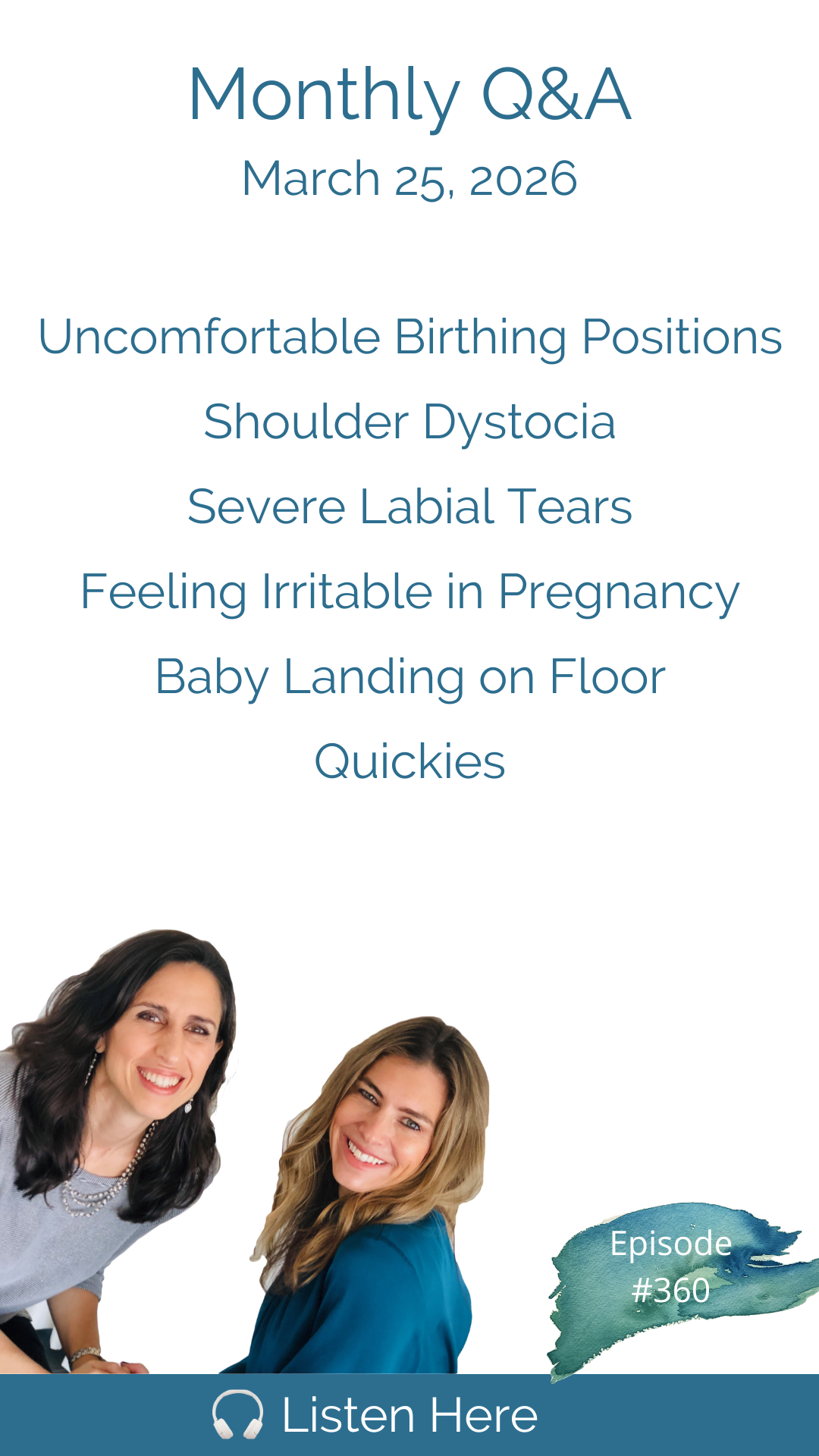
Welcome to the March Q&A! We begin today’s episode with a conversation about the strange, intrusive, and sometimes downright insulting comments women receive in public while pregnant. We also share a listener story about a home birth that took an unexpected turn when a woman’s mother, meant to support her during labor, ended up creating some chaos after drinking too much wine. Next, we address feeling unusually irritable toward an older child during pregnancy, what to consider after experiencing shoulder dystocia in two previous births, and whether an intact bag of waters could contribute to tearing during a very fast birth. We also discuss whether it ever makes sense to remain in an uncomfortable labor position in hopes of helping labor progress. As for Quickies, we cover questions about nursing pillows, pregnancy spacing, breastfeeding and fertility, bras for labor, sleep regressions, breast pumps, retained placenta, building a freezer stash, one of Cynthia’s favorite homemade salad dressing recipes, and the most famous people we’ve ever met. Thanks for being here, and enjoy today’s episode. PS: Check Patreon for more from Cynthia on salad dressings! ********** Needed <-- this link for 20% off your whole subscription order Join Patreon for our exclusive content Call 802-GET-DOWN Watch full videos of all episodes on YouTube! Please note we don’t provide medical advice. Speak to your licensed provider for all healthcare matters.
DrinkLMNT <-- this link for FREE 8-day supply
Primally Pure: ingredients good for you and the earth. Promo code: DOWNTOBIRTH
Postpartum Soothe: Organic herbal padsicles for healing. Promo code DOWNTOBIRTH
ENERGYBits: <--this link for 20% off
IG @downtobirthshow
I'm Cynthia Overgard, birth educator, advocate for informed consent, and postpartum support specialist. And I'm Trisha Ludwig, certified nurse midwife and international board certified lactation consultant. And this is the Down To Birth Show. Childbirth is something we're made to do. But how do we have our safest and most satisfying experience in today's medical culture? Let's dispel the myths and get down to birth.
Hello everyone, and welcome to the March Q and A. Woo Hoo March.
Bring on the warm weather. So what's going on? What's on the agenda? One of our fans wrote in and said, Can you please ask your community about the craziest things that have been said to them in public while pregnant. Oh, I thought you were gonna say during childbirth in public. I don't think anyone said anything crazy to me. Who are these women who go around with crazy people around them? Strangers just come up and talk to them?
Yeah, I can't think of anything. I'm sure it did happen, and I just can't remember, but nothing comes to mind. But we got a lot. Let's hear a few, right? Yeah, of course. Okay, so first of all, why are people commenting on your pregnancy in public anyway? Just keep to yourself. Well, I can see a pleasant comment. It's kind of like, what's up, what's up, what is a pleasant comment? You look great. Like, Oh, how exciting, baby coming. I don't know. I mean, I wouldn't get offended easily if someone said something, because it is, look, if you're just speaking to, let's say, a cashier at Trader Joe's and she's pregnant, it does feel a little weird to ignore something so exciting and wonderful too. So I don't fault people for saying things. I would just fault them for saying the wrong thing that, you know, that probably means I've been living on the East Coast for too long, because people aren't just friendly and chatty here, and that's probably rubbed off on me, and I think, Oh, why? Why? Why are people even commenting? I think people are so friendly and chatty, but that's because I'm friendly and chatty. So that's the world I live in, and people around me either respond accordingly or they're just like me. I've never understood that kind of thing about the Northeast. I think it's a wonderful place with wonderful people. But I mean, most of us probably feel that. I mean most of the country probably is. Most people are probably pretty wonderful, but if you, I think that's true, but the East Coast does have a reputation for being a little bit more keeping to themselves compared to the Midwest, where I grew up, where it's just very, very common for strangers to talk to each other. It's much less common here, yes, in general, yep, that's all I'm saying. Okay, so let's hear a few things.
Did you mean to get pregnant? No. Oh, stop it. No one's kidding me. Who would say that to someone? You're incredibly round to be only six months pregnant. Huh. Rub coconut oil inside your vagina every night so it slips out of what, what? Hold on?
How do strangers say this?
Rub coconut oil inside your vagina every night so it slips out. She is saying that a random man said this to her.
Is this how you all talk in the Midwest, Trisha? Is this what you mean by friendly? This is totally friendlier parts of—we don't talk this way in the Northeast, that's for sure. No one I've ever met. Okay, I'm nine months pregnant, and a man at our church goes, you still got that baby in your gut? Gut, gut. Well, that's what happens when you go around calling it a belly instead of a uterus. I mean, society calls it a belly because it's a cute word, and there's nothing offensive about it. It's incorrect, but it's still fine. So he went a step further and calls it your guts. We confused him by calling it a belly all these years.
The man lost track of where the baby is. Yeah, I guess everybody has. You need to give formula in the first few days because colostrum isn't enough.
Yikes.
Wow, you blew up like a wood tick. What? What? What?
That's horrible. That's horrible.
Look like you swallowed a beach ball. My husband used to say I looked—it was cute because he would be on the phone with people, and they said, How's Cynthia? And he said, Well, she looks like she's smuggling a volleyball, something like that, which is kind of cute. It was just showing that I was all belly, or like she turns around and then suddenly looks like she's smuggling a volleyball. I thought it was cute. Thought it was cute. Are you sure your baby is healthy? Your bump is pretty tiny. My baby was over eight pounds. Someone told me they knew I was having a girl because of how broken out my skin was. Wow.
These aren't funny at all. They're just—these are like mean tweets. These are not funny.
Get ready for your life to be over. Oh, you look so small. Is your baby okay? Nothing. Nobody ever said anything to me. Out of four kids, nothing. I do have a resting bitch face, so maybe that's why.
Perfect. How handy. Now we know. Now we know. Just walk around with that resting bitch face and nobody will comment on your pregnant belly. Okay, well, all right, so that was much more upsetting than I thought, like I thought we were gonna be laughing. No, no, we got an interesting voicemail that I want to play, and it's quite personal. So I texted her just so it was clear that we had her consent, because if someone calls us and leaves a voicemail, they obviously are giving their implicit consent that we'll play it on the show. But she also was one of these highly considerate people who wrote out what she said. So there's a very perfect flow. She took the time to write it out, and she read it in the voicemail, which you can just tell, like, leaves a very high-quality voice message. And the story is a little salacious. It's kind of an interesting story, and I tried not to find too much humor in it, because it's upsetting to her. But there is a part of this that is going to be like, what this is on its face, it sounds kind of like it could be potentially humorous, but it's clearly a pretty darn upsetting situation for the woman. So very interesting and I think well worth sharing. So anyway, I texted her and got a few extra details, but grateful she shared this, so let me play it. Hi, Cynthia and Trisha. I wanted to share the chaos of my second birth. A little context. My mom attended my first birth at a birth center, but afterwards, she claimed she didn't need to see it again because witnessing my pain was too difficult. When my second baby, my first home birth, arrived, we invited her back to help with our toddler. I should mention that all our immediate family, including her and my mother in law, live out of state. Not knowing when labor would start, she imbibed a bit too much wine the evening I went into real labor after two nights of prodromal contractions. After the midwives arrived, she fell down the stairs on her way to the bathroom. We have an in-law suite over our garage where she stays. When my husband opened the door to check on her, he and the midwife got a total eyeful, so embarrassing. Thankfully, it was only about four stairs and she didn't need any medical attention. However, wine also made her chatty. In the middle of a contraction, she kept asking if I was excited to meet the baby. When my husband politely pulled her aside and asked her to give me space, she tearfully went back upstairs and called my sister to complain that she'd been dismissed, even though we thought she had made it clear she didn't want to be present for another labor and birth. Worse yet, she didn't sleep, and with zero help the next morning, despite me birthing a baby at 4 AM, she claimed she had a mysterious headache and went back to bed at nine, leaving my also tired husband to juggle the toddler and tend to me. To this day, she's never mentioned it. We're convinced she doesn't even remember her fall down the stairs. For my third birth, we intentionally planned a mom swap with my incredible mother in law, who I wanted to be there for this final birth, and asked my mom to help us in the weeks leading up to my estimated due date. Instead, despite my best efforts to ensure the swap would occur before baby arrived, I planned for 39 plus two, since I've gone to within two days either side of my due date with the first two. My mom was with us for the birth and the first 48 hours after his debut, another testament to babies having their own timelines regardless of our wishes. I'm thankful she was more help this time and yes, sober. Thank you so much for the wonderful content you share with us every week. Wow. That would be really disturbing. You believe that story? So I reached out. And because you could tell she wrote it, it went so nicely because she wrote it out. It was like a perfect flowing story, which we so appreciate. And so she indicated that the midwife and her husband found her mom in like a compromising position at the bottom of the stairs. And I reached out, and I was asking her about that, and she said, My husband said he saw her naked, so that's what I assumed. So she's lying at the bottom of the stairs naked while her daughter's in labor, and her midwife and husband found her that way, so that's very awkward. And yeah. And then she just said, like, hang on. Whenever she got on my bed next to me, she started slurring her words, asking if I was ready for my next little baby while I was contracting.
And then she said, I can't fathom how she never brought it up, or if she doesn't remember. And she said it was most upsetting that she was supposed to help with the toddler. She just kept saying she had a headache, and they didn't know if it was from the hangover or from bumping her head in the fall, but what a crazy story, and what a mom that she couldn't rely on. So disappointing. That would be very disappointing. I'm actually really glad to hear that her mom ended up being there at the third birth, so that at least that wasn't her—not that she'll forget that story, but at least it feels like a little redeeming. But that would be very frustrating. I would be very, very unhappy with any family member who did that. She could have apologized. She could have apologized. Sorry. I didn't know. Slurring your words is another level, and falling downstairs and ending up naked at the bottom. Sorry, I love when people share things, because these are not easy things to share. And I'm—
No, that is a—I mean, yeah, she had to have known that it was possible any night that she was going to go into labor. Like, I mean, just have a drink, not get drunk.
Mid-contraction. Are you excited to meet your baby? Oh, my God, I would have wanted to punch her.
And especially if they were slurring words, you would just be—it would be incomprehensible. The frustration. Totally irritating. Well, it's never a great thing when the young mother, pregnant, having her baby, feels like the adult in her own relationship with her mom. That's not how it's supposed to be. Sometimes people feel that way when their parents get very, very, very old, and I think even the elderly parent doesn't like that very much, because no one wants to feel that way around their own child. But when you're in your mid 30s and you have a mother like that, and you realize you have to be the adult, even when you're in labor and need her, that has to be very, very difficult, very upsetting, very, yeah, and hard to forgive. Yeah, especially without an apology.
They don't know if she remembers it, so that might cut her a little bit of—not sure how you cannot remember that. I mean, oh my God. Okay, so really you gotta remember some part of that, you'd think. Well, she kept saying she had a headache, and they literally didn't know if it was when she bumped her head, right. And that's just another level of stress. Do we have to take you in and have your head examined, or can we just write this off to a hangover? That's not what you're supposed to be worried about on day one postpartum. No.
Okay, but people are here for the Q and A, and they can't wait for the quickies. So let's get started. Let's go. Hi, I'm pregnant with my second and I have an eight-year-old.
And I just was curious, like I imagine this is probably just normal irritability, but is it pretty common when you're pregnant to feel very, I don't know, just irritable and irritated by your other children? I mean, he just will look at me wrong or breathe in my direction and I just get like, I just want to be left alone. I don't know. I think there was more to that, but I don't know what happened to it. I don't remember anything. I think we got enough. I think we can go give a response to that. So yes, the way I knew that I was pregnant for the third time was exactly that reason. My irritability was sky high, just out of nowhere. Everybody and everything irritated me and frustrated me, and I was impatient and yelling and throwing temper tantrums, sort of. It didn't last that long, but it was definitely related to early pregnancy. So yes, what comes to mind for me is that in my training in 2015 to run postpartum support groups, my training through Postpartum Support International, I believe it was 30 to 40% of women who suffer from postpartum rage or postpartum depression or anxiety or OCD start developing symptoms in pregnancy. So on one hand, this is potentially something to take a little more seriously, that she might have real needs that aren't being met, and everyone better pay attention and make sure she's got her needs met in this pregnancy, and when the baby comes, so that she's not going to—that she's not at the beginning of a very difficult experience that's yet to come. And then the other thing, and this does come up in my postpartum group, so I'm just going to talk frankly about it the way I do with the women that I'm so close with in that group. This was very recent, actually, in the group. One woman just felt really guilty for how angry she was getting with her child and things she was saying to her child, and we just talked about how to do it differently. So we can't necessarily stop a woman from feeling incredibly agitated, but what becomes really important is what she does with it. And if she is saying things to her child that make her hate herself later and feel riddled with guilt and possibly hurt the child, she's got to make sure she doesn't do that. So the question is less like, Is it normal to feel this way? Maybe, yes. Maybe it's like Trisha experienced. Maybe, no. Maybe it's a flag for you and your loved ones to pay attention to. But whatever the case, what is your child's experience? Because he has no idea he's doing anything to annoy you, any more than my two dogs annoy me all the time. They don't know they're doing it when they're interrupting my podcast recording or whatever. So what is your son's experience is what becomes important, and how long has it been going on? If it's just early pregnancy and related to the hormonal shifts, it will be likely short-lived.
But if it's something that has been going on for a long time, then I would agree with you. Then that's definitely more a sign of unmet needs. She's gonna have a newborn baby in her arms soon to add to this mix. And if this wasn't just a fleeting phase, it does become very important. Well, what will you say to your son? One thing I suggest, of many, one I'll just throw out there in this quick conversation, is what have you said anything to him that you feel guilty about that's hurtful?
Decide now what you'll say instead and make it something very innocuous, if not a tad of humor. Just get those words out of your mouth instead of anything else. Just already know what you're going to say when you're feeling those things, and it makes an enormous difference. So just give that some thought. We talk about that a lot because we don't want anyone snapping. We don't want any children getting emotionally hurt or in any other way, and we don't want the moms feeling guilty about it later, even if the kids are resilient and they're not hurt from it. So what are you going to do instead when you're feeling that way? We can't bank on not feeling that way again, is the thing.
I'm not going to say, just like, take a deep breath, sure. But when your fuse is triggered like that, right then and there, what are you going to do about it? Put some conscious thought into that.
Like I had one woman in my group recently. I said, Well, what's something that you said to your toddler that you feel guilty about? And she said, like, I say to him, You are so annoying. And I said, Okay, that's like, it's done. You forgive yourself. Your child is going to be very resilient. But let's decide now what you're going to say instead, and we came up with something really—you can say anything. You can say you're such a silly head. You can say anything you want instead, but decide now so that when you're feeling it, you grab that other phrase that is really harmless. And of course, take what time you need to and calm yourself down. But the words are what women usually need to get a little control over, and what causes so many problems for them and guilt and all that. So very grateful for that question, because most women listening relate.
Hi, ladies, I have two babies, and both of them had shoulder dystocias, and I had a third-degree tear with the first baby, fourth degree with the second. Just real quick context, first baby was a home birth hospital transfer, pulled out with forceps. So I thought with the second baby it would be a different story. But I had a home birth, a really fast home birth. Baby came out super quick, but my midwife had to break her arm to get her out. So I feel like it makes sense that my third baby should probably be a C section. It seems like I'm high risk for shoulder dystocia, and then also with the tearing. But just curious if there's something else I should be considering before I make that decision, or if that seems to be the right choice. I'm really scared of a C section, so just want to feel as much peace as possible if I do make that decision. So just curious. Your thoughts. Thanks, guys. This is a tough one. So tough, really hard. I would struggle with this.
You know, we often talk about shoulder dystocia as being preventable by how you give birth, who you give birth with, the position you're in, allowing your body to be free to move so that your baby can choose the best position, allowing for two-step birth instead of head and body all in one contraction, which is often what's done in the hospital. So she did have two home births. The first one was a transfer, and she had a forceps delivery, which can increase the risk of shoulder dystocia. So I'm not sure about that one. But the second one, she had a home birth and a shoulder dystocia at home. So now she's had two shoulder dystocias. One shoulder dystocia, especially if it's a hospital birth with an epidural, or you were on your back, we would say, don't even think about it. Like, don't even think about it. Just choose your own position, birth differently, birth in a different environment, birth with a different person, and it's very unlikely to recur. Shoulder dystocia recurrence rate is right around like 10% probably on average.
Really. So to have two in a row would be 1%. No, no. So no, no, sorry, the recurrence rate is 10%. The incidence of shoulder dystocia is about 1% overall in the population. But if you have had one, your chances are higher the second time around, but not that much higher. So that would be a .1% chance of having two in a row. So it would make the odds of three much lower. But it almost makes you think that there's something about her that would lend—if you have had two shoulder dystocias, there's no data on this, right? If you have had two, your chances of a third are higher. Yeah, it doesn't seem like a coincidence anymore, right? It's only 1% of women who have shoulder dystocia. I think it's the one to two, really. And so many are told that they do, and—well, that right, the statistic might be different now that shoulder dystocia seems to be diagnosed more easily than it actually occurs. The definitions around shoulder dystocia, the diagnostic criteria, are also a little gray. I mean, a lot of providers will say it's just shoulder dystocia if it takes more than 30 seconds between the head and shoulders being born, which is just crazy. That's crazy. That's completely normal. I'm sure that happened in my births. Yes, okay, it doesn't make sense. I mean, my baby's heads came out and there was a long rest, like my body rest, which is completely normal. Yeah, so. But she has had a fourth-degree tear and a shoulder dystocia, a third-degree tear and a shoulder dystocia in the environment that we would believe would be most supportive of allowing a baby to choose the best position and come out the most physiologic way. So again, it's a tough call, but her chances of having a third shoulder dystocia, I think, are higher than average, and it's so hard to then say, so have a C section. And there is an option, a C section option, that no one ever talks about, where she could wait until she goes into labor spontaneously and then opt for a C section, which is what a number of my own clients did, and it's a much more satisfying experience for many women than scheduling. But still, it's a big, heavy decision.
I think she really—this is, in all cases, a mother really needs to lean into her intuition. But this is a hard decision, and I think the only way she's going to make the right one is getting really quiet with herself and listening to what she feels is going to be the safest choice for her and her baby. If I were in her situation—
I'd be like, she is really wondering what to do. I mean, it would depend on how treacherous the shoulder dystocia experiences were. Some of them are very scary. Many, many minutes long. Baby almost didn't come out, right? That would probably really— And the thing is, most shoulder dystocias can be resolved. They can. In her second baby, the clavicle had to be broken to get the baby out, and the arm, I think. I think she probably meant the clavicle, that's usually what they break. Oh, like the shoulder area, the clavicle. Oh, yeah, I forgot about that detail already. That sounded so—so that's a big deal. It sounds like it was just a quick shoulder dystocia that resolved very easily. If that were the case, I would feel differently. Definitely, definitely. I can't imagine how it would feel to have a little newborn with a broken clavicle. That's so sad. Very hard decision, hard one.
Hi, ladies. My name is Olivia, and I just had my first baby in December. I'm 22 years old and decided to go with a home birth. I know lots of people in my area and at my church who have chosen a home birth, so I felt fairly comfortable, but your show was always so interesting and an encouragement to me. So thank you for that. I had a very interesting birth experience, at least, I think so, and I'd like to get your take. I went into labor spontaneously at 37 weeks and one day, which I did not expect, and my labor was about four and a half hours long in total. I started tracking contractions at 11 PM and he was born at 3:37.
So one thing is my water never broke, and he was crowning with the water intact, so that was bulging. And when I pushed, there was no pause between the crowning and the head and his body. He came out in one push and he hit the floor, because no one was expecting him to come out that quickly. I was on hands and knees, of course. When I tell people afterwards, that's a total shock to them. And the midwife didn't seem too concerned. She's like, you know, like a little giraffe.
But I wondered if that is a concern. And the other thing is, I had a very severe labial tear where it was split entirely in half, essentially, and I had to get lots of stitches because the pressure was so great that it was so far apart, it would not touch by itself, it would not heal properly. So they had to give me like 10 or 11 stitches. Even with those stitches, part of it did not come back together. At this point, I'm six weeks postpartum. It's essentially healed. I've never heard of that happening to anyone. I'm wondering if having my bag of water intact put extra pressure, if that is ever a reason to break the water, fear of tearing or too much. He was only six pounds, 12 ounces, so he wasn't a big baby, but the water was there, so I'm curious about that. Thank you so much. Sorry, this is a little long. Bye, bye.
Can you believe she's only 22? Didn't she sound so mature? Yes, she did.
Definitely did not sound 22. No.
Well, the baby hitting the floor. We'll start there.
It does happen. Do you think the midwife said, oh, like a little giraffe, because the midwife was actually like, Oh, my God. How did I let that happen? Because the midwife let that happen. The mom was on her hands and knees. She could see the mom on her hands and knees. I mean, you have to be there at the ready.
Are you saying it can just come out so fast sometimes that even the best midwife could just be like, Oh my God, the baby could just fly out? Yeah, yeah, it can happen. All right, yeah. It's fair. It's not, obviously, not ideal. It's not a real far distance when you're on your hands and knees to the floor. Usually there's some padding under the mother, a towel, a Chux pad, something. I mean, we're hopefully not being on our hands and knees on a concrete floor or something like that. That would certainly be worse. But I mean, what are you going to do? If the baby—if the mother examines the baby and the baby is okay, then the baby's okay.
Yeah, I told a birth story once on the podcast where it happened with a client of mine. She had her baby in a bathroom, hands and knees. Didn't realize he was coming out, and he just landed right on the floor. I don't know if there's a little bath mat. I always envisioned that there was, but I guess it's probably not that uncommon. I remember Nancy Wainer giving me some advice before my home birth, where you and Amy were there, because my first birth was so quick that Nancy gave me some tips in case I ended up birthing that baby without midwives there, and one of the three tips she gave me was get low to the floor. Exactly, yeah, low to the floor. And usually the recommendation is to put something under the mother. I mean, even if a midwife is right there, sometimes babies slip right through their hands too. They can come out—if they come out really fast, they're very slippery.
So it's good to just be prepared. I mean, I think this mother would have probably appreciated the midwife giving a slightly different acknowledgement of it than kind of brushing it off, like, oh, like a giraffe, just fall out of you.
I would have rather heard her say something like, you know, I'm sorry. That was probably a little shocking that that happened. But your baby's perfectly fine. Everything is okay. I've looked over your baby and there's nothing to be worried about, right? A giraffe basically gets up, straightens its little crooked legs and walks away within an hour or something. It's a little different, quite a different thing. Yeah, yeah, yeah. So now, but wait, let me just ask you one more thing, just in case she's wondering. Her baby is probably about two months old at the time of this episode coming out.
Is there any way that she should be concerned that her baby isn't okay? Or would they know by now? Yeah, no, I think that they know the baby's fine. Yeah, absolutely okay.
Okay, so being 37 weeks and going into labor does tend to make for—oftentimes those labors are really fast. Her baby also came out very, very quickly, which is why she had that tear, most likely. I don't think that the water being intact was the issue. I think the issue was that the baby was like a rocket coming through her, and just the speed that the baby came through the tissues didn't have time to stretch, and for whatever reason on her anatomy, that was the give point.
Oftentimes it's the lower part of the perineum, not the labia, but it might have been the way the baby's head was aligned, the position she was in. Something caused her to tear there.
So that's an unfortunate tear, because that did require a lot of stitches, but I don't think it had anything to do with her water, and I wouldn't suggest breaking the bag of water to prevent that.
Hello, Cynthia and Trisha. My question is, during labor, with frequent movement changes, should I focus on withstanding an uncomfortable position for a few contractions before moving to another position, or should I focus on moving into a more comfortable position right away? I heard something once about trying to withstand a more uncomfortable position for a few contractions in order to stretch out a spot that may be more tight, which is thought to help the labor progress. Would love hearing your thoughts. Thank you. This, to me, starts to get into the territory of overthinking labor, right? Like forcing yourself to endure an uncomfortable position because maybe that part of your body needs to be stretched. I don't know. If your baby is truly in a position that is preventing progress of labor, and you really know the position of the baby, which requires a cervical exam or some really good palpation on the abdomen to figure it out, but probably a cervical exam to understand the baby's head position, then we can utilize a position that we know might rotate that. And if that position is particularly uncomfortable, but we know it's going to work, fine. That's one thing. But for the mother to be thinking in labor, ooh, this hurts, but I should probably stay here for three contractions because this might be something necessary to stretch my body in a certain way is too in our head. Yeah, I think that you hit the nail on the head with that. I think that we generally should—the benefit of a physiologic birth is that you can feel everything. And a benefit of feeling everything is that you're in, as I always like to say, you're in this dance with the baby, so you can respond as needed. And to the other point you made, yes, there are times that you can use positioning as a tool, like squatting applies a certain kind of pressure to the cervix, and a lunge can open up the pelvis. We have a great birth story way back in episode seven, Jessica's footling breech story in Amish country. And I'm sure being in a lunge was not comfortable for her, but that was a time they were using it as a tool. They knew how to support a footling breech birth, and they said, This is the position we want you to be in, and allowed her baby to come right through. So yes, by default, do what's comfortable until and unless there's some other call to action. And I would say, assume that there isn't. Yeah, and really only if there is a reason to do it, if there's a stall in labor, if there's a suspected fetal position that needs to be adjusted. You don't need to do these things preventatively, like follow your body's cues.
I think that is a wrap on the questions, and it's time for quickies. Quickie time. Did you ask for some today? Yesterday? Yesterday? Okay, good. It's funny how you always ask for a new batch. Yeah, because then they're more fresh. Yeah, yeah. And I don't have to organize them, but you have to always hope a personal one comes in, because we always end with a personal one. A personal one. So people are getting pretty good at that. Yeah, they are. They are all right. Time for the readers. Okay.
Okay, let's see. Here they are. What are your thoughts on nursing pillows? Do you have a preferred brand?
The quick answer is that you do not need a pillow in the beginning. I prefer you to not use a pillow in the beginning. You want to learn to latch your baby without a pillow, and then you can tuck a pillow under you for support. I do have a preferred brand. It's the bbhugme. But I think they are discontinuing the most amazing breastfeeding pillow on the market.
I'll keep you posted on that, and they're going to sell out overnight.
How long should you wait before getting pregnant again? And what is the best way to prevent pregnancies postpartum?
Postpartum resentment? Yeah.
Sleep deprivation.
Abstinence works, feeling touched out.
So many options. Yeah, there's so many ways to abstain.
How long to wait? I mean, honestly, we've talked about this a little bit before. I'm in the camp of waiting a little bit longer. I do think a year and beyond is a good idea. This is presuming she gets her period back and can conceive. Many women don't for a year or so anyway. But okay, so you feel that like, let the body fully restore, recover, replenish. Yes, I think that pregnancy, and especially if you're breastfeeding, it's very depleting on the body. It requires a lot of reserves from your body, and it takes time to rebuild that, and you don't get it back in six months. So I do think shorter intervals between pregnancies, while there's a lot of pressure to do that, maybe because people are having children later in life, or maybe people just want to knock it out and have three under three, but I think it takes a toll on the body, and I do think it actually can increase some risk factors in your subsequent pregnancy. Okay, next one.
My baby is 18 months old, we can't get pregnant. I have had regular cycles since 10 weeks postpartum. I am still breastfeeding. Any tips? Well, sometimes you do have to wean a little bit from the breastfeeding, even if you are having a regular cycle.
There's so much to fertility that I can't really answer that in a quickie, but getting some lab work done to look at your hormone levels is probably a good idea. Maybe weaning a little bit sometimes, if you just drop one night feed, or you extend the overnight interval between breastfeeding, within one or two cycles, you're back to ovulating. Do you want to have more sex when you're pregnant with a boy or more if you are pregnant with a girl?
So I actually did a poll on this to find out, because, I mean, who knows the answer to that? And this is what the results came in with.
13% said boy and 11% said girl and 26% said no different. It doesn't add up to 100.
Some people selected just curious. Oh, so we have to redo the math. So hang on, then those percentages are wrong. All right, hang on. Let's do the right percentages. Give me the three percentages again. 11 and 13. What was it? 13, 11, 26, and hang on, not just those two. Oh, okay, so it's very easy math. Okay, so the first one was 22% and the second 26%, so 22%, 26% girls, yeah, same, yeah, yeah. All right, what is the best kind of bra for delivery? Does a strapless or nursing bra get in the way of skin to skin? Bra for delivery? Yeah, you don't need a bra.
What? Why? I don't even get the question. A bra for delivery. Oh, like so she's not topless, right? I mean, I think most women are probably wanting that bra off toward the end of pregnancy. One woman actually suggested a bikini top, like a tie bikini top, which is kind of a good idea, because it'd be really easy to undo. Oh, that's true. One woman said that she wore a bra and it had to be cut off after birth because she couldn't get it off. Good reason to not wear one. But yeah, you do need to get it off before you latch your baby on for the first time. Yeah, I was always in the tub, so I wasn't wearing anything. But you could also wear one of those wrap gowns that just opens up.
Those are nice, like a wraparound gown. Yeah, I think a lot of the time, women who are giving birth in the water and they're filming their birth video or they're photographing it, they don't want the breasts out, so they're wearing bras. But you do want something that's easy to get off at the end. But I also think you might just at the end of labor say, Get this off me. That's pretty common. Okay, is there such thing as a three-month sleep regression?
I think that there is an opportunity for a sleep regression at any given moment in an infant's life.
There seem to be a few standard times. Everybody always talks about the four-month sleep regression. A regression is just basically when your baby goes from sleeping a certain way to not sleeping that way anymore. And there are so many things that can contribute to that. Sometimes it's feeding issues, sometimes they get sick, sometimes it's developmental. When they are figuring out a new skill, they tend to wake up more in the night because they actually want to practice that skill. There are so many times along the way where sleep changes. Regression isn't even the right word.
They're just sleep changes. They can happen. Do I need a new pump with every baby? No, of course not. Completely no. Why would you need a new pump?
You definitely do not.
You might need to change out some of the parts from time to time, but you definitely don't need a new pump. What are the symptoms and dangers of a retained placenta? How common and why does it happen? Okay, not a quickie, but the danger of a retained placenta is bleeding, hemorrhage. If the placenta doesn't fully come out, then the uterus can't properly contract down, and you are at increased risk of bleeding, even delayed postpartum hemorrhage, which can happen days to even weeks after birth. So that's how I'm going to answer that one. Best way to increase your supply to build a freezer stash?
One to two ounces of stored milk a day.
You do not need a huge freezer stash. If you do one ounce a day for a month, you will have 30 ounces. That is more than enough to go do whatever you want to do and leave your baby back home, and you're going to pump milk while you're out to replace what you used. You do not need hundreds of ounces of frozen milk.
Nobody does. It's the overachiever mindset. More milk feels like more security to women. But what you didn't say, but you're indicating, is it will really, really throw off her supply, so she has to be very, very careful, delicate of her body, like just—
Little. Breastfeeding works best when supply and demand are in sync. Yeah, a couple ounces difference in a day isn't going to alter that too much, but four or five, six extra ounces a day will alter it pretty significantly for most mothers and babies, not in every case. Oh, here's a good one. Best quick advice about picking a prenatal care provider.
It's a good one. I think that's a good one. Don't pick the nice one just because they're nice. Pick the mean one.
Pick the one you hate.
All right, my answer would be different any day that you ask me. That's how these things are, right? It's just the mood we're in. I know when I hear this episode, when it comes out, I'm going to hear the question, think, Oh, I can't wait to hear what I said to this, because that's the beauty of the quickie. It doesn't have to cover all the bases. Okay, my feeling right now is that for me, I would beware the provider with a palpable ego. What I'm getting at is you can hear that in providers saying, like, I can't let you go this late, or what I do with—when they're just— My baby, yeah, well, we've heard that too, but that's really what I notice when I meet people or hire people in a position like this. That makes me feel very uncomfortable, because I realize that they're ruled by their ego. They're not humble enough, and if they're not humble enough, they're not normally as receptive to growth, to respecting that the decisions are yours to make. It just really starts to define the relationship you would have with them. So for me, I would listen to how they speak for red flags, those red flags.
Great. And don't go to the provider just because they were your gynecologist at age 16.
Don't hire them by default, right? Don't hire them by default.
Okay, this one is asking for Cynthia's best salad dressing recipe.
Oh gosh, I have so many. You need to start sharing them. I don't know where to begin. One just begins—okay, the last one. I have so many. Oh my gosh. Okay, so I really have so many. Okay, one of my favorites has olive oil, a combination of balsamic and red wine vinegar, a little bit of mustard, a little bit of honey, a clove of garlic. Secret ingredient, a basil leaf or two, a splash of water to cut the acidity, but just a tiny splash, like not even a teaspoon of water, and fresh poppy seeds, and make sure they're fresh. And you blend that up, and it's going to emulsify and be this gorgeous, thick, delicious Italian vinaigrette. Are you withholding the secret ingredient or no? Of course. I would never get a secret ingredient. I would never withhold. So I would never be that person. Which one was the basil leaf? It just makes it. If I make that and don't have fresh basil in the house, it's a big difference. That's an incredible dressing and it's delicious. Took me a long time to find just the right ratios of everything, and I don't remember all of them off the top of my head. And then another one I made once when I had to cut vinegar for a while, absolutely delicious, was what did I do? It was instead of honey mustard, I did maple mustard. Instead of vinegar, I did lime juice. Very simple dressing. It was olive oil, lime juice, maple mustard. Again, it emulsifies. Absolutely delicious. A little salt and pepper in both of those. Those are two off the top of my head. I could definitely have a cookbook of my salad dressings because maybe we could put some of those over in Patreon. Ooh, that's a fun idea. I do love to share. Yes, let's do that. We'll have a recipe section right next to book club.
Okay, this one's kind of fun.
Who is the most famous person you have ever met? Phil Collins. I also met Reggie Jackson, Lou Piniella, a bunch of Yankees, but the most exciting one, Ina May Gaskin, of course, for this crowd. I had breakfast with her in Virginia once, the two of us, but Phil Collins was the thrill. So I grew up—Genesis and Phil Collins, obsessed. I still am. I still am. I love Genesis, especially like the old early Phil Collins Genesis. And I won the opportunity to meet him at a radio station, like breakfast with Phil Collins, or another breakfast. And there's a picture of me standing with him, like arms around each other. It was one of the thrills of my early 20s, absolute thrill. And I had a picture of him and me in my office in my first job, and I remember a man walking by, and he came in and stared at it and said, My God, your boyfriend looks a lot like Phil Collins. I said, That's not my boyfriend.
Wait, how much older is he? So much older than I. Are you going—I don't know how old he is now. He's like 70. I mean, it was ridiculous. I was like 22 years old. I was like, that's not my boyfriend. That is Phil Collins, but that's the most famous person I ever met. Super exciting. Yeah, for me at the time. Then I kind of got over the thrill, because it was normalized, but it was an incredibly exciting thing for me at the time. So what about you?
Well, we all know the only famous person I care about is Brad Pitt, and I haven't actually met him in real life yet. I promise you, he's boring. He's one of the most boring people out there. I'm just positive of it. So really? Yeah, he's boring. I can just tell he's super boring. He's self-conscious, he's into himself, and he's boring. Any interview I've seen with him, I'm just like, ho hum. I don't even watch interviews with him, so I must be— I've seen one or two, but he's always leaning back and trying to look cool, and has the same little crooked smile with his like— Anyone who's that into himself isn't handsome anymore. Yeah, anyway, I actually, I don't know. I mean, I'm not that into—I don't get that excited about famous people. So maybe I haven't really met many, but I did meet George Bush Senior when I was in third grade.
I stood on stage with him and sang, I'm proud to be an American. And I was very embarrassed because I didn't actually know the words. So what did you put in instead? I'm proud to be— I watched him, and I just tried to mouth his movements. I just tried to copy him, whatever he was saying. That's really cute. I have a great photo of it. It was on the front page of the newspaper, the Detroit Free Press.
Pretty boy Brad Pitt. I agree with the pretty boy part, and I don't like that.
You're obsessed with him, and you know it. I am obsessed with Brad Pitt in Legends of the Fall. Okay, so Trisha's fanning herself now. She's got to go cool off now.
That was fun.
That's it. Okay. Ton of a fun question. Who's the most famous person you've ever met? And then we led into who's the most famous person you'd like to meet?
All right, everyone, thank you for your questions. And in April next month we have a breastfeeding Q and A and our regular monthly Q and A. Oh, boy, look forward to those, and we'll catch you next time. All right, thanks, everyone. Next time, bye.
Thank you for joining us at the Down To Birth Show. You can reach us @downtobirthshow on Instagram or email us at Contact@DownToBirthShow.com. All of Cynthia’s classes and Trisha’s breastfeeding services are offered live online, serving women and couples everywhere. Please remember this information is made available to you for educational and informational purposes only. It is in no way a substitute for medical advice. For our full disclaimer visit downtobirthshow.com/disclaimer. Thanks for tuning in, and as always, hear everyone and listen to yourself.
Recent Episodes
Between episodes, connect with us on Instagram @DownToBirthShow to see behind-the-scenes production clips and join the conversation by responding to our questions and polls related to pregnancy, childbirth and early motherhood.
You can reach us at Contact@DownToBirthShow.com or call (802) 438-3696 (802-GET-DOWN).
To join our monthly newsletter, text “downtobirth” to 22828.
We'd love to hear your story.
Please fill out the form if you are interested in being on the show.
Subscribe to The Show
Follow Us On Social