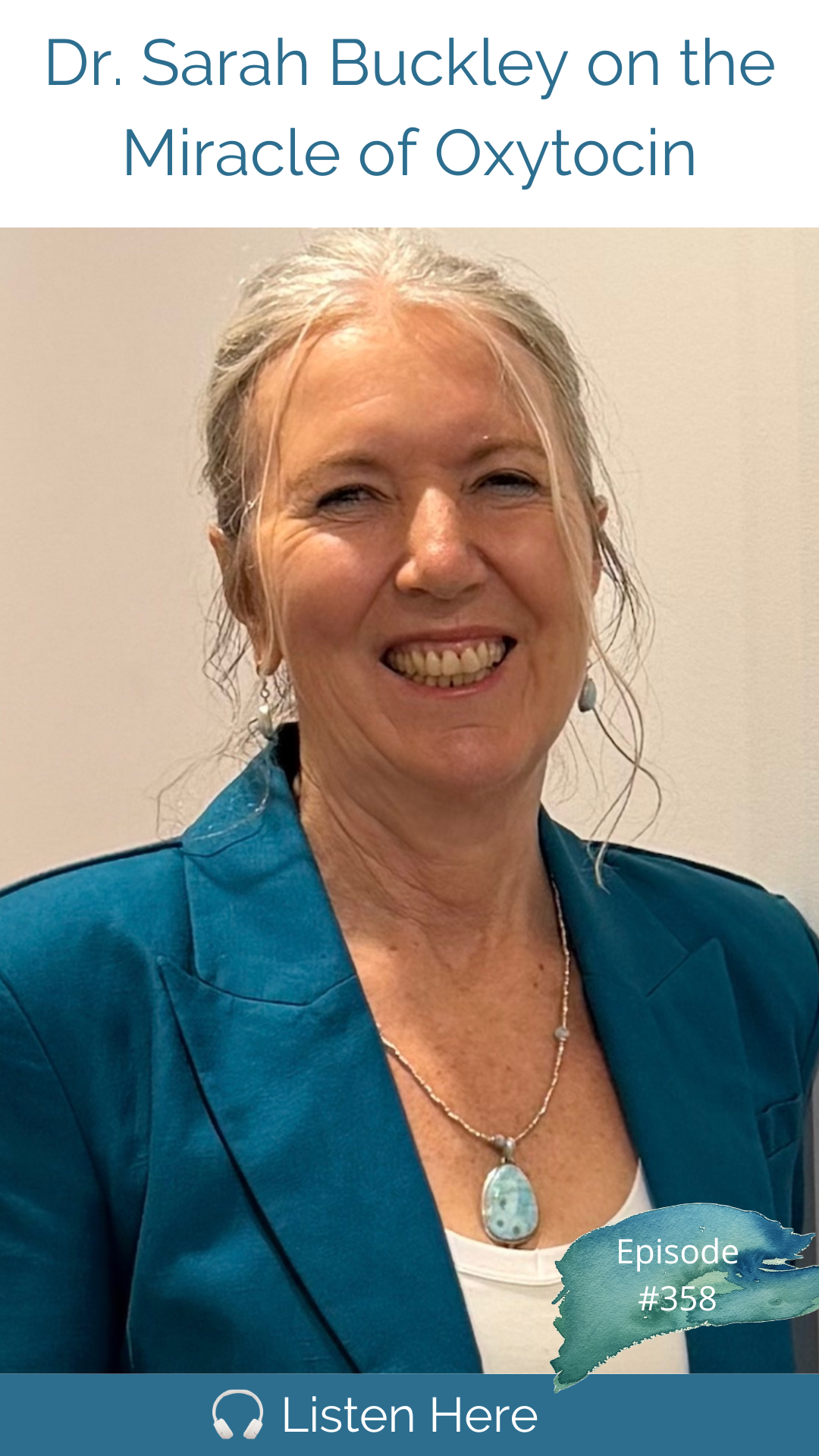
When Trisha was pregnant with her second baby, she read Gentle Birth, Gentle Mothering — a book that completely reframed how she understood labor, and to this day remains her favorite book on pregnancy. Trisha's second birth unfolded in just three hours, a stark contrast to her first. That book was written by Dr. Sarah J. Buckley, and we've long dreamed of getting her on the show. That day has finally come! Dr. Buckley is a New Zealand–trained family physician and leading researcher on the hormonal physiology of childbirth, and today she walks us through the science of oxytocin and why it matters so profoundly in labor. We explore how the maternal brain modulates pain, how safety and privacy influence hormone flow, and why certain features of modern maternity care can unintentionally trigger stress responses that disrupt physiological birth. This episode is a deep dive into the biology of labor — and what women truly need for it to unfold as designed. In this episode, we discuss: Needed <-- this link for 20% off your whole subscription order Join Patreon for our exclusive content Call 802-GET-DOWN Watch full videos of all episodes on YouTube! Please note we don’t provide medical advice. Speak to your licensed provider for all healthcare matters.
DrinkLMNT <-- this link for FREE 8-day supply
Primally Pure: ingredients good for you and the earth. Promo code: DOWNTOBIRTH
Postpartum Soothe: Organic herbal padsicles for healing. Promo code DOWNTOBIRTH
ENERGYBits: <--this link for 20% off
IG @downtobirthshow
I'm Cynthia Overgard, birth educator, advocate for informed consent, and postpartum support specialist. And I'm Trisha Ludwig, certified nurse midwife and international board certified lactation consultant. And this is the Down To Birth Show. Childbirth is something we're made to do. But how do we have our safest and most satisfying experience in today's medical culture? Let's dispel the myths and get down to birth.
I’m Dr Sarah Buckley. I’m a family physician or GP by training, mother of four children or one at home, and I’m a writer and researcher on pregnancy, birth and mothering. And I started off really from my own experiences of having such amazing experiences at home, which were a bit different to what I’d learned at medical school in my GP, obstetric training in hospitals. And I thought, how did that happen? How did I have that experience when that was what I learned about, and that’s kind of been my life’s quest, really, and specifically about what happened in my brain when I gave birth.
Because with my first child, I was, you know, I always had the nursery set up next door. I’d read books about parenting, and it was going to have my baby in there, and once I’d given birth to her, and she was in my arms, there’s no way that I would have her further than an arm’s length away. And I was quite different. It was like my brain went 180 degrees from where I was going.
So that’s really what propelled me onto this quest for you know, what happens in labor and birth? What happens in our bodies, what happens in our brains? How come it can be so good? What interferes with it? All of these questions.
So that led me to be interested in the hormones of labor and birth. I’ve written quite a lot about that in my book, gentle birth, gentle mothering. I did a report on that 2015 hormonal physiology of childbearing, and then I follow that up with doing a PhD, and I’ve just submitted that, and I’m working specifically on oxytocin, which I’ll tell you all about.
But it’s a great hormone for many reasons, one, because it’s a little bit famous as the hormone of love, but secondly, there’s more research on that than other hormones, partly because it was first discovered as oxyface tocent birth, the hormone that makes birth go fast, so it’s intrinsically a birthing hormone. And secondly, because there’s so much more recent oxytocin research about the effects in the brain, which is why it’s called the hormone of love. So we’ll get into all of those things.
I do have a medical background. As I said, I went to medical school. My father was an obstetrician. My grandfather actually went out into the bush to help women giving birth in a small town in New Zealand. My great grandmother was a granny midwife, so it’s kind of inevitable and I would be involved and interested in birth. Incredible.
Well, Trisha is still background. He’s not able to speak yet.
Gentle birth, gentle mothering, was my Bible. It was my Bible in preparation for not my first birth. I didn’t know about it in my first birth, I read it before my second birth, and I just thought it was like, Oh, this is it. I mean, I went to nurse midwifery school, so I knew some of this, but not the extent of how you described birth in your book, I knew it should be like that. That’s how I wanted it to feel. And I had a home birth for my first so I did. I did get that, but I really got it when I after I read your book and had my second and third babies at home in the water, very quickly compared to my first, very quickly, both of them, beautiful.
Congratulations, yes. Well, you know, it’s what I call mother nature’s superb design. And it’s not just human females that birth on this way, but every mammal. In fact, oxytocin is a mammalian hormone right right through and analogs are present right through the animal kingdom. So it’s a very fundamental hormone, and the reason for that is because it optimizes, or, we could say, ensures, reproductive success.
So oxytocin is actually a hormone of having making babies. When we make love, we literally make oxytocin the hormone of love as a hormone of orgasm. It’s a hormone of having babies. Obviously facilitates the powerful contractions of labor and birth. It’s a hormone of bonding. So that’s really critical. It shifts the brain to optimize maternal care and all species, we’ll talk about that in some more detail. And it’s a hormone of breastfeeding. It’s the hormone of the let down reflex.
So that’s the that’s the thing that happens when your baby’s suckling and suddenly the milk comes in. And all of those things are critical for reproduction. So there’s a lot of evolutionary investment, we could say, in the oxytocin system and optimizing it.
And, you know, another kind of touchstone for me in in my approach, is that I studied anthropology when I was at university. And you know, in evolutionary terms, you know, women or humans have been giving birth for 65 million years. That’s how long placental mammals have been evolving. And for almost all of that, we’ve given birth in the wild. So these hormonal systems are optimized to make birth as safe as possible in the wild.
And if you think about giving birth in the wild, it’s a very dangerous occupation. You know the female is making strange noises, strange smells, the blood, the amniotic fluid, the baby, the placenta, all of these things would attract predators, right? So it’s very it’s critical that first of all, she knows she’s in the safest place possible. So the hormonal orchestration of labor, including oxytocin, is optimized when the laboring female, women as well, feels and I call it. That the the core requirements for birth is that she feels private, that she feels safe, that she feels unobserved.
Because, again, in the wild, if you have that feeling of something observing you that makes your bristle, right, that’s a sense of danger. And that’s particularly true for a laboring female in the wild, so private, safe and unobserved, the core requirements for birth on all mammals.
And the other thing to consider about birthing in the wild and their evolution, or our birthing hormones, is that the duration of labor is the duration of risk, right? So the longer the female Labor’s for, the less like she is to survive the birth. So there’s an evolutionary investment, we could say, in labor being as efficient as possible.
Now we are, as I said, this subspecies called placental mammals. We have placentas. We give birth to large live young, as opposed to marsupials over here, that give birth to very small young and nurture them in their pouches. But large live young means it’s quite a process to get the baby out right. It doesn’t happen just in five minutes, but it has to happen through the contractions of the uterus, they’re going to push the baby out eventually, but that takes some time, you know, usually, usually hours for most mammalian species.
So again, how can the processes of birth be as efficient as possible? And if you look at the oxytocin system, well, oxyfastos and birth, that’s part of the optimization of the processes of labor and birth.
Now there’s a whole lead up to labor that happens. And to be honest, we don’t actually understand it. What it is that causes the onset of labor today, and not yesterday or tomorrow. If I could tell you that, I’d get a Nobel Prize, because we don’t actually know.
We know that there’s this complex, coordinated system between the mother and the baby, because, again, in evolutionary terms, it’s critical that the mother’s at the peak of readiness for labor and efficient labor and birth for the postpartum, for bonding, for breastfeeding, yeah, and it’s critical that the baby is ready for the rigors of labor, like labor is an intense process for the baby as well, because every uterine contraction squeezes the placenta, the baby’s deprived of blood and oxygen. To some extent, it gets more and more as labor proceeds, and so the baby has to be able to withstand that, and then the baby has to make this incredibly miraculous transition to life outside the womb like you can hardly believe it when the baby comes out, right? Even my own baby is like, whoa. How did that happen?
The baby in the womb, you know, is not breathing, is, you know, is not doing any of those basic functions. And suddenly the baby comes out, and the baby starts breathing like it’s incredible.
So those the baby has to be ready for that incredible transition, and then those life saving, survival enhancing behaviors of the baby, which is finding the breast or the nipple. And all mammalian babies know how to do that, the breast crawl and then attaching, and then also bonding to the mother.
So those are all as critical for the baby as they are for the mother. So that coordination of readiness, we don’t quite understand it, but there’s certainly hormonal signals that pass through the placenta that ensure that the mother and the baby are as ready as possible.
Now, as far as the oxytocin system goes, part of that readiness is an increase in sensitivity of the oxytocin system. So the oxytocin system gets, we say, upregulated and activated in the lead up to labor and birth. And one of those things is an increase in oxytocin receptors in the uterus. And I’ll explain some basic physiology. What is a receptor?
So a hormone is a substance made in one part of the body with the effects of another part. So oxytocin is actually made in the deep layers of the brain the hypothalamus, store in the pituitary gland, released in a specific portal circulation into the bloodstream, goes to the uterus, where it has its effects, and it has effects, like all hormones, by binding to a receptor.
Now, you can think of this like a key and a lock. So the the key being the receptor oxytocin, the lock being the oxytocin receptor. Now some in hormonal in hormonal worlds, some keys fit lots of locks. Some locks fit lots of keys, but oxytocin has one one lock, the oxytocin one key, the oxytocin receptor. Sorry, it’s monogamous. The oxytocin receptor and only fits the oxytocin molecule, and vice versa.
So the oxytocin travels from the uterus to the brain to the uterus, finds the oxytocin receptor on the outside of the uterine muscle cell, binds to that receptor, and it’s basically sends a chemical signal into the cell, saying, contract, and that’s what causes the rhythmic contractions of labor.
It’s not the only mechanism for the contractions of labor, as we found out in some of our research, but it’s the major, major functioning of the uterus, and so this increase in oxytocin receptors happens actually under the influence of estrogen.
So as the physiological onset of labor approaches, the whole estrogen increases. It activates all of the systems. There’s inflammation, there’s prostaglandins, a whole lot of other parallel processes happening. But this increase in oxytocin receptors means that on the day of physiological. Labor onset, the woman’s uterus is maximally sensitive, and this was one of our findings.
So what we found was that on that when women go into labor at that or that very last term, we could say the very end of pregnancy, she only needs tiny amounts of synthetic oxytocin to trigger contractions. We’ll come back to talk about synthetic oxytocin, but basically her system is highly sensitive to oxytocin, which means it’s highly sensitive to synthetic oxytocin, which is the same molecule.
So you know, for anyone that’s a maternity care worker, you know the equivalent of, like, four to six milli units per minute causes strong enough contractions to put women into labor at that point of maximal readiness. So that’s probably the kind of levels of oxytocin she would naturally have that trigger the onset of labor.
So this exquisite sensitivity, and that’s also important, because what that means when we come to talk about interventions, is that that sensitivity of her uterus means that you can’t give her a lot of synthetic oxytocin, like outside of labor and birth, you can give someone 40 units, 80 units, but in labor, you couldn’t do that like it would cause massive contractions that would endanger the baby, because of this intense sensitivity. And we’ll come back to that point.
So we have this maximum sensitivity of the Mother, the oxytocin receptors, the oxytocin that begins to get released during labor, and it’s released in pulses, which is quite unique to labor and birth and to breastfeeding also.
And what happens is that the oxytocin system and labor and birth is a self perpetuating cycle. It’s a positive feedback cycle. I call it the snowball of labor.
So what we found in our studies was that, well, first of all, from the beginning of pregnancy to the end of pregnancy, oxytocin levels increase about three to four times. And then from the beginning of labor to the end of labor, there’s another three to four times increase.
And the way that oxytocin increases is because of this physiological feedback, positive feedback cycle. So if you’ve studied this, you may know this as the Ferguson reflex.
So basically, what’s happening as labor proceeds is that you may have noticed this, if you’ve had a baby yourself, that the contractions caused intense sensations. Yeah, there’s this session that the baby pushing down, there’s the uterus, the cervix stretching the baby’s head pressing lower, and that sends that the sensory signals by a specific nerve pathway, the sensory information back up to the brain, and when that information gets to the brain in labor, specific to labor, it tells the brain to release more oxytocin.
So we get more oxytocin released from the brain to the uterus, causing stronger contractions, more sensory feedback, more oxytocin. This is what causes the contractions to get stronger, labor to increase, causes active labor, causes the increase in oxytocin, and causes what I call the snowball of labor starts small, becomes bigger and bigger, and in the end, becomes virtually unstoppable because of this positive feedback.
I’m just going to say one more thing about oxytocin and the studies that we synthesize we did systematic reviews. So oxytocin is hard to measure in labor. First of all, you’ve got to pin the laboring woman down to take a blood sample. Secondly, it’s released in pulses. So if you if you sample right now, you might get the peak of the pulse or the trough of the pulse.
Secondly, it’s technically difficult, because oxytocin is actually broken down by an enzyme in the blood called oxytocin ASEAN enzymes, and they’re produced by the placenta. So in pregnant women, you have to use specific mechanisms to inhibit the oxytocin enzymes.
So all of those things make it and thirdly, actually, there’s different essay, essay, essays or techniques for measuring the oxytocin in the blood, and some of them are very specific. Most of the studies that we reviewed used one called RIA radio immunoassay, but the modern studies use different assays, which means that these older studies that we reviewed are very high quality, are very authoritative, and some of the modern studies are kind of, to be honest, hard to make sense of.
So all the information I’m giving you really comes from older, very high quality studies.
And I guess the last thing to say is that, you know, as I mentioned, those contractions and the sensations augment the release of oxytocin. And as I said, if you’ve had a baby before, you’ve noticed that they get stronger and stronger and closer together as the birth gets closer, which means that you get these bigger and bigger peaks, closer together, peaks and again, that’s very hard to measure.
There was one study, and I’ve got to thank the women who participated in this, because you’d never be able to do this now. But they actually threaded a little catheter and measured the woman’s oxytocin and labor from her jugular vein. The levels of the jugular vein were like 800 you know, in the peripheral blood, maybe 100 but again, we’re probably not sampling those very high peaks, so enormous peaks of like of oxytocin, in that final stages of labor and birth, from this positive feedback cycle, and then in the hour after birth, when the baby does the breast crawl, starts to attach. To the mother, she can have even levels 10 times higher than that, and these are what we can measure in the blood.
We can’t measure it, obviously, in the brain in laboring women, but levels in the brain are increased because oxytocin is released not just from the brain, but into the brain. So it has all the psycho, some psychosocial, psycho, emotional effects of oxytocin.
So it is a social, affiliative hormone. It encourages social interactions. It’s a pain relieving hormone. It’s a soothing hormone, the hormone of love, the cuddle hormone. But it also, and this is important in labor, it switches, it controls or influences, or we say, neuromodulates, the the function of the automatic autonomic nervous system.
And the autonomic nervous system is like the automatic nervous system, so it determines the parts of our body, the function of parts of our body that we don’t think about. So our heart rate, our blood pressure, our skin temperature, and they’re in balance between the sympathetic, the fight or flight system, and the parasympathetic, which is the rest and digest, the kind of relaxing growth system, and oxytocin actually increases parasympathetic and decreases sympathetic, which is why it’s such a feel good hormone.
Like we feel relaxed, our heart slows down, our blood pressure slows down, our skin gets more circulation. We get more vasodilation. So all of these things are also happening in labor.
And one of the things that we we think is happening in labor is in addition to the oxytocin system that facilitates the increase that facilitates labor, basically, we think the parasympathetic nervous system is also operating in the background. So, you know, low stress, anti stress, is really important in labor, and as I’m sure everyone knows, especially you know, birth, work is stress, and labor kind of counteracts all of that tends to slow labor, tends to stop labor, and I’ve given you an evolutionary explanation, but from a hormonal perspective, you know, it tends to reduce oxytocin, increases adrenaline and the stress hormones that also counteract oxytocin at the end of labor, we think that there’s actually, well, the studies have shown, different studies have shown large outpourings of adrenaline and noradrenaline and oxytocin at the same time, and there’s probably happening for the baby as well.
You could say that both, both systems are maximally activated. So the baby in labor. I don’t want to go into too much detail on this, but the baby in labor actually has a huge actually has a huge surge of adrenaline. And no adrenaline, it’s great catecholamine surge. Yeah, that’s been measured in, actually, scalp blood samples from babies in labor, but the babies don’t mothers as well.
Yes, yes, some studies have shown that, yeah, yeah, it’s harder to, it’s harder to that hasn’t been measured in so many studies, but it’s, yeah, we think that happens. We think that happens as part of, well, I think that happens as part of the the pushing stage of labor, the fetus ejection reflex.
We think that both oxytocin and catecholamines reach high levels, which helps the mother to push her baby out. And that’s been shown in animal studies. Yeah, it’s kind of hard to get women that are undisturbed enough to measure those things in labor, right?
But for the baby, the baby also has this catecholamine surge, very high levels of adrenaline and ordering and high levels of oxytocin. And in fact, the baby at birth has high levels of oxytocin than the mother. So both systems that everything, everything in the mother’s activated, everything in the baby’s activated as part of that processes, and especially you know that that process of transition to life outside the womb, because actually the catecholamine surge in the baby is critical for the breathing transition, for the metabolic transition, for the temperature transition that helps the baby burn its own fat, burn its own and for the metabolic transition, helps the baby make glucose for that transition until the milk comes in.
So yeah, these systems are designed for mother and baby to optimize survival following physiological birth. So all these things are maximally effective following physiological birth.
You said earlier, the longer the labor lasts, the greater the risk to the mother. I just wanted to clarify for our listeners that what you meant by that was that, since the beginning of time, placental mammals gave birth around predators. So I just want to clarify what you did mean was, the longer she’s out there, exposed is the greater likelihood a predator could find her. But you didn’t mean you, I don’t want women to think in terms of failure to progress, quote, unquote, unless that’s what you were talking about. But I don’t know I was talking in an evolutionary session.
Okay, yes. Okay, good. I just wanted to make sure, like, the most natural thing, of course, for you to say, yeah, it’s designed to be as efficient and effective as possible.
Yeah. And is it correct? Would you say that the fear a mother would feel if she believes a predator is nearby would start to reduce the oxytocin tighten her cervix, essentially slow labor down and give her the opportunity to then protect herself like blood rushes away from the uterus to her extremities? Is this probably? How mammals have survived so successfully through the years that, yes, off exactly.
And women may have experienced this themselves, like Labor’s going all well at home. They’re feeling private, safe and unobserved. They move to hospital. And the thing is, these things are happening in our primitive brain, so we might have it like an intellectual idea that hospital is a safe place to give birth, but then we get that sensory information, that unfamiliarity, like the smells, the noises, the lights and all of those things go into that primitive brain and go, this is unsafe. You know, this is not a safe place.
So it’s very important to in that transition labor often slows down or stops. So I’m sure you all have your own tips as birth workers how to help women to to facilitate that transition and not have labor slow down or stop, but protecting the sensories is very important, like taking your own smells, like protecting your ears, like wearing an eye mask, like all of those things can help to make that transition by Protecting your primitive brain from the unfamiliarity of it, which, you know, in this primitive sense, you know, if it’s unfamiliar, it’s not safe, or it’s not guaranteed to be safe.
Yeah, yeah. That was exactly the thought I had when you were talking about the evolutionary perspective and the predators. My mind immediately went to all the people in the hospital who, just like, come rushing into your room when you first get into labor, and all these strangers and all these medical assistants and residents and doctors that you don’t know, and that would feel to your body not to your brain, but that would feel to your nervous system like predators coming at you.
Yes, yeah, we’re not designed to be with unfamiliar people. And if you think about like traditional systems of maternity care was all about having familiar people like my great grandmother, who is a granny midwife, right attended births in the local area of people that knew her and she knew and trusted so yeah, and also in traditional maternity care, often the or usually the women’s emotional well being is prioritized, and somehow we put that down the bottom of the list.
I think it really explains why birth is difficult in institutions for a lot of women, especially first time. First time, because, you know, these systems haven’t ever operated before. You know, second time, yes, they’ve. They know what to do, kind of thing. But first time, it’s, you know, it’s more difficult. The system is more sensitive, especially to interruptions and to unfamiliarity. Yeah, so often, first time mamas, I’m sure you know this, will find the smallest room that they can, like the bathroom, the shower, you know, where they can really feel as private and safe and unobserved as possible.
It never occurred to me, until this discussion that the sense of smell would play a role in this, and that was so interesting. I’ve spent so much time in this work, and that just never occurred to me that we are unconsciously spelling things all the time. Every room of our house has a slightly different scent, and to go into a hospital or a different place would actually have an unconscious impact on that. It never would have occurred to me. So it’s so important to wear your own clothes, bring your own pillow, anything that anchors you to what feels safe.
It’s impossible not to think about the impact of Pitocin, or you call it Syntocinon in Yeah, synthetic oxytocin. Yeah, right. Synthetic oxytocin. Either way, yeah, yeah, yeah. You know, when you talk about the whole system of how oxytocin is generated in the brain. It’s and we have these oxytocin receptors, and synthetic oxytocin is an exact molecular copy of what we naturally produce, but the impact in the body is very different, and we know that in the medical community, they love to use the terms interchangeably, oxytocin with synthetic oxytocin. They’re radically different.
And can you please talk about the difference between those two things and whether Pitocin has any effect in the brain at all, or just head straight for those receptors and impacts the uterus?
Yes. So this is really interesting, because one of the systematic reviews that I did, or we did my research group did, was we gathered all the studies that had measured oxytocin levels, and women that have had synthetic oxytocin in labor.
So what was interesting about that, and it comes back to what I said before, about the sensitivity of the laboring mother’s uterus to oxytocin because of those oxytocin receptors, and you can’t give her very much. So what was surprising in that study was that the levels of Oxy and because it’s the same molecule. When you measure it in the blood, you can’t discriminate. Can’t discriminate between natural oxytocin and synthetic oxytocin, right? So we’re just measuring oxytocin in the blood.
But when women had been given synthetic oxytocin, the levels in their blood were not that elevated. They were like two, three times higher than than levels measured in women without synthetic oxytocin.
So what that means is that, well, just going back a step, is that oxytocin is quite a simple molecule. It’s a nine peptide molecule. It doesn’t easily cross biological membranes. So biological membranes are matter of fat. They’re lipid. So if a molecule is fat soluble, you know, like anesthetic agents, it. Actually things that are made to go in and out of the brain, they tend to be fat soluble. Yeah, lipophilic.
Oxytocin is not that kind of molecule, so it doesn’t easily cross biological membranes. So its ability to cross from the blood, what goes it’s released from the brain into the blood, but its ability to go back into the brain is very limited. About 1,000th of what’s in the blood can go into the brain, and similar for the placenta, right? So about 1,000th of what’s in the in the blood can cross the placenta to the baby in any way the baby’s making more of it, even more of it, than the mother is in labor, but just from a from a biological point of view.
So what that means is that we’ve got these two to three times higher levels, and not any, not an easy ability to cross biological membranes. So basically, our conclusion from that is that the giving synthetic oxytocin to the mother is not going to cross to her brain. It’s not going to cross to her baby. So we don’t think that there’s direct effects of synthetic oxytocin. Now, you’re right. It is a different it is works differently, because instead of being released from the brain and into the brain so that, well, it’s wonderful, isn’t it, Mother Nature’s superb design.
As the contractions get stronger and more painful, we get more oxytocin in the brain to counteract that more calm pain relief effects in the brain. So synthetic oxytocin doesn’t do that. So it’s ejected into the body. As you say, it goes straight to the uterus.
We’ve got those maximal uterine oxytocin receptors, especially at the physiological onset of labor, a little bit different if a woman’s induced, right? So I’m just going to go back a step and say that the oxytocin, kind of numbers or density has been measured in real live women from non pregnant. It’s about 18 as a kind of wool pack number, early pregnancy in hundreds. Late pregnancy, about 1000 onset of labor, 3000 so there’s technically about a three, three times increase, we could say, an oxytocin sensitivity at the physiological onset of labor.
So if a woman’s getting synthetic oxytocin for reduction, she’s probably not going to have as much sense that well, she’s not going to have as much sensitivity as if it was the her own physiological onset of labor, if she had that maximum readiness. Does that make sense?
Yeah, that also explains why induction often doesn’t work as well for women who are not already very close to going into labor naturally, especially first time eyes, because those receptors need to be recruited. Basically, they need to develop. They need to be there. So you need to be closer.
But also, does getting this synthetic Pitocin? Does Pitocin block your natural oxytocin from binding to those receptors, which then can lead to problems with you? Turn the Pitocin off? Or does it that doesn’t happen?
No, no. Two things, well, one thing, there’s plenty of oxytocin receptors. They’re not going to get blocked up. Secondly, yeah, it does work the same as natural oxytocin. As far as the receptor goes, it binds in the same way, and you’re not really giving that much. You can’t give that much.
Thirdly is, yeah, it doesn’t have those brain effects. So it doesn’t go from the body back to the brain. So it doesn’t have all those calming, connecting, pain relieving effects.
So what we think is the major problem with, or to for the mother, what we think is the major problem is the extra stress that it puts the uterus under. So it basically is overworking the uterus.
So in a natural labor, you know, contractions start, you know, milder and further apart, and then they get closer together as labor proceeds. And she’s building up her arming her oxytocin and her brain, all of those things, so that by the time that intensity happens, she can deal with it. You know, that’s the Mother Nature’s superb design.
But when we give synthetic oxytocin, we’re causing contractions that are stronger and closer together than the woman would naturally have at that time when we’re overwhelming her system, like her ability to cope with the pain, but also her uterine muscle, we’re overworking her uterine muscle, which is a muscle like any other muscle, right?
If you go for a long run and you’re not very fit, you overwork your muscles. Your muscles get sore. They build up lactic acid, yeah, because there’s not enough oxygen to metabolize the fuels that you need.
So basically, this happens with synthetic oxytocin. The woman gets a buildup of lactic acid in her uterine muscle, and we think that’s what causes the uterus to become inefficient in its contractions, and probably that’s what contributes to the increase in postpartum hemorrhage that we know happens with synthetic oxytocin and labor now, there may also be receptor effects.
It may be that this buildup of lactic acid and other metabolites in the muscle impacts the receptors. I actually did a deep dive, because I previously had been teaching that a lot of synthetic oxytocin down regulates the receptors like causes the receptors to disappear or reduce and I looked at those studies, and I looked at the actual amounts of synthetic oxy oxytocin used in those studies. And it’s not, as I said, you can’t get very high blood levels. So we don’t think that’s the primary mechanism. We think it’s a secondary metabolic mechanism that may impact. Affect the functioning of receptors. So that’s that’s our hypotheses at the moment, but certainly we know that there is, you know, when you give synthetic oxytocin, it overworks the muscle. The muscle becomes the uterus becomes less effective and efficient. Has difficulty contracting hard enough to stop the stop postpartum hemorrhage as well, which is why that we end up giving more Pitocin after a Pitocin augmented or induced labor to ensure that they don’t have postpartum hemorrhage, which is also why it became very routine to give mothers Pitocin postpartum as active management of the third stage.
But also what you just explained justifies why it is okay to turn off the Pitocin in labor, once a woman is contracting, if she’s being induced, you can turn it off, and her own gives her own oxytocin time to sort of catch up and build up those beta endorphins to give her that natural pain relief.
And in most hospitals, they will not do that. They won’t agree to that. They say, once they start the Pitocin, they just have to keep going up higher. These are their protocols. We go higher and higher and higher and higher until you have the baby. Is that how it works?
Because you were saying when labor begins, the woman’s levels are maybe around 3000 now, if you take a woman who’s nowhere near going into labor on her own, let’s say she would have gone into labor at 41 weeks, but they induce her at 39 no signs of labor. They give her Pitocin, and it’s up, taking the Pitocin, synthetic oxytocin.
Does she ever increase her own oxytocin levels? Like, does her body say, Oh, I see what’s going on here. Start producing oxytocin. So in tandem with the synthetic is she producing any? Does she get anywhere near that level, 3000 so that what Trisha saying would theoretically make sense. You can just get rid of the synthetic and then her own body.
Too. Good question. Sorry, the 3000 was the receptor density. So she’s going to have the receptor numbers that she has, you know, when labor is induced or whatever, so she’s going to be less sensitive.
But the point that you’re making is exactly right that the whole point of induction is to get women onto that feedback cycle. You know, if she can get onto that feedback cycle, she’ll get into active labor, and labor will proceed. But for that to happen, she has to have enough sensitivity or enough effectiveness from whatever means is being used to induce her.
So if it’s synthetic oxytocin, she has to have enough sensitivity and maybe a high enough dose to get that feedback cycle happening. And that’s kind of active labor, you know, when women kind of be mucking around and suddenly it all happens. That’s active labor. That’s that positive feedback cycle going.
And synthetic oxytocin can get women onto that because it can cause contractions that are strong enough to give that feedback so synthetic oxytocin actually can and even in some studies, and I don’t want to confuse anyone, but even in some studies, if synthetic oxytocin triggers labor and we get these positive feedback loop going the Ferguson reflex, then it is going to release oxytocin in her brain. So even though it doesn’t directly cross to the brain, it may indirectly have some of those benefits in her brain as well.
But as I said, we think that the problem with synthetic oxytocin is really the additional stress that’s caused to the mother, and that could put her system into more of a stress in labor than the anti stress the oxytocin anti stress system.
And how are they? How are nurses and doctors and midwives knowing at what point she’s hitting that stress level, they just keep going up on those protocols that they have and they apply to every single woman.
I would really just love to see some more examples of women who might need to be induced, getting Pitocin, getting into active labor, and then, oh, okay, this is working. Let’s, let’s turn this off for a little while and see what happens.
It’s interesting. In the older studies that we looked at, they didn’t use very high doses of synthetic oxytocin. They didn’t go over like nine to 10 milli units per minute, which actually under that the levels are similar to women’s levels and physiological labor. So they were quite strict on that we’re not going to overdose women with this.
And the other interesting thing about synthetic or oxytocin generally, was synthetic oxytocin, and, like, we don’t know the basic pharmacology of we don’t really know how it works in the body. Those studies haven’t been done. We don’t even know the half life, you know, which is a very basic you say, Come, you know, fat, fat for any pharma, pharmacology, you know, we don’t really know the Half Life and Labor.
And the half life determines the interval of dosing. How it should be three half lives before you turn it up. And it probably should be about 40 minutes. You know, they should be slow and low, probably every 430 to 40 minutes, no faster than that. You know, that’s really mimicking physiology as far as possible, and really not, you know, if we do it like that, we really shouldn’t need those higher doses, according to the studies that we reviewed.
That’s pretty unbelievable that the half life of this very powerful drug is not known, and that also explains why so commonly women who are getting high doses of Pitocin 30. Sometimes 40 units are having fetal distress in emergency C sections.
Yeah. Well, let’s go back to that, because we talked about the effects on the mother, but there’s a different set of effects on the baby, because, you know, as I said, the baby is under intrinsic stress and labor, so the baby is going to be deprived of blood and oxygen during a contraction, but the baby is every mammalian baby is superbly designed for that as well.
Like they’re very good at recovering. They did studies. They did studies in sheep where they actually took the baby in the womb and they completely obliterated they clamped the cord so there was no blood going to the baby for I think it was one minute, but as long as they released it, as long as the baby had two minutes to recover, that baby could, you could keep doing that for a long time and have no problem for the baby, but it’s that recovery period that matters.
So that’s the problem for the baby with synthetic oxytocin, is it reduces the recovery period, and like the mother, you know, the the baby can’t get all the oxygen that it needs and during the contraction, and it needs that time to recover, so the baby is more likely to have distress.
You know, I say to women, if you’re offered an intervention, and it requires monitoring, you know, there’s a risk to your baby. Of course, synthetic oxytocin definitely requires monitoring. There’s a definite risk, as you say, a fetal distress, and it’s because of that lower gap between contractions.
If the contractions were further apart, the baby could deal with stronger contractions, as the baby does and normal labor, the baby builds up its tolerance to those strong contractions, actually through the building up of the catecholamines. The fetal catecholamines surge helps the baby to tolerate those strong contractions.
But if it’s happening at the start of labor, the baby doesn’t have that capacity. And if the contractions are getting closer and closer together, the baby can’t recover in between. So as you say, emergency cesarean fetal distress, those things are more likely with synthetic oxytocin.
Is that also in part, because oxytocin happens in waves, so that baby has that whole biofeedback system during which to obtain more oxygen, not just have this onslaught of I mean, is Pitocin like an on switch and it’s just pumping and pumping and pumping, or does it manifest any in any manner, in waves? I always thought it did it, but I don’t know.
Yeah, that’s so interesting Cynthia, isn’t it? Because natural oxytocin is released in pulses, and we get these rhythmic contractions of labor. But synthetic oxytocin is given straight, but we still get rhythmic contractions of labor. How come? Right?
You’ll have to, yeah, you’ll have to read that because the, I guess, because physiologically, the uterus, the muscles ripple in a way that creates its own Wave, physiologically, right?
Yeah, yeah, that way. Well, I recommend, I recommend you read a paper that we wrote on synthetic oxytocin. We’ve got a really nice model.
So what we think happens is that as the contraction builds up, it starts to build up this lactic acid the stress systems, probably the sympathetic nervous system, gets triggered a bit, and that all gives a negative feedback to contractions and oxytocin. And on this kind of micro tissue level, what’s happening in the uterus, and it’s probably that’s what causes the contraction to subside, and then the oxytocin comes back again, and then the contraction starts again.
And so it’s the same mechanism, which is a metabolic mechanism, probably, that has the contractions be intermittent, rather than one a long contraction in labor. Yeah, that’s what we think. But look at the model. Is a really nice model. When oxytocin is in the body, in the blood. It’s released in pulses, but then it’s sort of in the blood in one however, it’s coming into the blood. Your body deals with it the same way, whether it’s coming from an infusion or coming from pulses in your brain, that it deals with it in the uterus, in the same way.
As a follow up to trisha’s question earlier, she was saying, like, why don’t they turn down the oxytocin once they have a woman in labor? But I did have a question that I thought of when she was asking that question, what’s the explanation for failed induction?
How come sometimes her own oxytocin doesn’t kick in? Is it that it’s a first time mom, and does a first time mom have fewer oxytocin receptors? Is that more common for those women? Why does it not necessarily happen that her own oxytocin will come in and take over?
Well, if you think about like when they did studies in rats, every rat goes into labor on day 22 you can set the clock by it, but women have a much wider range of biological, physiological onset of labor, right? Could be from 37 weeks to 42 weeks.
And as you said, you know we could induce a woman at 39 weeks, when she wouldn’t actually go into labor at 41 weeks. So we don’t know when we induce women, how far, how big that gap is between that readiness gap, we could say, you know, how far away she is from her own onset of labor. So we don’t know how sensitive her system is.
And it’s not just the oxytocin receptors. There’s a whole lot of things that happen in the lead up to labor that make us sensitive. Like estrogen kind of literally wires up the uterus for so the electrical signals pass more more effectively through the uterus. You know, the cervix softens. Inflammation is a big thing that the inflammatory cells get into the. Vagina and start to kind of break down the cervix as well. And that trick, you know, that increases prostaglandins, and there’s a whole lot of mechanisms in parallel.
And as I said, we don’t even know which one it is that causes the onset of labor. So you know, if you’re induced today, and you would have gone into labor in two weeks, you’re going to have a big readiness gap, right? And that’s going to really contribute to, you know, an unsuccessful labor, unsuccessful induction. I think that’s probably the main thing.
And as we’ve talked about, you know, first time mamas, you haven’t been through this whole process before, your system is it as sensitive? Now, in some animal studies, they actually, yeah, their brain was more sensitive to oxytocin as well. So yeah, all of those things, all of those things contribute.
And of course, we’re not, you know, induced labor is labor, and are we helping the woman to feel private, safe and unobserved when she’s stuck on a bed with a IV going into her, right? So all of those things, yeah.
But I think the thing just to take home here for me anyway, from doing this research on synthetic oxytocin. So I went into this research thinking synthetic oxytocin is the devil. It crosses the blood causes autism, all those things. And what we found was, I can’t do all those things. It really isn’t the devil in the same way that I thought it was. You know, it, yes, it causes extra stress, but, you know, not way out of league from from thing, but, but what I think, personally, and what the research that we’ve done shows is it’s not the synthetic oxytocin, it’s actually the epidural that’s the problem in a lot of these studies, and the epidural does impact oxytocin for, yeah, reasons. I’ll explain if you’re interested, and I’m very interested in hearing that.
But I also think what you just said about the Pitocin not being the devil. The devil is in how it’s delivered. The devil is in how it’s used. The devil in what we’re doing with it without considering how it might be building up in the system excessively or affecting the baby by fetal distress. It’s like if we learned how to use it differently, maybe it could actually be a more helpful medication without as much harm as it causes.
Exactly, I agree, exactly. Trisha, so yeah. So the thing is, with synthetic oxytocin, it causes contractions that are more painful than the woman would get at that stage of labor, so she’s almost certainly going to need some pain relief, and she’s almost certainly going to have an epidural. And vice versa, if you have an epidural, labor will slow down for reasons I’m about to describe, and she’ll get the synthetic oxytocin. So those two things often go together, and a lot of the research in these areas doesn’t really discriminate between those two things.
So the epidural, if we go back to our feedback loop, remember, I said that the sensations from the lower uterus, the cervix, the vagina, feed back to the brain to release oxytocin.
So the good thing about epidurals, and the bad thing is that they’re so effective at stopping sensations, at stopping pain. So basically, they stop those sensations, they stop the increased release of oxytocin in the brain and from the brain.
And as we measured and well as Studies measured and we summarized the studies, oxytocin levels don’t go up with an epidural, and in fact, through the processes of labor, they tend to go down. So the woman, even at after birth or the end of labor, doesn’t have those peaks that she would naturally have in physiological labor and birth.
And that explains why labor tends to slow down. You create what I call a hormonal gap. You have to fill it with synthetic oxytocin. It explains why, you know, the pushing stage is difficult because you’re not getting those really powerful contractions to help you to push the baby out quickly and easily. It’s longer you tend to need forceps or vacuum.
Yeah, there’s other for the baby. You know, the drugs that are used in epidurals go they are lipophilic drugs. They’re designed across biological membranes to go into nerves, to numb the nerves. They cross the placenta, they go to the baby quickly. They could be measured in the cord blood. They’re opioid drugs, you know, they can affect the baby as well, and local anesthetic drugs.
So, you know, all of those things, all of those things can impact the mother and the baby as well.
And there’s something that happens, and it’s still argued about what the cause of it is, but also, within 30 to 60 minutes after the epidural. Often, there’s not often, but sometimes, I mean up to 10% of time, there can be distress for the baby.
And we don’t know if it’s because of the drugs going through to the baby cause it because the mother’s autonomic nervous system is suddenly switched from stress to anti stress, and the uterine contractions have picked up. We don’t know if it’s because of the changes in blood flow that happened with the epidural, because it blocks the sympathetic nervous system, the blood pressure tends to drop, and we don’t really know the reason why it’s argued about, but that can also obviously cause problems for the baby as well, if the blood supply to the baby is impacted in those early times after the epidural.
And all the other epidural effects, like fever can impact the baby. Fever is a risk factor for brain damage in all circumstances, and that may apply to epidural babies as well.
Yeah, there’s a lot of things about the epidural and all the monitoring, and as we said, it’s very difficult to move with an epidural. You have the oxytocin, you may have a catheter, all of those things that really make birth much more. Medicalized when an epidural is in place.
Yeah, a good reason that we should again consider turning off or down that Pitocin right about the time the woman is asking for an epidural. Oh, hey, here’s an alternative solution. Let’s take this down so that your own natural pain relievers can kick in, and you might be able to avoid the epidural.
When I think about epidurals, the first two thoughts that come into my mind are, I think pregnant women often think, what are the risks? What are the risks? But the first two things that come into my mind are, one, it’s going to make your labor less efficient, and two, it’s going to cut off your communication with your baby.
Your baby and your body are in this dance together, and they’re responding to each other. And when you introduce an epidural, it’s for the baby. It has to be a very unusual experience, because in my mind, it’s like its dance partner has changed. Its dance partner is less responsive. So it there is so much we don’t know it’s it’s clear from what you’re saying, there’s this impact on the babies. But it has to be a strange experience for a baby to suddenly have this partner that’s that’s not as responsive or responding differently and similarly.
I wanted to just give a nod to that point when we talk about Pitocin, because we kept talking about the impact to the mother and her experience. But what a strange experience, what a jarring experience for a baby who, let’s say, is going to come at 41 weeks, if left alone, and is now induced like out of nowhere, this baby is just growing in its mother, everything is normal, and all of a sudden, the uterus around the baby starts responding and contracting, and the baby is like, whoa, hold on to your hats. What’s going on here? Because things that didn’t happen in the order that we expected. That has to be a very unusual experience for a baby.
So I do feel that it was just fascinating to hear from you that we don’t even know the half life of Pitocin. So the word reckless just comes to mind for me.
Yes, over administered, for sure, willy nilly, like just to almost everybody these days, but it’s just so reckless to think of how prevalent it is, and we still don’t even not only know those things, but they should be all over this research. They should care immensely about getting to exactly how to administer Pitocin, considering how common it is.
Yeah, exactly. And as I said, if we knew the half life, we could say for sure the interval between when you raise it, yeah, yeah, yeah. If you, if you read the the Product Disclosure Statement, they say it’s between three and 10 minutes. I think so that’s a wide variation.
Yeah, yeah. There’s a lot we don’t know. And as you say, it’s used very commonly. And, and also, you know, why do, why do we need it? Why does? Why are so many women giving it? And I would say it’s because we’re not helping them with those basic needs of laboring women, which is to feel private, safe and unobserved, you know.
And, and again, just going back to, you know, labor is monoxytocin is a relational hormone. Like labor is a relational event. You know, you want more relationships than labor, relationships with people that you know and trust. You want a doula. You want a midwife. You know, ideally you want to be in a place where you feel safe as well. All of those things will have the oxytocin system to flow will help labor. Do you be efficient and you know, are compatible. Are what we’re designed for over 65 million years of mammalian evolution, really, to give birth in a place that we feel safe, on this very primal level.
Do you think, from an evolutionary perspective, that it’s natural or normal for a woman to give birth alone?
I think women should give birth how they want to give birth really, you know, like, if you look at, I mean, sometimes I tell animal birth stories, right? So, animals, some animals, give birth, you know, like elephants give birth surrounded by a troop of helpers who sway in time with the laboring female in sooth or with their trunks, right?
And it’s difficult for an elephant to give birth by itself in a zoo, for example, elephant birth is very difficult in a zoo by itself. It was a, I’ve got a story of a European zoo an elephant was having difficulty in birth, and they rang up, no. Was an American zoo with an elephant was having difficulty in birth. And they rang up a European zoo and said, How do we help this mother? And they said, Well, where are the other elephant helpers? And the other elephants came in and she had a successful labor. So elephant birth is very much a group thing.
But you know, cats, if we had a cat and your care give birth, they tend to be solitary birth. There’s a lot go and find a drawer or the laundry basket or something to give birth, right?
So, you know, every every animal is different. I think every woman’s different. You know, some women want to be by themselves. And I think, fine, if they do want to do that, you know, I mean, I was quite a solitary birther. I quite like to be in my room by myself. I didn’t really want people touching me. But some people want all the touch in the world.
And I think, you know, a responsible maternity care system offers women all those choices and all with a backup, all with a plan B, or with someone that can respond if helps needed. Because birth is a mystery. You know, we don’t really understand it from a scientific point of view. We don’t understand it from. From any number of points of view, and it is ultimately a mystery. We don’t know what’s going to happen. You know, even no matter how many babies you’ve had, you don’t really know what’s going to happen.
So, you know, having some kind of backup, having someone there, someone you can call someone with experience, that’s what we’ve done. You know, they say midwifery is the oldest professional, maybe the second oldest profession, you know, I think we’ve always had midwives available to help women in labor and birth.
And you know, the village, if women wanted, I read, she look at such as book called rediscovering birth. And she was telling stories about how women in pioneering times, or white women in pioneering times, would gather all their friends, like weeks before they’d live in isolated places, so they’d gathered all their friends to come to the farmhouse, and the husband would complain about how much food he had to buy for all these like, God sips, all the women coming to support the woman having a baby. So, yeah, that was my first woman. Like, was it? Yeah, it works for some women, yeah, whatever, yeah. And culturally too, some women wouldn’t feel safe by themselves, you know, without their aunties and siblings, yeah, yeah.
I think the most important thing about birth is flexibility, really, you know. And my daughter’s actually having a baby soon, and I said where you want to arrange a situation, where you can make choices a night, but you know, you can have people or not have people. You know, you can tell people to leave. You can have water or not have water. You can have heat or cold, whatever. You don’t know what it’s going to feel like. So, yeah, make it flexible.
We did get a couple of questions. I don’t know if you’re interested in or willing to take a few minutes and just answer a couple of questions that came in, but I did find at least one of them very interesting. I’d like to Yeah, yeah.
This is something that was interesting to me because Nancy Weiner is a friend of mine and advised me to do this at my home birth. And then a woman wrote in and wanted your take on this. What are the benefits of waiting for the placenta’s birth before cutting the cord? Not a lotus birth now, but just allowing the placenta to come out before cutting
Yeah. Well, look, if you think about other mammals, they don’t do anything until the placenta comes out, right? Well, as my friend Sarah Wickham would say, if we were designed to cut the cord, we’ll be born with a cord clamp on our thigh, right? So you got to do something to clamp the cord before that. It’s an intervention, really.
So other animals, you know, the nothing’s done till the placenta comes out. And I think, Well, I’m a big fan, as you might know. A lot of my early work was on the third stage and delayed cord clamping. And it’s so heartening that that’s all come to pass. Really, we’ve actually, we’ve actually realized the blood that the baby gets when the cord isn’t clamped early.
And I think, you know, allowing the the placenta to come out before you do anything with the cord is basic physiology. It ensures the baby gets the full blood supply. It also ensures that the blood, it’s not just that the baby gets the blood that, but the placenta loses the blood.
Because if you think about, you know, the placental transfusion, the blood that goes from the placenta to the baby in those early moments after birth, it’s about 100 mils, right? So imagine that 100 mil clots still being in the placenta, right? So that’s quite an extra volume for the uterus to contract against.
So for the baby and that and the blood that they should be getting, and for the placenta and the blood it should be losing, I think allowing the full placental transfusion is ideal. And I think allowing the placenta to come out is a really good idea. Yeah, yeah.
And my friend Robin Lim. I don’t know if you Robin limb and barley, but you know anytime that the the baby and the cord uncut, and the placenta is actually cause that a lotus birth, even if it only happens for a short time, and it’s very sweet when it happens, and if the baby has any need for extra oxygen, is it not the case that if the placenta is still attached, that it can still deliver a little extra oxygen to the baby, as long as it’s still attached?
We think probably. We think, probably, so we don’t have evidence for that, but if the placenta is still in the uterus, maybe, but at least, you know, even if it’s not, the baby’s getting that extra blood, that’s, that’s well oxygenated, that’s, you know, got good sources of glucose, and all the good stuff the baby’s getting, you know.
But I mean, after the cord stops pulsating, is really the key question. I think we we all have, thank goodness, one trend that’s gone the right direction in recent years, one of few, is that it seems more to be common knowledge that to allow a baby to get all of his or her blood.
But the big mystery is, well, why? Why not just cut the cord right when it stops pulsating? And I think that’s where this question lies. It’s just very interesting.
As you said, it’s such a mystery because birth crosses into the spiritual realm. There’s just such a mystery around it, yeah.
And the point that you make is true, too, Cynthia, because the baby can be really sensitive at that time, like some babies really react to having their cord cut at that time. They actually, I mean, it is part of their body, right? They actually feel it. They can cry. Well, not I say I might never feel it in a in a sensory way, but they can have a sense of that, an energetic sense of that being part of their body. So some babies can react to that.
Oh, that’s fascinating. I did not know that.
And what are your favorite tips for naturally stimulating oxytocin? Is it just hugging? Kissing, sex, nipple stimulation. Is there something else?
Yeah, all of those things, all of those things release oxytocin, yeah, yeah, yeah.
I mean, I think you know, if you’re in in labor and birth, for example, and you want to speed things up for some reason or another, or you’re being threatened with synthetic oxytocin, then all those things can help.
Like nipple stimulation is really good. Some women, yeah, it Yeah, it has been used, has been trialed for induction of labor, not quite as effective as chemical induction, but it does have some benefits, the nipple stimulation, hugging, sexual activity, you know, orgasmic birth using a vibrator in labor, that’s a very fun way to release oxytocin, and more fun than the than the chemical in your into your veins. So, yeah, all of those things.
But as I said, you know, and also that, you know, really, I think in labor particularly, it’s about the circumstances. So, you know, how if, how can I be more How can I help this woman to be more private, safe and unobserved, because then her own oxytocin will flow naturally. So that’s, you know, basic birth physiology, 101, I would say, yeah,
it’s oxytocin. Is probably the most important hormone on the planet, and you are doing the most work on studying it, so that makes you very, very important.
Thank you.
Yeah, no, it’s a pleasure. Thanks. Thanks, guys. It’s always much to talk about it. And, yeah, just sending good wishes to everyone that’s listening, you know, to all the birth workers out there supporting birthing families in these difficult circumstances of medicalized birth. And yeah, all the mamas and birthing families you know, your body is superbly designed. Don’t forget that.
Thank you for joining us at the Down To Birth Show. You can reach us @downtobirthshow on Instagram or email us at Contact@DownToBirthShow.com. All of Cynthia’s classes and Trisha’s breastfeeding services are offered live online, serving women and couples everywhere. Please remember this information is made available to you for educational and informational purposes only. It is in no way a substitute for medical advice. For our full disclaimer visit downtobirthshow.com/disclaimer. Thanks for tuning in, and as always, hear everyone and listen to yourself.
Recent Episodes
Between episodes, connect with us on Instagram @DownToBirthShow to see behind-the-scenes production clips and join the conversation by responding to our questions and polls related to pregnancy, childbirth and early motherhood.
You can reach us at Contact@DownToBirthShow.com or call (802) 438-3696 (802-GET-DOWN).
To join our monthly newsletter, text “downtobirth” to 22828.
We'd love to hear your story.
Please fill out the form if you are interested in being on the show.
Subscribe to The Show
Follow Us On Social