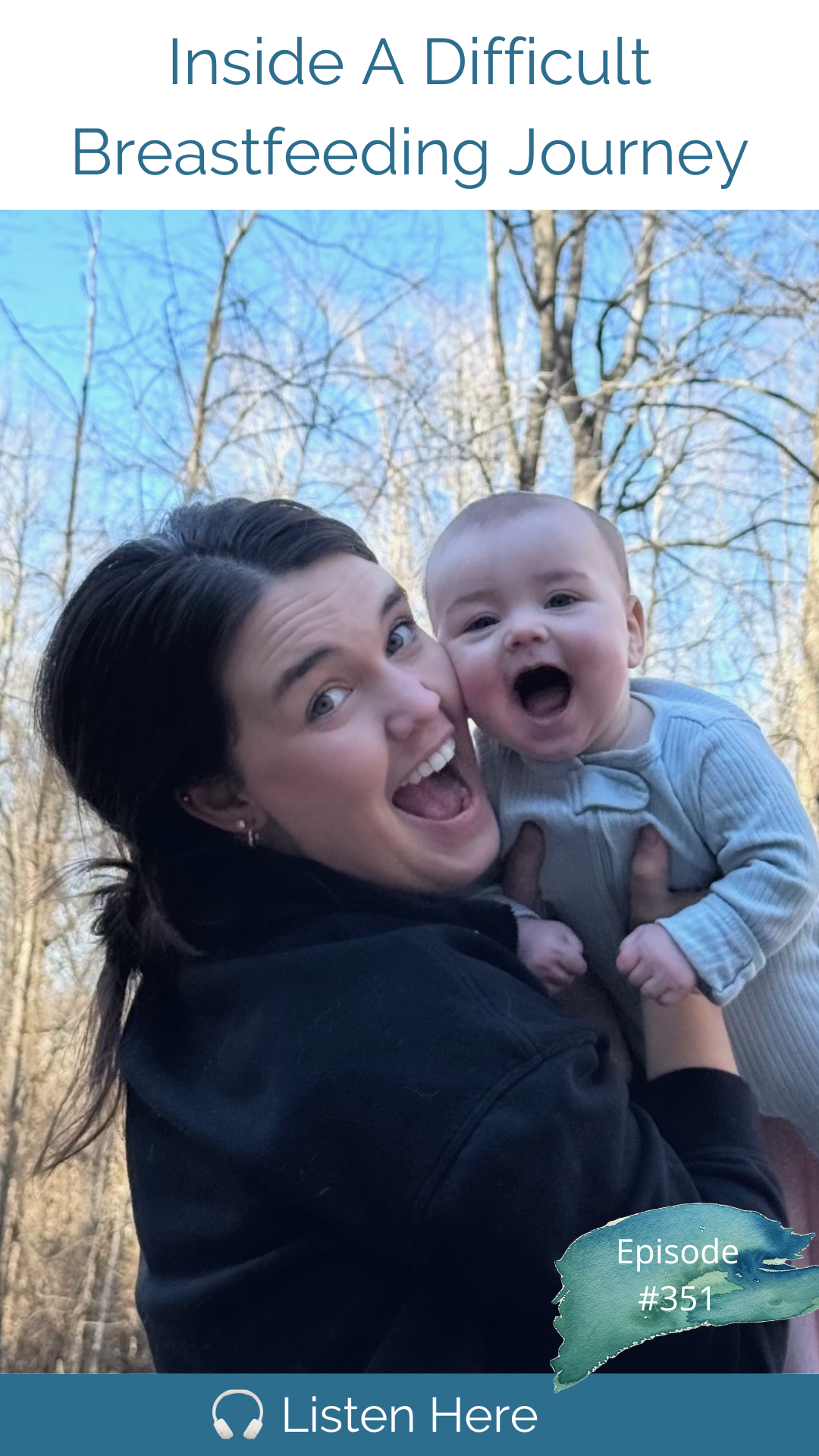
In this episode, Jessica shares the breastfeeding journey she never expected. After a smooth birth at a birth center, feeding quickly became complicated: flat nipples, an early nipple shield, a missed first feeding window, a significant tongue tie, and a baby who grew increasingly sleepy and underweight. What followed was weeks of pumping, weighted feeds, donor milk, tongue-tie revision, and the ongoing effort to understand why breastfeeding wasn’t working despite doing everything “right.” Jessica describes the emotional strain of those early weeks, from feeling inadequate to questioning her own anatomy, and the constant fear she was letting her daughter down. This conversation brings needed attention to the realities behind many breastfeeding challenges and the gaps that leave mothers without the support they need. ********** Needed <-- this link for 20% off your whole subscription order Join Patreon for our exclusive content Call 802-GET-DOWN Watch full videos of all episodes on YouTube! Please note we don’t provide medical advice. Speak to your licensed provider for all healthcare matters.
DrinkLMNT <-- this link for FREE 8-day supply
Primally Pure: ingredients good for you and the earth. Promo code: DOWNTOBIRTH
Postpartum Soothe: Organic herbal padsicles for healing. Promo code DOWNTOBIRTH
ENERGYBits: <--this link for 20% off
IG @downtobirthshow
I'm Cynthia Overgard, birth educator, advocate for informed consent, and postpartum support specialist. And I'm Trisha Ludwig, certified nurse midwife and international board certified lactation consultant. And this is the Down To Birth Show. Childbirth is something we're made to do. But how do we have our safest and most satisfying experience in today's medical culture? Let's dispel the myths and get down to birth.
My name is Jessica, and we live in Stafford, Virginia, and I have a 16-month-old daughter, and I'm actually currently pregnant with baby number two right now. We're about 26 weeks in, so over half.
Congratulations.
Thank you. So you're going to share with us today not a birth story, but a breastfeeding story, correct?
Yes. I did not have the breastfeeding journey that I was hoping for. I ended up exclusively pumping about 12 weeks into all the fun trials of breastfeeding. I definitely struggled with looking around me and feeling like everybody else had such easy breastfeeding journeys. Even though I know that's not necessarily the case, it felt like, is there anybody who has a story similar to mine? And I know we have a lot of birth stories on the show, so I thought maybe we can do a breastfeeding one too, to loop in some women who might have struggles and things that didn’t pan out the way they wanted them to.
Why don't you start by telling us about your birth, since the breastfeeding journey typically begins right then and there.
Yeah. Well, I went into labor — my daughter was due August 11 or August 16 of ’24, and I went into labor on August 10, so I was early. She was born August 11 at 11:29 p.m. My birth was great. I wouldn’t really change anything about my labor and birth. I had back labor, which I would prefer not to have again.
But careful what you wish for.
I know.
For my first and not for my second.
Oh really?
Yeah.
So one never knows.
Yeah. Well, that gives me a little bit of hope, because I’m nervous for this second one.
Don’t be nervous.
Yeah. When she was born — I birthed at a birth center — everything you talk about that’s important was the expectation for after birth: Golden Hour, waiting to cut the cord, all of that. But my midwives were concerned because my placenta wasn’t coming out as quickly as they hoped. It felt rushed. Around the 15- to 30-minute mark they were getting worried. They also worried I was hemorrhaging because I couldn’t really feel the contractions. I was dizzy, very lightheaded. They tried to get me to sit up and I just couldn’t. So we ended up cutting the cord and they passed my daughter to my husband so we could try different positioning to get the placenta out. So we didn’t get the immediate, prolonged skin-to-skin chest contact I was hoping for, but everything really turned out fine. They delivered the placenta maybe five to ten minutes later. It’s all so foggy. I know we did get the golden hour, but I think my husband was holding her for that time. Because I was so out of it, I didn’t get that full hour with her on me. Sometimes I wonder if that plays into things.
Let’s put it out there right now that the golden hour is nonsense. The Golden Hour needs to be disregarded. It is not an hour. It is hours and hours and days and days of skin-to-skin that benefit the baby. Yes, the first hour is important, and we want to keep mother and baby in continuous skin-to-skin for at least the first 15 minutes, and ideally many hours afterward — really the first 15 to 24 hours. But we have to let go of the notion of the golden hour. People think, “Oh, I got the golden hour, so everything will be great now.” That’s not how it works. And if you don’t get the golden hour, there are many hours and days to make up for it.
Well, that’s good to know. I’ve had that in my head, like maybe that played a part. But she also ended up getting diagnosed with a tongue tie, and it was a pretty good one. So there were a lot of factors.
If your baby was tongue-tied, that explains much of your breastfeeding challenge. Tell us the details.
She was born, and we tried to get her to latch before we left the birth center, but she wasn’t very interested. I have flat nipples — or had flat nipples at the start of motherhood and breastfeeding. They sent me home with a nipple shield. I’d never heard of nipple shields. I took all the breastfeeding classes they offered at the birth center and never heard of them. I didn’t know it was a major intervention. I was in such a twilight state that I said, okay, sure, I’ll try anything. We went home and it breaks my heart thinking about it now — we didn’t really know what to do. You go home and you’re like, okay… what now? It was 3:30 in the morning. We got ready for bed and I didn’t try to re-latch her again until morning. It breaks my heart thinking about the missed feeding opportunities. I had heard about cluster feeding and feeding every two to three hours, but I also heard they might take a nice four-hour sleep because they’re exhausted from birth. I didn’t know. I felt clueless, tired, worn down. By 6:00 a.m. I thought, okay, I guess we need to try again.
She didn’t latch directly. She had no interest in latching directly to the breast. So I pulled out the nipple shield. She would latch onto the nipple shield, but I was confident she wasn’t getting much — colostrum is so hard to get through a shield. I ended up hand-expressing for the first three days, to the point my breasts were bruised. It was so hard and she was so fussy.
Can we pause? What time was she born?
11:29 p.m. on August 11.
So her first latch attempt wasn’t until around 6 a.m., about seven hours later. Many mothers are told babies don’t need to breastfeed much in the first 24 hours so they don’t worry. And yes — babies do take a long stretch of sleep early on, but it should be after they’ve latched at least once. Otherwise they go a long stretch with no intake. Their stamina is affected. Their desire to latch decreases. And then if you put a nipple shield in there, getting back to the bare breast becomes very difficult. It’s one of the biggest mistakes people make. It’s routine in hospitals: “Baby won’t latch? Nipple shield.” It teaches the baby to latch incorrectly, makes it harder to latch without it, and colostrum doesn’t pass easily through it. You’ve described a lot that set your breastfeeding journey up for difficulty.
So when did bonding kick in? Because we are completely different women once that happens.
Probably when my milk really came in. I felt connected knowing my body was providing what she needed. When your milk comes in hard and fast, it’s easy for the baby to get it in those early days, and for the first two weeks we didn’t have too many issues after the colostrum phase. Around day three or four when my milk came in, I felt like I had a glimpse of what it was supposed to be like. And sometimes the bonding felt tied to the feeding issues. When things regressed, something in me almost shut off. I felt frustrated — is it me? Is it her? Why isn’t this working? It was fluid.
It’s common for mothers with breastfeeding difficulties to feel a disconnect, or feel like their baby is rejecting them. It’s hard not to take it personally when the baby seems to push away. Really, they’re trying to find their way. They’re wired to breastfeed. But they’re also wired to survive, so if a bottle is easier, they’ll take it. That isn’t rejection — it’s intelligence. But with a tongue tie, they can only do so much. It’s not you. It’s not them. It’s lack of support.
We also see women blaming themselves, apologizing, feeling like they weren’t meant to be mothers, or that their babies don’t like them. And really, they just weren’t taught or supported. How did it manifest for you?
I felt all of that. I felt inadequate. I felt resentful toward my own anatomy. Angry at my body for needing a nipple shield. I felt resentment toward myself and a little toward my daughter — but I knew we were both learning. I thought, this is supposed to come easy. I felt every level of inadequacy and resentment.
Let’s set the record straight. Breastfeeding is not easy. It is natural, but not easy. You have two people learning together, with little support. You haven’t watched other women breastfeed. Historically, women breastfed among each other all day. We don’t have that now. Instead, we put on an artificial nipple that disrupts everything. A mother can have flat nipples and a baby can latch — it just takes teaching. Our hospitals do not have real breastfeeding experts on staff. You’re lucky if you get an LC, rarely an IBCLC. And nipple shields are handed out constantly, often without good reason, and always with the implication something is wrong with you. They set you up to feel inadequate from the start.
Yeah, 1,000 percent.
So we're creating these problems.
Yeah. And it wasn’t until I did my own research — heard things on this show — that I realized. And this was before we even knew about her tongue tie. I wanted to wean from the nipple shield. My milk came in and things were good for two weeks. She latched a long time, but she was a very sleepy baby. We had the hardest time waking her. We stripped her down, tickled her, used cold wipes — she genuinely didn’t want to wake up. Her sleepiness gradually increased. Around two to three weeks postpartum my breasts felt different — not as full. I thought my supply was dropping. I contacted my midwives. A friend who was an LC said I should schedule with an IBCLC. She came around four weeks, watched a feed, did a weighted feed — my daughter only transferred an ounce in a little over an hour with the shield. We had milk-transfer issues. She diagnosed the tongue tie — posterior tongue tie and a lip tie. Around three to four weeks that was confirmed.
Even with bottles, she wasn’t transferring well. It didn’t matter the flow — she spent 45 minutes and took an ounce and then fell asleep. All red flags. We got the tie revised around six weeks. We did stretches, chiropractic, craniosacral therapy. Nothing seemed to help much. She still wasn’t transferring from me. But she transferred well from the bottle after the revision. I was more concerned about weight than the method, so I pumped. I hated pumping. I only did it for her. Every time my husband fed her a bottle, I pumped. She was supposed to be on me, not a machine. I felt like a cow. Pumping saved my supply, but I hated it. I exclusively pumped for two weeks before the revision, and mostly after the revision. She still wasn’t feeding well at the breast. The only time she fed well was morning when I was engorged. She’d get a full feed from one side. She would transfer 3.5 to 4 ounces in the morning. Then I asked my LC to come in the afternoon. At 3 p.m. she transferred half an ounce in 30 minutes and fell asleep again.
Weighted feeds can be misleading. Morning feeds are about breast fullness, not baby efficiency.
I’m glad I asked her to come back midday. My daughter was 10–12 weeks old. I was breastfeeding mornings with the shield and trying direct latching with screaming every time. I thought, if my breastfeeding journey is with a nipple shield, I’ll take it. I don’t care. After the afternoon feed, I knew I needed to stop trying. We had done everything — stretches, craniosacral, chiropractic, OT. Her suck never really increased. I had to release myself.
All of those interventions were successful — they helped her in the long term. Posterior ties take time to improve, and the revision benefits feeding for years.
Yeah. And then around three to four months we found she had a dairy intolerance. She developed a feeding aversion. She spit up a ton. She wouldn’t take more than two ounces at a time. She wanted nothing to do with it.
To be clear — the dairy intolerance was to the protein in your milk from your diet?
Yes. I never introduced formula. I changed my diet completely — no cow’s milk protein for the first year. I tried to introduce formula, but I felt territorial over my breast milk. I had tried so hard to feed her myself. By the time I was done pumping, she wouldn’t take the formula anyway — it tasted awful. So she stayed on breast milk. I weaned from the pump around 12 months. She wasn’t attached to milk anyway. She still can’t have dairy, so we offer almond milk sometimes.
So around 12 months she was on solid foods, water, and some almond milk.
For the most part, yes.
That’s important for parents to hear. You don’t need to give cow’s milk at a year if your baby eats well.
Looking back, you blamed yourself. How do you see it now?
I don’t think there was anything I could have changed. I could say if she didn’t have a tongue tie, or if we didn’t use a nipple shield, or if it was the dairy intolerance — but I think everything worked together into the perfect storm of not being able to breastfeed. I’m taking pieces of this into my new postpartum season. I won’t introduce a nipple shield. I’m having my lactation consultant come very early. I know more now. I can give myself more grace. Maybe it just wasn’t in the cards for us because of all the factors. And that’s okay. I know I did everything I could. She’s strong and healthy. That’s what matters. And I’d say to any mother experiencing this: you’re doing the best you can, and that’s all you can do.
Thank you for joining us at the Down To Birth Show. You can reach us @downtobirthshow on Instagram or email us at Contact@DownToBirthShow.com. All of Cynthia’s classes and Trisha’s breastfeeding services are offered live online, serving women and couples everywhere. Please remember this information is made available to you for educational and informational purposes only. It is in no way a substitute for medical advice. For our full disclaimer visit downtobirthshow.com/disclaimer. Thanks for tuning in, and as always, hear everyone and listen to yourself.
Recent Episodes
Between episodes, connect with us on Instagram @DownToBirthShow to see behind-the-scenes production clips and join the conversation by responding to our questions and polls related to pregnancy, childbirth and early motherhood.
You can reach us at Contact@DownToBirthShow.com or call (802) 438-3696 (802-GET-DOWN).
To join our monthly newsletter, text “downtobirth” to 22828.
We'd love to hear your story.
Please fill out the form if you are interested in being on the show.
Subscribe to The Show
Follow Us On Social