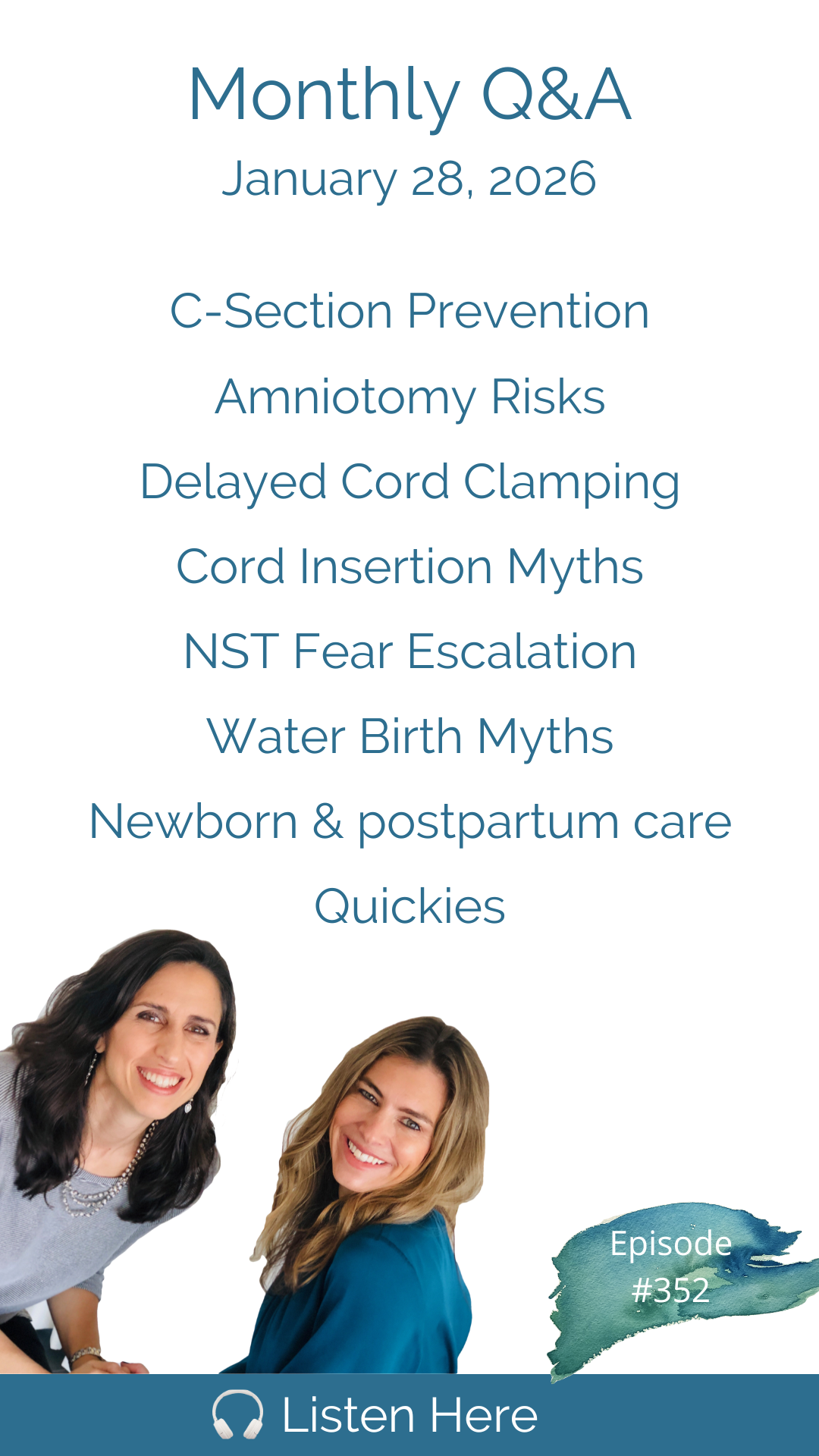
Welcome to our first monthly Q&A episode of Season 7! In today's episode, we discuss why C-sections are sometimes framed as “prevention,” how fear around tearing, fetal monitoring, or cord concerns impacts clinical decision-making, and why breaking the bag of waters is still routine practice despite clear risks and limited benefit. We explain what delayed cord clamping looks like during a cesarean and why vague language like “misplaced cord insertion” can unknowingly lead to unnecessary intervention. Additionally, we talk about nursing while pregnant, early breastfeeding challenges, frozen breastmilk, feeding to sleep, and other common postpartum concerns. Lastly, Barbara Harper joins us to dispel the fear around water birth by explaining the exact physiology of newborn transition under the water. As always, thanks for calling in with your questions. Call us anytime at 802-GET-DOWN (that's 802-438-3696). ********** Needed <-- this link for 20% off your whole subscription order Join Patreon for our exclusive content Call 802-GET-DOWN Watch full videos of all episodes on YouTube! Please note we don’t provide medical advice. Speak to your licensed provider for all healthcare matters.
DrinkLMNT <-- this link for FREE 8-day supply
Primally Pure: ingredients good for you and the earth. Promo code: DOWNTOBIRTH
Postpartum Soothe: Organic herbal padsicles for healing. Promo code DOWNTOBIRTH
ENERGYBits: <--this link for 20% off
IG @downtobirthshow
I'm Cynthia Overgard, birth educator, advocate for informed consent, and postpartum support specialist. And I'm Trisha Ludwig, certified nurse midwife and international board certified lactation consultant. And this is the Down To Birth Show. Childbirth is something we're made to do. But how do we have our safest and most satisfying experience in today's medical culture? Let's dispel the myths and get down to birth.
Hello and welcome to the January Q&A, our first Q&A of Season 7. Seven. That’s so many seasons. Our kids were so young when we started this—this crazy seven years. That’s a full cycle, right? Seven-year cycles?
We’re in the seventh year. It’s a full cycle period.
Okay, I guess so. Your daughter just turned three cycles old.
Don’t you think about life in seven-year cycles?
I do not.
Oh, I do. I’m just learning this.
Okay, so we’ve reached one cycle.
Well, we’re reaching the final year of this cycle when we complete the seventh year.
Interesting. Trisha, I’m still getting to know you—full of surprises—much like when I opened a drawer in your kitchen and found hundreds of corks.
I almost threw them out yesterday. Almost did.
Not gonna happen. Bad idea.
So what have we got?
We wanted to start with something light. In our Christmas episode, we talked about our own holiday traditions, and we asked our community to share theirs. Even though the holidays are over, we thought it would still be fun to talk about them—especially since it gives people ideas for next year.
One person said they add to their traditions every year.
Add what?
They just keep adding traditions—doing more every year.
That’s kind of fun.
Another woman said they buy an ornament on every trip they take.
That’s awesome. I do that too—not religiously—but I love ornaments. I’m really into unique, special ones, and I have ornaments from all over the world.
I give each of my children an ornament every year so they can build their own collection. Ornaments are expensive. You can’t just go out and buy fifty unique ones at once.
When my brother got his first apartment in his twenties in Hoboken, he was throwing a Christmas party and didn’t have ornaments. I suggested a tree trimming party. He didn’t want to imply people had to bring anything, so he called it a “tree party,” which is somehow worse. People were confused. I might have shown up dressed as a tree.
Our kids draw names for each other in honor of Saint Nick and do a kind of Secret Santa.
That’s super cute.
My brothers and I have eight kids between us, and the cousins are incredibly close. They do their own Secret Santa now that they’re older.
Someone else said they do Christmas at the capitol in South Dakota, see the tree, and feed the wild geese.
Geese are underappreciated.
They taste good.
Okay, dark turn.
Another family rolls great-grandma’s meatballs together a few days before Christmas and freezes them for easy subs on Christmas Day.
That’s really sweet.
I didn’t realize “rolling” was the official term.
You roll them between your palms.
I’m Italian. I know how to make meatballs.
Mine are perfectly round.
Saving face.
Another tradition: homemade cinnamon rolls first thing Christmas morning.
I make lemon poppy pancakes every Christmas morning. They’re complicated—meringue, lots of eggs—and I only make them that day.
You’ve never made them for me.
Come over Christmas morning.
I do yeasted Belgian waffles. You have to start them the day before. They rise overnight, and everyone makes breakfast at their own pace while opening gifts.
We drag Christmas morning out too—stockings, gifts, then breakfast.
Another family sings Happy Birthday to Jesus with a cake.
Another does a Christmas Day hike.
Someone cuts down their own tree, looks at lights, eats crab, and watches the original Grinch.
One family has eleven siblings, so everyone brings appetizers instead of doing a full meal.
That’s impressive.
Which tradition are you adopting?
Feeding geese.
I’ll keep buying ornaments on trips. I have far more than can fit on the tree.
You’ve given me ornaments over the years.
Your mother gave me ornaments too—really beautiful ones.
Okay. Back to birth. Holidays are over.
Someone wrote in about a recent ultrasound. The doctor noted a previous birth where she had a significant tear. She explained that she was forced to wait in the ER, was told to push immediately because the baby had passed meconium, and the baby came out fast with an arm up, resulting in a bad tear. The doctor suggested that because of the risk of a fourth-degree tear, she should consider a C-section for this baby.
She was surprised. She thought a C-section would be a last resort.
Is a C-section less traumatizing than a fourth-degree tear?
“Traumatizing” isn’t the right word—but is it less risky? No. A C-section is the last resort. It’s been so normalized that women are told things like, “You had a big baby, you should have a C-section next time,” or “You tore badly, so definitely C-section.”
Fourth-degree tears are rare and terrible, but women who’ve had them almost never have them again—especially when steps are taken to prevent them.
This comment is absurd. It’s a perfect example of coercive counseling. Telling a woman to have a C-section to prevent a tear is ridiculous.
She was rushed because the baby had passed meconium. That happens in labor. She was forced to push too fast. That’s why she tore.
Now she’s being led to believe there’s something wrong with her body.
That belief is easy to buy into because tearing is such a difficult recovery, but it’s extremely unlikely to happen again.
We’ve done a whole workshop on preventing tearing. There’s so much that can be done.
Good thing we’re here to talk about this.
On to the questions.
Jordan asks about breaking the bag of waters. She’s due in February and keeps hearing how common it is in hospitals. Is there benefit? What are the risks? Is it ever appropriate?
Her mom’s water never broke on its own with any of her births.
If her mom’s water never broke, where would she be today? Still pregnant.
The water always breaks—or the baby is born en caul, which is completely safe and amazing to see.
Usually it breaks during transition or as the baby moves through the birth canal.
She wants to know the risks and whether it should ever be done.
I want to say “never,” but never say never.
There is one scenario where it might make sense: a woman is well into labor, contractions are strong, she’s nearly fully dilated, and the bag of waters is preventing the baby’s head from applying pressure to the cervix—more common with multiparous women.
Breaking the waters in early labor or for induction is a terrible idea.
Risks include infection, cord prolapse, malposition, increased pain, and increased C-section risk.
ACOG has stated that more than 15 studies show amniotomy does not speed up labor.
Hospitals imply it’s necessary and helpful. It’s not.
Amniotomy is routine in induction protocols, and that’s where it becomes dangerous.
Next question: delayed cord clamping during a C-section.
She’s not getting 15 minutes in the OR, but most blood transfer happens in the first minute. One to three minutes is realistic.
It depends on the baby, the surgeon, bleeding, and circumstances.
If a baby needs help transitioning, skin-to-skin would be ideal—but that’s not routine.
Gentle cesareans should be the norm.
Next question: manual extraction of the placenta due to “misplaced cord insertion.”
I’m not buying it.
This sounds like a bait-and-switch. Likely a marginal cord insertion, which is not a reason for induction or manual extraction.
Manual extraction is only appropriate with severe bleeding.
Hospitals have no patience for the placenta.
It’s invasive, painful, disrespectful, and becoming routine when it should be reserved for emergencies.
Next question: late decelerations and induction pressure.
She was told induction was necessary or her baby could die or have brain damage. She resisted C-sections and epidurals and had a healthy vaginal birth.
One of the biggest risks of induction is fetal distress.
NSTs have poor predictive value.
You don’t go through a long Pitocin induction and deliver a healthy baby if there was true distress.
Late decels are heart rate drops that don’t recover well after contractions—but context matters.
Women are pressured using fear.
You can delay. You can get more data. Or you can trust your body.
Next question: water birth.
A midwife said babies aren’t dolphins and can inhale underwater.
That is physiologically impossible.
Barbara Harper explains this in detail. Babies do not breathe until facial exposure to air triggers the neurological and circulatory changes needed for breathing.
In 40 years, she has never seen a baby inhale underwater.
Water birth is safe when practiced correctly.
Quickies:
Is it nutritionally depleting to nurse while pregnant? It can be if nutrition isn’t adequate.
Does expressing colostrum help milk come in faster? No, but learning to hand express can be helpful.
Will postpartum hemorrhage happen again? Not likely, especially after a physiologic birth.
Is progesterone in the luteal phase harmful? Depends on why you’re taking it.
Is frozen breastmilk safe after three years? Probably, assuming it stayed frozen.
Do you need to fully wean for your period to return? Usually no.
Can epidurals affect nursing? Yes. Be patient with the process.
Cough remedies in pregnancy? Time, fluids, avoiding sugar and dairy.
Feeding to sleep? Feed your baby to sleep. Wake windows are a fabricated concept.
Vitamin K? It’s not a no-brainer. Get the information and decide.
Final question: smells and nostalgia.
Obsession cologne. Pine forests. Palo Santo.
And finally—beliefs that surprise people.
Not identifying as a feminist.
Believing in equality without dividing the sexes.
Masculine men and feminine women both matter.
That’s it.
Thank you for the questions. We’ll see you next week.
Over and out.
Thank you for joining us at the Down To Birth Show. You can reach us @downtobirthshow on Instagram or email us at Contact@DownToBirthShow.com. All of Cynthia’s classes and Trisha’s breastfeeding services are offered live online, serving women and couples everywhere. Please remember this information is made available to you for educational and informational purposes only. It is in no way a substitute for medical advice. For our full disclaimer visit downtobirthshow.com/disclaimer. Thanks for tuning in, and as always, hear everyone and listen to yourself.
Recent Episodes
Between episodes, connect with us on Instagram @DownToBirthShow to see behind-the-scenes production clips and join the conversation by responding to our questions and polls related to pregnancy, childbirth and early motherhood.
You can reach us at Contact@DownToBirthShow.com or call (802) 438-3696 (802-GET-DOWN).
To join our monthly newsletter, text “downtobirth” to 22828.
We'd love to hear your story.
Please fill out the form if you are interested in being on the show.
Subscribe to The Show
Follow Us On Social