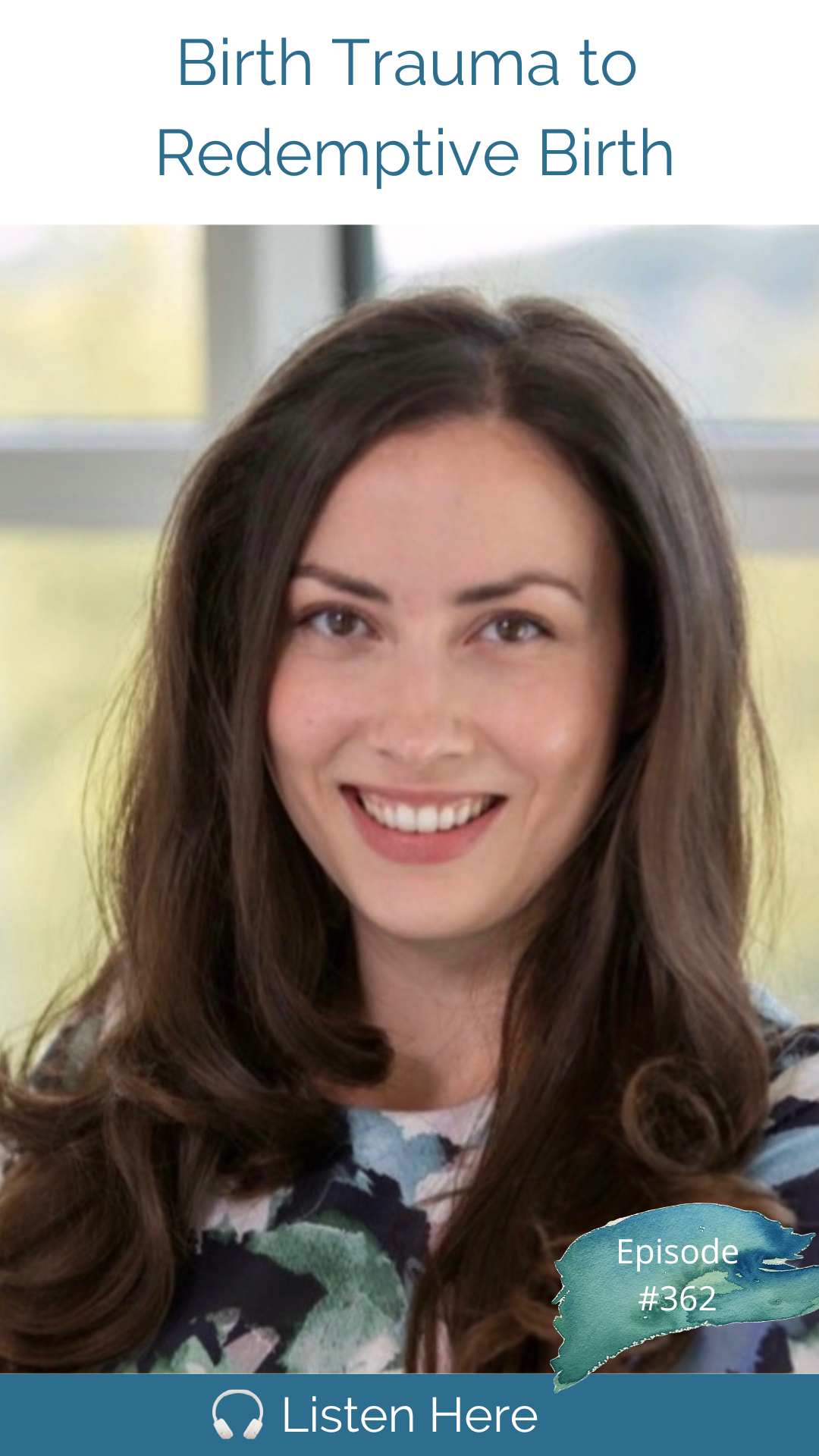
In today's episode, one of Trisha's clients, Holly, shares the story of two very different births and two equally different breastfeeding experiences, and what shifted between them. Her first labor began spontaneously but ended with a vacuum delivery, and the demoralizing message that her “pushes weren’t productive.” Breastfeeding was just as difficult, leading to a year of mostly exclusive pumping and undiagnosed postpartum anxiety. Four years later, she approached birth with real preparation, a clear plan, and a timely transfer of care to a midwife who immediately changed the tone of her birth experience. This episode examines how preparation, autonomy, and the right support can change not only the course of a labor, but the way a mother understands her own strength. ********** Needed <-- this link for 20% off your whole subscription order Join Patreon for our exclusive content Call 802-GET-DOWN Watch full videos of all episodes on YouTube! Please note we don’t provide medical advice. Speak to your licensed provider for all healthcare matters.
DrinkLMNT <-- this link for FREE 8-day supply
Primally Pure: ingredients good for you and the earth. Promo code: DOWNTOBIRTH
Postpartum Soothe: Organic herbal padsicles for healing. Promo code DOWNTOBIRTH
ENERGYBits: <--this link for 20% off
IG @downtobirthshow
I'm Cynthia Overgard, birth educator, advocate for informed consent, and postpartum support specialist. And I'm Trisha Ludwig, certified nurse midwife and international board certified lactation consultant. And this is the Down To Birth Show. Childbirth is something we're made to do. But how do we have our safest and most satisfying experience in today's medical culture? Let's dispel the myths and get down to birth.
Well, thank you so much for having me here, Cynthia and Trisha. I'm excited to share my birth story, and I'm hopeful maybe it resonates with someone who has a similar experience with me—having two kids, first birth going not the way you want it to, and having a redemptive birth in the end with my second.
So to start, I'll share my first birth experience with my son. Getting pregnant with him was pretty easy. The pregnancy was great. Everything was going smoothly. I did no prep. So this is where I look back, and I wish I would have spent more time. I'm a person who always thought I have a really low pain tolerance, I'm just going to get the epidural, not even looking further into it. I would listen to podcasts, and I would actually skip anything that had to talk or discuss pain, that part of labor, pushing, all of it. I would just kind of skip it and say, no, no worries. I'm getting the epidural. I don't even have to think about it.
What I did uncover is that I wanted to obviously avoid a C-section, so that's really where I focused. And I knew all about the cascade of interventions, and I was prepared for that element of it. I declined having my water broken, all those kind of things I kind of knew about. But essentially, I'll just kind of go into the story. I went into labor naturally. I was nine days post-date, so I went into labor, went to the hospital right away, didn't really labor too much at home, got the epidural. As soon as I felt any overwhelming kind of sense of the pain and the pressure, I fell asleep, took a nap, woke up, and the epidural had worn off, and it was just in time for me to be 10 centimeters, and they're telling me, yep, go ahead and push.
So I'm going from zero to 60, feeling everything, and one of the most triggering moments from looking back and remembering the experience: the two nurses that were in the room look at me and look at each other, and they go, your pushes are not productive. So I'm like, that had never crossed my mind. Like, how would my pushes not be productive? And it's just kind of defeating, right? Like, I'm just getting started, like, here we go. I'm feeling everything, and you're telling me my pushes aren't productive. I knew I didn't want to labor on my back, but they eventually convinced me to lay down on my back, push on my back. The overall labor was 23 hours, and I ended up pushing for three. And I know now, knowing what I know, my baby was just too high up, and I shouldn't have been pushing just because I was at 10 centimeters.
I gave it everything I could, with no gas in the tank, no fuel. So I hadn't been eating this whole time either, barely drinking water. I was hooked up to something, I'm sure, because I was having the epidural, but I had nothing in me. And I was told again, your pushes aren't productive. Nothing's happening. Essentially, you're pushing and nothing's happening. But also, we're not going to give you more epidural medication. So it could have been one or the other for me, right? Like if I would have gotten the epidural increased, then maybe I would have at least not been panicking, because I was panicking from the amount of pain I was feeling, not having any prep.
Why did they tell you that you couldn't have any more epidural? Did they think that because your pushes were, quote unquote, not productive, that the epidural would make you even less productive? Because there is such a thing as laboring down. You don't actually have to push your baby down. Your uterus does that job, and if you can actually relax your body, your uterine contractions can become more effective and do the job without you having to create a productive push.
I think that there is a case for not getting an epidural at that point, for exactly that reason. I mean, it does make everything less productive. It does lengthen and slow labor, and it would have driven up your odds of a C-section if you didn’t push your baby out within three hours. It very well could have meant four or five hours, and it might have meant a C-section in that time period. What I think is the most important point is what Trisha just said: we have to stop giving women the impression that if they just work hard enough and push hard enough, they can do it. So just work harder and push harder. You can't force the baby to come down when the body isn't unfolding to the baby, when the baby isn't descending on their own. And were you on your back?
I was on my back, pushing against the grain with the baby high up, and losing all the steam that I had, and screaming at the top of my lungs because I had no other tools. I didn't know anything about low moaning, preventing fight or flight, none of that. And I was in a complete panic and suffering and distress.
The other important point is that you felt nothing in your labor, and then you entered it at 10 centimeters with a high baby. So your body, physiologically—your brain and your body really hadn’t been able to get in sync with what happens at the second stage of labor. So actually, three hours isn't that long with an epidural to first second stage, but it also probably would have been fine if you had a little bit more epidural and you just let yourself labor down and let your baby get lower before you actually then felt the urge to push, because you don't really feel that when the baby's up that high, right?
Exactly. I did not feel that at all. I was just told, hey, you're at 10 centimeters, push. And if we would have just waited a little bit, if I could have gotten my bearings a little bit, maybe even if someone told me to low moan instead of scream, that would have been helpful.
But what I got instead was a room full of people, right? Because they then told me, you need a vacuum. You're not going to be able to push this baby out. And I was in tears. I was completely a mess. I didn't really have much left in me, and we were very close to a C-section. But the option was, we can try the vacuum, and you'll have three pushes to do that.
Holly, would you mind if I jump in? Yeah. I always try to keep in mind the listener who doesn't understand a reference that we make. And I think that just happened when you made a couple references to low moaning. So it's worth just mentioning. And this is the kind of thing that people would learn in, like, when Trisha and I are teaching about childbirth or something like that, but there's a correlation between the throat and the vagina, and we can have tension in our throat or relaxation in our throat. And when we make high-pitched sounds, we have tension in the throat, and that means, with certainty, there's tension in the vagina, and it's more difficult to relax and birth your baby.
So one of many, many tools for an easier birth is just to have low—like the kind of sounds someone makes when they're making love, or when they're having a massage—just the natural sounds that come out of us when we're relaxed. So as a tool, you can just cut right to that tip, cut right to the chase, and just have a woman making those low sounds. So it sounds like you know all about that now. But isn't it interesting how they don't tell women any of these tools, basic: get off your back and make low sounds, make vowel sounds, make an ah sound, make an ooh sound. And it also helps her focus, like just let her have something to do other than push, push. And the fact that they say it's not productive is just so wrong. It is just so upsetting that they say that to women. I feel like the nerve of them to make a judgment about it—it is socially acceptable, that's common.
It's also very, very normal and expected for a woman to reach full dilation and not be ready to push. There's a pause, sometimes a very long pause. Sometimes it's an hour or two before the mother actually starts to feel the sensation and the urges to push.
And that one fact, I feel like, could have saved me and changed the whole birth trajectory, because I wouldn't have been just pushing against the grain without any gas in my tank. That would have been a game changer, I believe, for the birth.
What happened instead? So I ended up choosing to do the vacuum. The room floods with people. I have the three opportunities to push, and I'm still screaming because I have no tools. I have no way to cope. I don't know what to do. I'm panicking in my body. And there is an OB that comes in, never seen her, met her before, and she begins screaming at me to stop yelling. She's screaming at me in my face. I remember it so vividly. She's on my side over here, and she's saying, cut it out. Cut it out. Cut it out.
And I just felt so embarrassed. Number one, I'm embarrassed. I'm completely vulnerable. I have these three opportunities to push, otherwise I'm going into a C-section, and she just made me feel so demeaned and like a child. I felt like I have no control over my body, over this birth. I'm just not strong enough. And now I have this person in authority yelling at me, saying, cut it out, like I'm a child acting up. I was beside myself. That's something I continually go back to when I think about that birth and how that person spoke to me, and that was a big catalyst for me wanting a better experience.
But from there, another piece that was difficult for me is once I did get the baby out on three pushes—thankfully we didn't have to go into a C-section, and my son was healthy, everything was fine—they did take him right away from me to check him. And another nurse, it must have been a nurse, comes over without saying anything to me, addressing me, looking at me, and just starts wailing on my stomach to do the fundal pushing. I had no idea what fundal pushing even was. I didn't know what she was doing, and it was excruciating. I'm crying, and she just won't let up, and she doesn't even look at me or speak to me.
And I understand that with a vacuum there's an elevated sense of stress in the room, and people kind of have to do what they have to do. But I didn't know what was going on, and I was terrified. I was scared, and it was extremely painful.
Once the baby was out, the pressure of the vacuum is gone. There's nothing about vacuum birth that creates an excessive need to—this is after your placenta was out or not out.
I don't think the placenta was out yet, and they were pushing, I guess, to try to get it out. I don't even remember.
Well, that's actually a very bad idea. It probably was out. I would think it was probably out.
They usually do it after the placenta either way.
I'm just saying, there was no need to have that sense of panic and urgency. The baby was out, the vacuum part was done, that pressure point was passed, unless you were severely bleeding. That aggressive type of fundal massage is just mean and cruel, right?
And without even telling me, hey, this is what I'm going to do, this is why, take a deep breath—none of that. No addressing me. I just had someone I've never met before just wailing on my stomach and feeling that intense pain. And I was scared. I didn't know what was happening or why, and I felt so raw at that moment with what happened with the vacuum and being yelled at. And it was trauma-filled birth that didn't have to be. It's not like my baby was in distress. He was very healthy, and it was just, okay, instead of getting you to a C-section, we're going to get this vacuum, put you out of your misery, so to speak. And we're not going to treat you like a person.
Did they suggest a vacuum because you were approaching the three-hour mark for a second stage? Because if your baby wasn't in any type of distress, why was there the pressure to get the baby out in three pushes?
I candidly did not have anything left in me. I didn't even know if I could get the baby out with the vacuum. I had so little in the tank. I had no strength left. I was crying everything out of my body. I was completely spent, probably wasn't well-hydrated, definitely didn't eat anything, and then screaming and crying in complete panic and stress for the full three hours, and then being told, you're not being productive. So it was just like, I didn't have much in me. And I think they could tell.
You both felt at that point that some assistance would be helpful.
Yes, exactly. So from there, baby was healthy, like I said, totally fine. But the real pressures really started when lactation didn't go well either. I was told in the hospital, you're not going to be able to breastfeed this baby, at 2 a.m. in the middle of the night. Just have yourself a glass of wine. Here's formula. And I didn't know what else to do besides believe the lactation consultant. I thought, okay, again, there's something wrong with me. I'm not strong enough to do this. My body is not capable of doing this.
And I kept trying. I was given a nipple shield right away. I tried with the nipple shield, and my baby was able to feed off the nipple shield, but never could get a really great latch, and never was able to transfer enough milk. Week after week we would go into the pediatrician's office, and he was losing weight and losing weight and losing weight, and it was, I couldn't sustain my own child. I couldn't feed my baby. And all I wanted to do was breastfeed and have that experience. I was just in shambles. I wasn't mentally well. It was very, very upsetting.
And I did have a lactation consultant come to the house a few times, and just the way that she was offering her assistance was more, here are these gadgets that can help you. I wasn't really getting that hands-on approach, like Trisha, what you did with being hands-on and actually helping me shape the breast and do different things and tactics. That way, I was given these gadgets, like, oh, here's this pulsing, vibrating thing to help the milk. You can do this and that. We'll do this weighted feed. I'm going to listen to hear how the baby's swallowing. Like, it was very gadget-driven and less about, let's get a really good latch.
We got to a point where we took the nipple shield off to try again, to have just a natural nursing experience, and it was excruciating. And the lactation consultant basically told me, if you keep trying at this, you probably won't even end up pumping. So why don't we just focus on getting your pump experience going so that you don't give up entirely.
And once again, I said, you know, you know better than me. I don't want to not give my baby the chance to have my pumped milk. So I gave up and said, okay, let's just start pumping. So I ended up mostly exclusively pumping for a full year. We did some combo feeding here and there when his needs went up. But it was very difficult. Anyone who knows mainly, exclusively pumping—cleaning the parts, all of that—it was very hard.
And I ended up, if you fast forward a year and a half later, with undiagnosed postpartum anxiety. And I just didn't know that was what was happening to me. I just thought, again, I am bad at this. I'm not great at being a mom. I really want to be a good mom, but I'm just not good at this. I'm not strong enough, just like I wasn't strong enough in birth, and I wasn't able to use my body the way I'm supposed to, to just have a breastfeeding experience that was great.
So I decided we are going to be one and done. And I felt that way for a good four years. My husband was never too thrilled about that. He always did want to have two children, but he was very supportive. And he said, okay, whatever. He supported my decision, even though he did truly want a second.
From there, I was in a much better career path. My mental health was better. I had quit caffeine at that point, so anxiety had very much waned at that point, which was another tool that has helped me this time around. Then my father passed away, and I just got to this point feeling like, okay, my family feels to be shrinking. I want to expand my family, and why do I have to let a bad first birth experience prevent me from having the fullest family experience that I could have? And if I could have a second, why am I going to let that prevent me? Let's expand our family and have more instead of the minimum.
So I got a fire back. So I thank my dad for kind of infusing that in me and getting me kind of excited for trying again. So right off the bat, I said, I am not going to be screaming this time. I need to find the tools to be able to cope. I need the coping mechanisms ingrained in me. So I am prepared this time. I'm not going to lose my stamina. I am going to go into birth fully knowledgeable, and I am not going to scream.
So that was my first kind of foray into why I wanted to try for a natural birth. The other piece of it, as I started to learn, was the fact that I could potentially have a better breastfeeding experience if I have a natural birth experience. So those two things really fired me up to say, let me have the second chance to do this the most empowered way.
So from there, my birth prep was pretty extensive. Right away, I hired a doula, and I started taking, with my husband Bradley, birth classes, which were incredible. They were three hours long, six sessions, and we spent basically our whole summer before having the baby prepping and learning and hearing birth stories, watching the videos, and all of that was invaluable. It was really incredible. And doing that with my husband was great. It was a bonding experience for us, and it really got him on the same page as me.
Because what we did have to kind of work through is my husband is in the medical field, and he is very medicalized, and I was on this opposite spectrum of, I want a 100% natural birth. So we were able to find this happy medium of learning together about what should happen in a natural birth, and giving him the tools to help me, and also giving him the freedom to ask all the questions that he wants to ask, and really help him to feel comfortable with the process. And so that was incredible.
We also had sessions with the doula where we could learn and ask questions, and there was a lot of homework. So we spent our summer reading a lot of materials and getting as much knowledge as we could.
Bradley is big on homework, yes.
Which was great is there wasn't this expectation, oh, when you come back, you have next session, we have to talk about what you learned. It was just, it's available to you and in your own time, right?
Right.
So that was good. The other thing was Spinning Babies was huge for us that our doula helped us get into. So my husband and I were doing—the forward-leaning inversions, and then he helped me with the sideline release—pretty much all through the ending of our pregnancy.
And then also being active this time. So the first time it was COVID, I wasn't working out at all. I wasn't even taking walks. It was barely going outside. And this time, even before I got pregnant, I was active, so you had that stamina focus training, but also the yoga element for relaxation. The breath. And that was huge. And I ended up working out until 40 weeks, so I was able to continue it just with some modification, keep it up. And it really ended up helping me, again, with my stamina. So even just like my leg strength and for pushing and all of that, it was really helpful. And the focus of the breath.
And then HypnoBirthing was incredible as well. HypnoBirthing and meditation practice all throughout my pregnancy, and that really came in handy. I really wanted to prioritize relaxation, so that was incredible.
I'll fast forward to we're now at the end of my pregnancy. My OB was very supportive of my natural plan throughout the months that I was going to visit her. She even held me when I cried talking about the fundal pushing experience and my birth trauma. But our sticking point was the cervical checks.
So I go into her office, it ended up being my last office visit before having my baby. And every time that I would see her, from 37 weeks on, there was this discussion of cervical checks, and each time I would decline, and it ended up being a struggle. So in this last visit, I was two days post-date, so we started talking about scheduling an induction, and I started to get very nervous. I didn't want to have an induction. Went into spontaneous labor the first time, so why couldn't we wait this time? And she did tell me that she would give me about a week and a half.
And now we're looking at the calendar and trying to decide on when this induction is going to be, and I'm just getting stressed. And she looks at me, and she gets on one knee and puts up prayer hands and says, just let me check you. Let me check you. I'll be able to schedule you appropriately. And I didn't look up at her. I just looked at my phone and looked at the calendar, and I just basically had to sit in the awkwardness and outlast her, and basically not even acknowledge that she was begging me to perform a cervical check, because there was just no way. She wasn't able to convince me. I just did not see any reason for it. I gave her all the reasons prior, so we just weren't going to have the conversation.
So eventually she had to get up, right? Because I was not budging. I wasn't even addressing it. And there was all this fear, though, around, well, if I don't know how far dilated you are, then I won't be able to schedule you appropriately, and I'm available on these days, but if we go beyond this date, then you may be with a different provider that doesn't know your story, and this and that. So it was very stressful, or it didn't need to be.
I love how they use that line all the time, like, well, then you might not get me. It's so crazy. Like, it reminds me of a story where I had a client once in a Stanford Hospital, and she had this very, very long birth. And it was a Friday afternoon, evening, and her doctor came in and said, so what do you say? You've been in labor for this long, I'm going home. Do you want the A team to deliver this baby, or the B team, which meant, should I give you a C-section right now? Or do you want to risk, heaven forbid, not birthing with me.
I mean, I can't believe the self-importance. So like, would you rather have me and with a C-section? I'd rather have any stranger off the street who's a qualified professional over choosing a C-section that's not necessary with a provider that I know. Like, I don't see what the big deal is. I don't understand it. I get it when you love your provider, it's a home birth midwife, you love each other, that puts you into a deep state of trust and relaxation. But random hospital attendant versus random hospital attendant, or one that you've had like five prenatals with versus zero or one prenatal with, I don't see what's so great about it, honestly.
Or even an OB that you really like, an induction versus a spontaneous labor. I mean, it's a pretty easy choice. But she really was on her knees. She really got down on her knees.
They try every tactic. They try the fear, they're playing good cop, bad cop in one human being. This is what they do. So if the hard ball doesn't work—well, this is going to happen, and I'm going to have to say I can't fit you until this time, and at that point, this could happen to your baby—and it's like, no, I still don't want it. Please, will you do it for me? Like, they just keep trying different things, and you didn't break. You were going through your YouTube shorts or whatever you had to do to keep focused on your phone. Oh my gosh. She was trying different strategies.
I was, but I was steadfast. I was like, there's nothing she could say to convince me, of all things. Like, there's just no need and no reason for it. But at that point, she had washed her hands of me, and I was feeling very nervous about the situation.
So that was Monday. Come Friday, I was scheduled for an NST, but this time we would be in the hospital, so I would be going back into the setting where I'm already nervous. They take my blood pressure. It's a little high. I'm typically a 117 over something. This was 135. So the nurse looks at me, and she's like, oh, what are your blood pressures normally? And she kind of got all flustered and nervous, and then I got upset. And I was like, okay, great. So I have this slightly elevated blood pressure.
We do the NST. It takes an hour. They couldn't get a read for whatever reason. Oh, have you eaten today? Let's give you some sugary snacks. So the stress in the room was there, and it was very like, this is the first time it took an hour to take an NST. I've never had a poor reading on an NST.
But here's where I kind of step in and I fumble the ball a little bit. It ended up working out. But I go, check me at the end of it, at the end of the NST. Go, check me again. I don't want to have a poor reading of my blood pressure on my record, right? Because I'm having a very healthy pregnancy. No gestational diabetes, no positive for GBS, very good blood pressure throughout.
They check it again, and I'm at a 150. And the nurse looks at me, and she goes, well, now I can't let you leave. So I had to stay there for two hours with an automated blood pressure reading every 15 minutes. At this point, my husband was with me, which was great, but my son was at my mother-in-law's house, so I hadn't given him a proper goodbye as my first son. We didn't have anything prepared for my natural birth in the car. Like, this was not happening tonight. Like, I could not afford to have any issues.
But there we were, every 15 minutes being checked. We turned out all the lights. My husband knew exactly what to do to help me to relax and calm down. So I put on my HypnoBirthing tracks, and I got my blood pressure down. So then it went down to 114, and I was like, wonderful. They did my blood work. Blood work was fine.
Here comes my OB, who was on call. She comes in the room and she says, you have gestational hypertension, I recommend an immediate induction, and I don't think you should leave. And she was like, you're having this baby, basically. And I just looked at her, I looked at my husband, and I said, not tonight, I'm going home. We can reassess in the morning, but I'm not doing that.
And she said, okay. She kind of, I think, knew the deal with me at this point, and again, maybe washed her hands of me, and she said, I'll have to have you sign out AMA. I said, okay. My husband in the corner was very nervous at this point. He's like, Holly, are you sure you want to talk about it? No, I don't want to talk about it. We're going home.
Signed out AMA. Worst night of my life. I was just so fearful. Even though I went home and I had time to relax, I couldn't sleep. I was so nervous. I was praying to God. I just was like, please make a way where I don't see a way. Clear the path for me. God is going before me. I just kept meditating on these things. Like, there's no way that I'm going to have the birth that I want unless God steps in. So I was just praying and praying.
Next day, morning comes and I'm still elevated, and I had promised my husband that if I'm elevated again, then we'll go to the hospital for the induction. Wasn't even really that bad. It was 140. You guys would know better than me what's mild to severe borderline. Do you remember the bottom number?
I don't remember the bottom number.
That's right at the cutoff, technical cutoff.
So, but at that point I said, I acquiesced. And for the sake of this happy medium between me and my husband, my medicalized husband, right, we're going for the induction. Packed up my son. Got to say goodbye to him. Go into the hospital.
We get there around 3 p.m. and the midwife greets me, and they're basically like, your OB has transferred care to me, and now I'm going to be here for your birth. And I was just—you would think that maybe I would be upset. No. I was completely, I just felt the stress fall off of my body. I was like, wow, here's a midwife who's going to be here with me. I didn't even know they had midwives this whole time for this hospital. I had no idea there were midwives.
In practice, they're relatively new to the hospital, but it was just like a weight lifted off my shoulders. Okay, I'm here with this midwife. She was incredible. After meeting her within three minutes, I just felt completely at ease. They checked my blood pressure: 117.
Oh my gosh. We knew this.
And it's over. Unbelievable.
It never elevated again throughout my entire labor. It was just, I needed to meet this woman, and somehow me speaking up to say, oh yeah, check my blood pressure again, led us down this path that connected me with this midwife, who is who I should have been with. So I'm very thankful. I'm even thankful for my doctor who transferred the care. She knew at that point what I needed, and it was this midwife.
We went through my birth plan, and there was no qualms. This is my bread and butter. I do this all day. Low interventions after the induction. I felt incredible. I felt prepared and excited. And now we're rolling again. We're back on my birth plan.
So then we talked about the inductions, and I told her how I hadn't been checked so far. I don't want to be told what my cervical dilation is, but I will let you check me. So right after meeting this woman I've never met before, I let her check me, no problem. So she checks me. Doesn't tell me what I am, but basically says, based on your dilation, I recommend Cytotec.
And the options were Cytotec, basically, if you're not really dilated; a balloon, I guess, if you're middle of the way; and then Pitocin. So I had reservations about Cytotec. Part of my birth prep was reading Ina May's Guide to Childbirth, and I knew about the black box warning and all that. So I was very nervous, and we spent some time talking about it.
But essentially, the midwife explained to me there are things that you're using in your everyday life. Aspirin has a black box warning. She's had very good experiences with Cytotec. Not to feel nervous about it. At least it's not a Pitocin drip kind of situation. So I felt better kind of hearing about that and letting her sit and talk to me. She didn't just kind of breeze past my concerns. She listened, and we had an informed discussion about it with my husband as well.
I had the book in hand too, and I made my husband read the chapter on it before we got started, just to make sure everybody's aware of the risks, right? The uterine rupture, I think, is one of them. But for me, it worked out excellent with the Cytotec.
So we ended up going down that path. It was every two hours. The doses were—you take it by mouth. They checked to make sure the baby is tolerating it well before giving me any more doses.
What was great is I had the Novi, so it was continuous fetal monitoring, but it was wireless Bluetooth, so I wasn't hooked up to anything, and I barely kind of noticed it was there. And that worked out really great for me. Again, this happy balance of possible birth and doing what is most natural.
And so I ended up taking three doses of the Cytotec, and by the third dose, I had dilated three centimeters without even feeling much activity. So there was the four doses, I think, was the only that they were going to allow me to take. So it was like, all right, we have this fourth dose coming up. I'm fully in the relaxation mode. I'm listening to my HypnoBirthing.
But to up the ante a little bit, I said, okay, I'm going to start nipple stimulation. So I started the nipple stimulation. And by nine o'clock, I had taken the fourth dose of Cytotec. And then by midnight, I went into active labor. I went into intense, every two minutes apart contractions, and it came so rapidly.
And I just said, okay, I'm going to pull all the tools out of my toolbox that I learned about over this time. I got on all fours on the hospital bed. I put on a blindfold to kind of have that deep focus and tune out everything. I had my hair in a low braid at the time, and in between a contraction, I ripped it out and pulled my hair on top of my head into a bun. I just kneaded it up and off my face.
And the big, big tool that I had was my husband. He was pushing on the middle of my back, very even pressure. It had to be very, very perfect, with his hands very flat. And I told him, push as hard as you possibly can. He did that, God bless him, for four hours straight. He never relented. He was so strong. And he was there with me, pushing every contraction. It was incredible. And that was the pain relief I needed. Nothing else worked.
I tried the birthing comb, no, it wasn't enough pressure for me. I tried the TENS machine, not enough pressure. All I needed was my husband's hands on my back. And I did the low moaning. So I totally changed my tone. So there was no high squealing, there was no high-pitched screaming. I was loud. I was very loud and primal, but it was at a very low register. The alto voice versus the soprano. And that was huge, huge for me.
And it was funny, at one point I was getting towards transition, and I threw myself on the ground. Threw myself on the hospital ground. My husband pulled some bedding or some cushioning from the hospital bed and put it underneath me, and the doula gave me the birth ball, and my nurse was there, and I had my whole team, and I was just growling on the ground. And I just needed to feel that stability of earth, so to speak.
And I found out later from my midwife, one of the nurses went to her and was like, she's on the ground. The midwife was like, yep, she's doing her thing. Don't worry about it. And of course, they were so wonderful. There was no sense of concern in the room. Everybody was just kind of rolling with what I needed and very supportive. It felt amazing. So no fear. There was no sense of fear. So that was incredible.
And at one point they checked me and I was at a seven, and then another point they checked me and I was at a nine, and I just couldn't believe that we had gotten that far. It just, in my head again, I was one of those women who said I have a low pain tolerance. And even with all the prep, I still had this cop-out where, oh, well, I may still get the epidural. Like, whenever I talked to people about it, oh, you never know what will happen. I'm trying for natural birth, but I gave myself this little excuse because I just couldn't fathom that I could get through the pain.
And we did. We got to nine. I couldn't believe it. And I experienced the quietude. So everything kind of calmed down. The contractions spaced apart. I started kind of talking again. I was saying some pretty funny stuff. I was like, this is so stupid. Why did I do this? All of that.
And I wanted to say, oh, I can't do this. But I changed it in my head to, I don't want to do this. And that was helpful for me, just because I knew I was doing it. I knew I was going to do it. I knew I wasn't going to get the epidural. I knew I was going to give this baby naturally at that point. And I just had to say something. So I said, I don't want to do this.
Yeah, that's good. And I like that you reminded yourself that you could get an epidural. When I have spent all these years teaching, I never gave a message that quite said—I never like when people say you've got this. I don't like to presume what other women know is right for them. And informed women know enough about the benefits of a physiologic birth. I don't think it's helpful, at least to someone like me who was once very anxious about giving birth, to hear something like, you can do this, you can have this baby naturally. It's like, yeah, I know I can. But just give me a little breathing room.
I think it's helpful when you have an anxious mindset to say, well, look, if you want to get the epidural, you're going to get the epidural. It's an option for you. And then you realize you're choosing the physiologic birth. But to realize it's your choice is the most empowering part. So for a woman to feel obligated, or she has to prove that, like she's got this—I like that. You ended up saying, well, if I really need to, I'll just get the epidural. And you, turns out, opted against it because you remembered it was a choice.
Exactly, and I didn't have the fear connected to it anymore. It's like, okay, now if I get it, I know what to do. I know how to cope still with the pushing.
So I get in transition, and there's a cervical lip. So my midwife, who was incredible, during a contraction pushes it out of the way. And even before that, when I basically got to nine centimeters, I felt the fetal ejection reflex, which was incredible. I was looking forward to feeling this. I actually felt, at the end, my baby's head turn, which I wanted to feel that connection. It was so incredible to feel that.
I felt all the pressure, and I ended up pushing her out in 15 minutes, and it was just incredible. I felt so euphoric and triumphant. I felt all the feelings. I was weeping. And when she came out, I couldn't take her in immediately. I had to catch my breath, and I just wanted to focus on my husband for a second. I put my hand on him, and I'm like, we did it, we did it. And I kept thinking and saying, we got to 10. Like, that was still in my head. Like, I couldn't believe we got to 10. We did it.
And he's looking at me, and he's like, we—he's like, you did it, you did it. But I needed that moment of thankfulness and appreciative feelings between the two of us to happen. And then I was like, okay, I could take a breath and take her in.
So I looked at her, and I'm just crying and so happy, and tears of joy in the room. It was just incredible. And I felt so powerful. It gave me this confidence that no one can take this away from me now. I was able to learn what I could and give birth as physiologic as possible and as natural as possible, and set myself up for a good breastfeeding experience with my newborn girl.
So it was amazing. And then fast forward to working with Trisha, which was incredible, because I still did have a little bit of an uphill battle with the nursing situation. So she had a poor latch, but the key was, she and I had stamina. So because I think we had this natural birth, we weren't pumped with epidural or anything else, we had this stamina to keep trying and keep practicing.
And my daughter versus my son—she was very, very eager to feed, and my son was just very sleepy. He would very sleepily feed, which can be normal, I think, too. But I noticed a stark difference. Like, my daughter and I had this eagerness to keep going, and when it got tough, when I had nipple damage, and we had to work through that, we were able to keep going and practicing and practicing.
And it did end up taking about a month. Maybe it was like five weeks to get to exclusively breastfeeding, but we were able to do it. Trisha gave me the tools as I navigated all of those issues to get to a place where we could fully breastfeed and have a wonderful experience. And now I'm exclusively breastfeeding, and it's incredible. I'm so thankful every time I look at my daughter while she's nursing, and I'm still in awe, because I just, like with the natural birth, I didn't know that I could do it.
I just want to say one thing: you took your postpartum rest very seriously, and that is a huge reason why you were able to have that stamina, the two of you to work together, and why you had such a good bond at the breast. Even though the breast refusal developed later, you had already established such a healthy bond there.
Every time I came over to see you, you were in your bed with your shirt off, exactly where you were supposed to be, staying in bed. And not everybody takes that postpartum rest so seriously. And I really believe that was a huge factor in why you could do all the different things you had to do, because you actually had to go through just about every trick of the trade to get to exclusive breastfeeding. And you did, because you were taken care of, and you took the instructions seriously, and you rested, and you just stayed skin to skin with your baby all the time.
Oh yeah, and my milk came in right away. The first time, it took five full days. This time, I want to say it was a day. I don't remember exactly, but it came in very quickly because we did the 15-hour skin to skin like you had also prepared me with in the hospital. So between myself and my husband, we kept that skin to skin going.
And then, like you said, we went home, and for two weeks, I didn't prepare a meal, I didn't clean, I didn't do any laundry. I said hello to my son and didn't parent him. I stayed in the room with the baby for two weeks, and it really helped.
I feel incredible that I put in the work to learn about my own body and give myself the confidence to have the birth as I imagined it, as I had always wanted it to be, as natural as possible, and to give my daughter the most amazing breastfeeding journey. And I feel this confidence that no one could take away from me.
Thank you for joining us at the Down To Birth Show. You can reach us @downtobirthshow on Instagram or email us at Contact@DownToBirthShow.com. All of Cynthia’s classes and Trisha’s breastfeeding services are offered live online, serving women and couples everywhere. Please remember this information is made available to you for educational and informational purposes only. It is in no way a substitute for medical advice. For our full disclaimer visit downtobirthshow.com/disclaimer. Thanks for tuning in, and as always, hear everyone and listen to yourself.
Recent Episodes
Between episodes, connect with us on Instagram @DownToBirthShow to see behind-the-scenes production clips and join the conversation by responding to our questions and polls related to pregnancy, childbirth and early motherhood.
You can reach us at Contact@DownToBirthShow.com or call (802) 438-3696 (802-GET-DOWN).
To join our monthly newsletter, text “downtobirth” to 22828.
We'd love to hear your story.
Please fill out the form if you are interested in being on the show.
Subscribe to The Show
Follow Us On Social