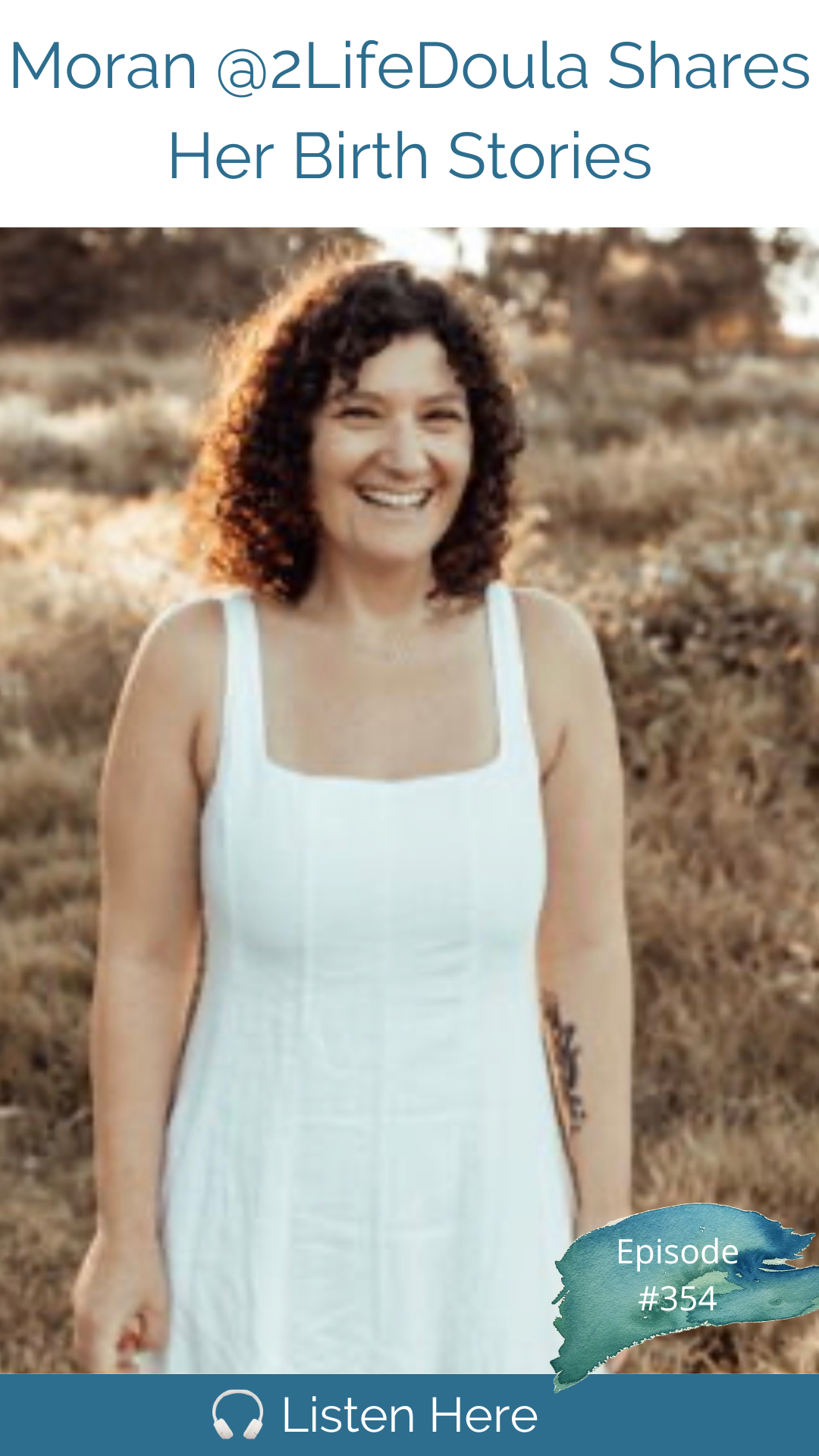
My name is Moran. I’ve got three girls now, aged—one is going to be 22 in a few months. The other one is 17 and a 14-year-old. I am a doula as well. Been a doula for nearly 14 years, and I never imagined that I would step into birth work at all.
When I was preparing for my first birth, I had no idea what birth entailed. I had no idea in terms of what pregnancy kind of, like, looked like. The only book I kind of reached for was What to Expect When You’re Expecting which—oh, no, not that one. Do not recommend. It just did not give me anything to kind of guide me on my way. It didn’t really give me any resources. It didn’t give me any strategies, any tools. It didn’t really prepare me mentally for what pregnancy and birth would look like, and so I really had nothing.
And to be honest, I was 24 at the time, so I wasn’t really seeking out that information. I was kind of—didn’t know much about anything. And so when we found out that I was pregnant, we went to the local GP, who did a blood test, confirmed the pregnancy, and then I had private health insurance. So here in Australia, the model of care is, if you’ve got private health you’re automatically going to be offered to birth in a private hospital. So they don’t—depending on your GP, but most GPs, their first port of call will be to refer you to private healthcare.
And so I had private health insurance, so he basically gave me a list of obstetricians. I randomly picked one off the list. I grew up Jewish, and so I kind of picked the first Jewish name off the list. Not the best thing when you’re kind of looking at big life.
A name you can trust, you can trust. You’re saying that was kind of your upbringing, right? Like a lot of people would err toward what they’re familiar with. It’s not the most surprising.
And that was, I think, that was my comfort blanket. I was just like, “Okay, I’ll just go back to something that I know.” And so I picked this guy off the list. To be honest, he was a big schmuck.
I like that. You used a Yiddish word to describe him, of all things. Schmuck, how perfect.
There were so many women waiting for this big schmuck that I was like, “Oh my God, he must be good. He must be like, a really sought-after obstetrician.”
Well, they were all doing exactly what you were doing. Just exactly picking the Jewish guy, you know, whoever their friend recommended. People pick their OBs like they pick their mechanic or their realtor or their—just, “Oh, whatever. Whoever has good reputation. Okay, let’s go.” Yeah, yeah.
And we’re just going to basically subconscious core belief systems and that. Like, we’re just going to pick what feels familiar, you know? And that’s what I did. I just went to what sounded familiar. And so I probably waited in the waiting room more than I actually saw the guy.
Sounds about right. Sounds very American from our perspective.
Well, it’s very much Australian as well. You don’t see the obstetrician for very long. You just see them maybe for like 10 minutes. It’s a very quick chit chat. They might do a scan, and that’s about it.
And so that’s kind of how I went through the pregnancy. Didn’t really think much of it. Kind of just went with the flow and didn’t really seek out to do any sort of classes or anything. I was going through a private hospital that had sort of like a birthing center unit where you could have a water birth. And in my mind, I was like, “Oh, I’ve got a really good pain tolerance. I’ll just breathe through this one.” And so that was it. That was my strategy.
And so as we were kind of creeping into the end of the pregnancy, I remember having an appointment with him, and he said to me, “Oh, Moran, if you don’t go on your due date, I’ve already booked you in for induction. Not to worry.” And that moment, I started feeling dread, but I didn’t know what to do with it. Like, I was just like, “He knows better than me. He does this every day. What do I know?” sort of thing.
And so I was kind of feeling a little bit of anxiety, but just kind of buried it. It was like, “No, no, don’t worry, things will work out,” kind of thing.
And so I went into spontaneous labor a couple of days before my estimated due date, and the first contraction I had, I had a massive panic attack. Massive. And the reason I had that massive panic attack is, first of all, lack of preparation I had. It was really walking into the unknown. And secondly, I experienced a lot of childhood trauma that suddenly came back to me in that moment, and I was just like, “I’m not ready to have a baby. What am I doing? Why am I having a baby?” Like I’m only—because a lot of the childhood trauma kind of occurred when I was like 12. And I was like, “Oh my God, you’re 12-year-old. Why are you having a baby? Why is this happening?” I was really dissociating from the experience, and I was going into a place of shock.
What did you experience when you experienced the panic attack in labor? What did that feel like?
It felt like a full-blown anxiety attack. I felt like I was dying. I felt like my whole body was shivering. I felt like the situation was completely out of my depth, out of control. And all my body wanted to do was stop it. I just wanted to stop the labor. I just wanted somebody to hold me and go, “You don’t have to do this. It’s okay. We can make this stop. You don’t have to do this.”
And so I looked at my husband—we were still at home—and I said to him, “Call the hospital. Tell them I want a cesarean. I just want this to stop. I don’t want to do this.” And so he did. He rang the hospital, and he said to them, “My wife is requesting a cesarean.” And they said to him, “Listen, we don’t offer a cesarean as a method of pain relief.”
And when he said that to me—what they said—I just felt complete…I felt like I’d hit a wall, and I felt completely helpless. And my support people at the time were my husband, who had no idea what this would look like, and my sister, who experienced the same trauma as I did. So she was—when I looked at her, I saw fear just looking straight back at me.
And so we were just—I was just in this loop. And I describe that a little bit in the book that I just recently wrote. It felt like, you know, when you go up a roller coaster and it slowly clicks and clicks and clicks and clicks, and then you’re at the top, and then there’s no way back. You just have to go down. And you’re just like, “Oh my God, what have I done?” Like, I just can’t go anywhere but down. I have to experience this ride.
And that’s what it felt like. I felt like I was in this stage where no one was going to rescue me, and I just had to go through it. And so that was very bewildering, that was very scary, and that was kind of what cascaded me having a very long labor and a point where I just resigned to, “I’m just going to get an epidural,” because there’s nobody here to help me get through these ups and downs of this emotional upheaval that I’m feeling within my mind—more in my mind than in my body, to be honest.
Because if you asked me to describe what I was feeling in my body, I couldn’t even tell you. It was more my mental load of, “I can’t do this,” that was causing my body to just reject what was happening. So I resigned to an epidural, which I felt was like numbing the emotion as well, which led to that cascade of everything.
And then two days later, my obstetrician walked into the room like the knight in shining armor that I felt that he was at the time, and he said, “Are we ready to have this baby?” And I was like, “Get this thing out of me. I just want it out.” And so without even asking for consent, he grabbed the surgical scissors, did an episiotomy. I didn’t actually know until I was a doula that I had an episiotomy, so I had no idea he did an episiotomy. He grabbed forceps. He took her out.
At the time, they weren’t really aware of the benefits of skin-to-skin. It wasn’t modern practice to do that. It wasn’t standard practice. And he bundled her up, he put her on me, and I thought nothing.
Moran, can I ask you a question before you continue? Well, first of all, in the beginning part of your book, you alluded to the trauma that you endured when you were 12 because your uncle hugged you and your sister and made that comment apologizing. And I think you said something like, “More on that later.” So my first quick question is: did you ever publicly speak about the trauma that you went through, or is that something that you hold private? Because this is a very underserved area.
I just know that I’ve never actually spoken about it. I remember once, many years ago, doing a talk at a birth conference, and it was just when Zoom kind of happened, and I spoke very briefly about it. I’m happy to speak to it now, because I’ve kind of done a lot of processing and work and healing through it. But the trauma was very much holding me back from going forward, and I feel like since then, since supporting clients, I’ve attracted the women that I was. And so there’s been a lot of healing that’s been done, even through my own clients, and even through talking through it and looking back and, in hindsight, looking at the strategies that got me through it has made me the person that I am today.
So I ask because I have worked with clients, of course, who’ve endured sexual trauma. For example, I don’t know if that’s the kind you endured. Women have endured medical trauma, all sorts of trauma. And the reason I ask is that it’s an area that I’m very concerned about, and I haven’t, in my own mind, figured out if I were a doula, for example, or if I were a midwife, the best way to care for those women. Because on one hand I feel—and this is only on one hand—that we should know and understand that; on the other hand, what a terribly inappropriate, invasive question to ask a woman.
And I wonder what the ideal question is even to say, like, “Is there anything about your past you’d like to tell me?” It’s like, no, I don’t know. The answer is right. So how do you identify? I don’t know. The question is: we don’t have one. If we were caring for women in labor as a doula or a midwife, we don’t need to know her trauma. We don’t need to know her story. There should be no part of that that serves the provider.
So then the question becomes: whether we know or not, in the absence of knowing, how—and I hope you’ll get to this in our conversation today—how do we care for those women? How do we have respect for the triggers that may occur, and she herself may not see it coming until she’s in labor? But this affects millions upon millions upon millions of women. I mean, Elena Genevieve, Vladmir, doula, spent most of her career on this very topic, and has attracted tons of women to her workshops, 50% of whom endured sexual trauma as minors. So she’s really, really done a lot of work in this field, and I’m just always grappling with, you know, how does a professional respect the privacy and tend to her better? So do you want to comment on that later on? Or do you want to—
No, I’m happy. Yeah, I’m happy to speak to that now. Well, for me as a doula, because I’ve had hundreds of clients as a doula, when you initially meet them, you can kind of see the verbal and nonverbal cues. If something’s going on, it’s just there. It’s whether it’s in conscious awareness or it’s still in their subconscious, or something that is potentially not a huge trauma, but something that’s happened that had an effect on their emotional wellbeing and their mental wellbeing, or relationship issues, or something. There’s always something there.
And you can be very—like, you kind of act like sort of a little bit of a detective. “Oh, this is how she answered that question,” or she’s holding back with that, or I’ve given her some strategies or tools to kind of practice or do or prepare or look into or reflect, and she’s choosing to do that but not to do that. There’s cues. There’s signals and cues.
And I feel like even though someone hasn’t gone through something huge, they’ve always gone through something. And so we should treat each woman with the same care and the same respect and the same kind of giving them that autonomy to be the adults that they are and make these decisions for themselves and what they feel that they need.
But what I do is I usually—I don’t ask them, “Have you been through something traumatic?” I usually educate them that what happens in the past has a reflection in the birth room. And I kind of let them know that those memories, those stories, the belief systems, are all coming with them into that birth room. And not just for them, but anyone supporting them is carrying baggage that they might not necessarily know about, and bring that into the birth room. And so we need to look holistically at: what have I gone through? What have my support people gone through? So that we’re able to have this incredible experience, no matter what type of experience you have, but you’re coming into it a healed woman. So you’re able to, even if you do kind of get a trigger, a dissociation, or moments of crisis of confidence, you’ve got those people behind you that know how to catch you when you fall. And that’s the biggest thing.
Okay. Do you want to continue with your story now?
Yeah. So for me, after I had my first baby, I spiraled down into postnatal anxiety and postnatal depression, and I really felt that the things that happened, not only in childhood but in my birth, it compounded on the trauma. I felt really helpless. I felt like I wasn’t able to stand on my own two feet. I felt my strength was taken away. And I think it came as a bit of a shock.
So it kind of started off as panic attacks that just started in the middle of the night, and then it kind of came in the middle of the day. And then I used to have this anxiety that was overwhelming, and I didn’t know what to do with myself, and I just felt really helpless, and kind of spiraled into postnatal depression because I felt it was going on for a very long time.
And so I wasn’t really into taking medicine and kind of quieting the mind in that sort of way. And I didn’t want that. That just didn’t resonate with me. Because when I went to my GP and said, “This is what I’m feeling,” he said, “Oh, I think you have postnatal depression. Here’s a script for some medication.” And that was it. And I was like, “Oh, that just doesn’t resonate with me. I want something that will actually help me navigate what I’m going through and give me something as a shining light so I can see the light at the end of the tunnel, so I can breathe a bit easier.”
And so it took my own research to kind of look into a psychologist, a therapist, who would work on me in terms of thought process. And so I did a lot of CBT. We did a lot of EMDR, so working on trauma and things like that. But I didn’t delve straight into the trauma. I delved into what I was experiencing in the here and now before I went back into the trauma.
And then as the years went by, I resigned to the fact that I wasn’t going to have any more babies. I was just like, “No, I’m not meant to. No, I’m not mentally ready.” And so years later, we moved away because we were living in Sydney with my first. We moved away to the Gold Coast, here in Queensland, and then I started surrounding myself with a bit more like-minded women.
And there was this one friend that I had, and we shared our birth experiences, and I said to her, “I really don’t know if I’m able to have another baby. I just don’t know if I can go through that again.” And so she said to me, “Have you ever thought about getting a doula?” I was like, “What’s a doula? I have no idea what this thing is.”
And so I researched it, and it sounded like everything that I could ever want. And so I really craved that maternal figure in birth. I really craved someone who could just hold me and protect me, potentially catch my triggers before I fell, and kind of be there in that sense. And so that was everything that I wanted.
And so when we got pregnant with my second, I hired this doula, and she was everything I ever needed. It was about normalizing birth. It was about working on the mind-body connection that really attracted me to the work. It was, “I have power.” And that’s what really gave me that sense of like, “Oh, you can actually do something. You don’t just have to be a bystander to what’s happening. You can actually be an active participant.” And that really highlighted for me how much I could do, and it made me stronger.
And so I watched birthing videos where my Bible with my first birth was What to Expect When You’re Expecting. With my second it was Birthing from Within. And I was like, “Yes, I’m so ready for this.”
And so the only thing that I did similar to the first experience is that I hired a private obstetrician. And when I look back in hindsight, I was like, that was my safety blanket. I hired him to kind of just in case—what if—kind of thing.
And so he was the nicest guy, gave me a lot of time, really dedicated his time to listening to me and everything like that. But he was still a doctor. And at one of his appointments, he kind of said to me, “Oh, Moran, here’s the consent form to get an epidural. Do you mind just signing that so we have it in your file?” And I said to him, “No, I’m actually not getting an epidural this time. I’m having a natural birth.”
And so he chuckled. He gave a little bit of a laugh. And he said, “Oh, you know, Moran, women in labor, they change their minds all the time.” And I was like, “Yeah, I’m aware of that. I know what an epidural is. I’ve had one before. If it comes to it, I will sign that on the day.” And so he put it away. He was really good about it.
I went into labor on her due date. I remember I woke up in the middle of the night. It was like 3 a.m. I felt something different happening within the body, and I was like, “Oh, it’s probably it. This is probably it.” And so I felt excited. I went back to sleep, woke up in the morning, kept on having contractions. I remember going for a nice walk on the Broadwater. The Gold Coast is right on the beach. So we went for a nice walk, came home, the contractions got a bit more intense.
I then rang my doula to come. She was supporting me through different birth positions. We went for a nice walk, then I felt like I needed to be back home. My waters broke. And then she said to me, “Moran, I think we’re ready to have a baby. Let’s head into the hospital.”
Now my doula, I knew, attended what’s called free births, which I don’t, but she did. And I never imagined even having a free birth, never thought about it, never was—it was not on the radar at all. But the minute that she said, “Let’s head to the hospital,” I was like, no. I was like, “Fill up my bathtub. I’m having this baby at home.”
And so she filled up my bathtub, and I birthed her like 45 minutes later. And it was the most euphoric experience of my life.
Have you had any thoughts at all throughout your pregnancy that you might do that, that you might have that shift in labor? You never talked about it. Nothing has been—nothing, just out of the blue?
Out of the blue. It didn’t even come into my mind once. Never.
Well, that was obviously the right thing. Because when something’s right, it happens like that. You know, it’s like a knowing. “This is what I’m doing.” There’s no other option. It was instinct.
It was instinct, pure instinct. And because of that experience, I kind of awakened to, “Wow. Look what we can do. Look what women can do.” Like, I was high on oxytocin that you cannot even describe. And so that planted the seed of like, “Oh, I think I want to support women in this way.”
And then I kind of left it. I had my third. And my third was actually my longest birth. She was posterior for quite a while. And so I had my third. And then when she was about six months old, I trained to be a doula. And then when she turned one, I attended my first birth, and I was like, “Hooked.” I was like, “Oh my God, I’m hooked.”
And so I started supporting anyone and everyone just to get the experience. I wanted any birth. I just wanted birth. I just wanted to attend it all the time.
And so I started—you have a tendency, I don’t know if that’s been the case for you girls, but like when you kind of attract clients that really resonate to your energies—and so I started attracting clients to me that were highly anxious, have gone through something, need a lot more mental, emotional support.
And in the beginning, when I didn’t have—because it took a little while until I did a HypnoBirthing training and Lamaze and I got all this education behind me. And just attending birth was the experience in itself.
And so I started seeing a pattern in the women that weren’t doing the work. I started seeing them go into their birth and the birth be so much more challenging. It was either long or it was hard, or there was kind of dips of emotional breakdowns. And I only saw it in the women that weren’t doing the emotional and mental work in pregnancy, or they haven’t even done it before pregnancy.
Sorry to interrupt you. Are you talking about the work of prepping and preparing for labor and getting educated, or the work of working through their trauma beforehand?
Both. It was actually both. It was like these women were walking into birth with so much baggage that you can see it in how they held the contractions. You could see it in their face. You can see it even in the vocalization that they did. And I was like, “Oh, this is really interesting.”
And the women that did the work—and you could see that they were doing the work because I was seeing them in so many prenatal sessions, I was debriefing with them, seeing where they’re at, where their headspace was at—these are the women that have the easier labors.
The ones that were just coming in with so much unprocessed, unhealed trauma, the ones that were holding potentially their support people on top of them that they were so worried about them, the ones that weren’t doing the birth prep, they were just—like, you know, doing their HypnoBirthing techniques, but they’re so relaxed, so like, it’s definitely working. But what if you’re faced with a physical stress? Or how are you going to relax? Then these are the women that I saw facing so many challenges in the birth space. And I was like, “Oh, this really reminds me of me.”
And so when I started seeing this pattern, as I kind of—probably four or five years into becoming a doula—I did so much more education around sexual trauma and emotional trauma and mental trauma, that anything that this woman has gone through her life, even relationship issues, anything, domestic violence, all this stuff, she was bringing it with her.
And what I was seeing is that the women that did have those things, and did certain things—which I call in my book kind of the Essential Ten—they didn’t have to use all the Essential Ten, but they were using aspects of the Essential Ten. Their birth was suddenly beautiful. They were suddenly empowering. They suddenly felt strong. And they walked away from it looking at it as such a positive experience.
And so I was like, these are the things that I did. And so I reached out a couple of years ago, and I reached out on Instagram, and I said, “I would like to interview women who’ve had any trauma throughout their life, not just birth trauma, and I would just like to interview you for a project that I’m doing.” And I got many responses, from everywhere, from all over the world.
And so I started interviewing these women, and then I kind of asked them certain questions, and I wasn’t leading the conversation. I was just letting them share their stories. And the same patterns emerged. They were using some of what I call the Essential Ten to get the experiences that they wanted, these healing, beautiful experiences, even though they’ve gone through some really big stuff.
So in the book, I have women who’ve had a loss in their first pregnancies, or experienced sexual violence, or had—intergenerational trauma. Like, there were so many diverse stories. And what enabled them to have these kind of empowering experiences is doing the work. And that’s where I feel women are not really understanding, just like I didn’t when I was 24, that you need to do the work.
So without giving away everything in your book, can you share with us a few of the Essential Ten?
Yes. Okay, so a couple of the Essential Ten. One is safety. So what usually in our conscious mind we equate to safety might not be what the woman equates to safety.
So my safety, as you could see from my second birth, instinctively, was: “No. If I go into the hospital, I’m no longer going to feel safe. I want to stay at home.” Okay, that’s my safety.
So safety is really, really important. So one of the things that I found was a pattern in women’s stories is that they really took a deep dive to look in pregnancy as to what equates to their safety. As in: where am I birthing my baby? How am I living my life? Who am I requesting to support me so that if I feel like I’m no longer safe, I can look at that person and they will resonate safety to me.
And oftentimes women just assume and equate safety with hospital and OB, and they don’t really go much further than that.
So yeah, that might feel like the first easy access to safety.
Oh, 100%. And I’ve had women who thought that home birth equated to safety for them, and then all the things that they were saying in our prenatals were like, no, no. But it actually reassures me that the hospital is so close by, or—and you can read between the lines of like, no, no, the home birth is not what equates to her safety.
And then we might have where labor doesn’t progress, or things halt or stop, and then we need to move to a hospital environment, and then she just goes and has a baby.
Let me ask you a question on safety, because when you’re talking about it, your first birth is coming to mind for me. When you went into labor, you were like, “That’s it. I want a C-section.” So would you say that in your first birth, the C-section, or avoiding a vaginal birth, equated to safety? Or would you go so far as to say you were not in touch with your instincts, that neither was the route of safety? How do you make sense of that?
I was so disconnected from my instincts in my birth. Like, I was so disconnected from what I really needed.
And I remember—and I mention this as well as a story in the book—I remember probably around 35 weeks I went out to a restaurant with my in-laws, and we were all having dinner, and then something in me just didn’t feel right. I felt like this intuition going, “Oh, something’s not feeling right.” I went to the bathroom.
And because in my childhood, I was always told by my dad, like, if you’re feeling weak—weak is something that you just put to the side. You just don’t talk about it. Just put it to the side. You’re not allowed to have panic. You’re not allowed to have weakness. You just have to be strong all the time.
And so I remember I went to the bathroom, I kind of said to myself, “Get yourself together, woman. You’re about to be a mother. This is no time for bullshit, okay? Like, you need to just get yourself together.”
And so I feel like I had moments where my intuition was trying to tell me, “Listen, woman, there’s some things you need to kind of process and deal with right now. This is obviously not the route that’s right for you.” But I was like, “Not, not. I don’t need to listen to that.”
And so I was definitely disconnected. So cesarean was not my safety. That was never my choice. That was not something that I needed.
But as well, like in my second birth, I knew that my sister was not the correct person to be in my birth. So my sister still did not process her trauma, still did not do the work around therapeutic healing or anything regarding—she just kind of put it away and locked it in a box and kind of go, “I’m not dealing with this today.” And so I said to her, “I don’t think you’re the best person to be with me in this birth.” So that was a really hard decision, but a decision she accepted with full love.
But I needed to be selfish at that point and say, “What will equate to safety for me?” And that wasn’t her, you know what I mean.
So it makes sense. Yeah, 100%. You really need to think of yourself.
The other thing that I kind of mention as the Essential Ten is resilience. Women seem to think that they’re kind of lacking that, and so all of the Essential Ten essentially doesn’t work if we don’t actually believe that we’re worthy of it and that we’re resilient to achieve what we want.
And so resilience isn’t about being strong. It’s about looking at things that we’ve gone through and saying, “I went through that, and look at me. Like, I’m still standing.” Like, I’ve got so much history to back it up and to show myself that I can do it.
And women are kind of—we’re shutting down their resilience with potentially like doctor’s appointments that tell them, “No, no, I do this for you. Like, this is how this is going to be managed,” and all these messages of like, “You’re not resilient.”
And so a lot of the women—like most of the women that I spoke to—were just so resilient. We build this resilience through the things that we’ve gone through in our life, the challenges we faced, everything that we did to get to this point, and we need to build that tool, that really important tool.
Other things that I talk about is oxytocin. Like I find, especially even with women that haven’t gone through anything, I find that we tend to kind of go—and again, this is societal pressure, it might be medical pressure—to go into labor by a certain date.
And so we’re ticking all these boxes of like, “I’m doing the osteo, the chiro, the acupuncture, the dates,” all these things. But we’re actually not having oxytocin moments. We’re not having these love-bomb moments throughout our day. We’re not actually looking within and kind of going, “What actually makes me feel really good, makes me feel really trusting, makes me feel really loved?” These are the things that I really need to be doing in the later stages of my pregnancy, because those are the things that are going to get me into labor. So I kind of walk you through all of that.
And I also talk a lot about doula support because obviously I’m a doula, and I’m a bit biased, but a lot of these women that I was interviewing, they had a doula, you know what I mean, or they had support. That was monumental support.
And I kind of differentiate between the support that you’d get from a doula compared to the support you get from a friend or a family member, again because they’re bringing their stories. They’ll be well intentioned to kind of give you what you want. But there’s a huge difference between sympathy and empathy.
If a woman hits kind of a pain point or a crisis of confidence moment, or she’s hit a wall, if she’s looking at her crew and she’s looking at her people that she’s chosen for support, a woman tends to kind of scour the room for her weakest link. And if her weakest link is kind of going, “I’m running out the door and getting you help,” then that might potentially not be what she needs if she’s trying to have an unmedicated experience.
There is actually research to support that. Yes, there are major studies that show the difference between a doula and, say, just even a labor and delivery nurse being there and supporting—which is still far better than no one there—being there and supporting. But the outcomes are much more significant with a doula versus just a nurse.
And I also want to add: that’s the reason that I didn’t have my own mother, the closest female to me, at my birth. And she and I mutually understood why that couldn’t be. And the language I like to use is that she just loves me too much. She loves me in that maternal way.
And not only that, there’s another half to this that I think we neglect to acknowledge: that I would have been taking care of her. I would have been looking at her saying, “I’m okay,” or “Don’t worry,” or “How’s my mother doing?” You can’t have that in the room. You have to have liberty to not be concerned about taking care of how someone else is feeling.
So she and I both understood she belonged behind one wall, like very, very close, the first person to walk in the room the minute a baby slipped out of me, each time, at my birth center birth and at my home birth, but absolutely not in the room, because I would have seen that little knot in her eyebrows, that little worry that she could not melt away. She just couldn’t get rid of it. So not the right choice.
Okay, do. And also I will—I also want to say that I’ve worked very closely with doulas for years, and I’ve noticed, and maybe you have too, there’s an incredibly high attrition rate, turnover rate, with doulas.
Women who have beautiful births, and they go into the field of doula work because they want to spend their lives—who doesn’t—being inspired by the beauty and miracle of birth, and then they have a very rude awakening to how brutally difficult the work is, and observing things where they ultimately see their hands are tied, witnessing abuse sometimes.
And I knew a doula who absolutely—and this is nothing against them. I would probably be among them—could not handle doula work. They were not cut out for doula work, and respectfully, had to bow out.
And I think it comes down to not only character, but boundaries. I knew a doula once who would sob after births, and it was like, okay, this wasn’t your story. You were witness to something difficult. But if you make—and I’ve heard professionals sometimes say, like, about the babies, their affection towards someone else’s baby, they’ll sometimes say things, “I mean, that’s my kid.” I’m like, “That’s not your kid. That’s her child.” Like, I knew a sleep expert who once said that. “I mean, these are my kids.” I said, “No, they’re not your kids. They’re your clients’ kids.”
And I really think having that appropriate boundary is a very important part of the work as well. Have you anything to say about that, witnessed anything similar?
Yeah, definitely. I think when I first initially started, it was hard to not take their stories on board. But then I felt that it really played a toll on me emotionally. So I was just like, “No, I need to find a way to kind of disconnect their story to mine, and even the choices that they make,” because there are times your clients will make choices that you would never consider.
And so it took a lot of self-reflection and work, but today I feel like I’ve got it down pat.
And I’ve experienced situations where there has been loss and situations where I’ve witnessed birth trauma, and I actually mention one of those situations in the book. And that was a really big eye-opener for me, because I kind of moved away from just being the doula in a room to also advocating.
And I know there’s a lot of kind of conflicting opinions about doulas actually advocating, but I think when you do it in a respectful way, where you help the woman to have a voice, then it can speak volumes to how that woman experiences what she does.
And so I could no longer be a bystander to obstetric violence, to coercion and things like that. And I felt like if I’m just sitting here doing nothing, then I’m complicit in what’s happening right now.
And so I kind of gave these women a voice of asking the questions, respectfully, saying what she wants, respectfully. And I’ve never had any issues because most of the practitioners here are happy to work with me because I’m not there to sabotage a birth. I’m there to just give these women autonomy in owning their birth, so that they’re able to feel like they’re walking into a room and able to be there fully and not feel judged or intimidated by what’s going on.
I knew a doula who said to me once that she was really struggling with feeling angry when her clients didn’t take her advice, and I remember saying to her, “I’m sure that would be incredibly difficult.” I mean, as an educator, I’ve gone through similar experiences where women are going against what they believed they would do. But I remember saying to her, “If you’re feeling angry, then it feels like you’re forgetting whose—what this is. You have to respect the woman enough to recognize she is wholly responsible for her birth.”
Yeah, yeah. And that’s how you have to look at it.
Like just a few weeks ago, I had a mom who only discovered at 40 weeks that her baby was breech. And so the choice was: do I do a breech vaginal birth, which they were actually pretty open to at the hospital, but they said to her, “You can also do a cesarean.” And obviously, we all want—because she already had a vaginal birth before—we all want her to experience vaginal birth again and not go through major abdominal surgery.
But I said to her, “There’s no wrong choice here. It’s whatever makes you walk away from that birth feeling amazing that you’re able to step into motherhood feeling holistically healthy.” And so I gave her all the information on both sides of the spectrum, and then she made the decision that was right for her. But we’re never there to sway them in one way or another. We’re there just to guide them and show them the beauty of both ways.
The job of the doula is to support the mother. If you’re supporting the mother, you’re supporting whatever it is that she needs, wants, feels in that moment. And if you know in that moment that she’s making a choice that doesn’t align with what you believe she wants, you can gently remind her of that, but it’s still her choice. It’s still her choice, and you can’t be mad about it. You support her. Your job is to support her.
I think we have to be careful not to get too hung up on the intellectual part of birth, and that’s really something that’s happening today. Like the laundry list of things that you have to do to get ready to have a baby—the list is getting longer and longer and longer. And more and more people are becoming aware of it because it’s everywhere now, and social media, of course, is spreading this like wildfire.
And that does get you away from just embodying yourself as a pregnant woman and allowing that trust. Really, we’re kind of breaking down trust by getting a little too hung up on the list of to-do’s that, “If I do these things, birth will go right?” Yeah. It’s not how it works. Oxytocin requires us to feel safe, calm, connected, not stressed, in our right brain, not in our left brain.
Yeah, yeah. Well, people forget that the effect of feeling trust—which is how the oxytocin is secreted in the body—causes the cervix to ripen. It causes everything to happen.
And sometimes we want this shortcut. “Well, how do we make the cervix ripe?” Oh, give it prostaglandin gel. “How do we open it?” Give it a balloon catheter. You’re forgetting that what matters is to stay way, way, way back. Like this whole biofeedback system in the body, where about 100 things are actually happening. This is just the effect we see, and we recognize this softening and opening needs to happen for the baby, but we can’t ignore all the little steps that got us exactly to that point.
And it isn’t as safe and it isn’t as blissful, and it’s a completely different experience, which is why I don’t know if this is happening in Australia, but it’s completely offensive to us that we hear a lot in the United States that in hospitals, they have the nerve to refer to Pitocin—and I know you call it Syntocinon—in Australia, they use the term interchangeably with oxytocin. In the hospital, they’ll say, “We’ll give her oxytocin.” I’m like, how are they going to give you oxytocin? Are they going to love you? Are they going to hold you and stroke your hair? What are they really giving you? And I think that’s an injustice, because it’s just perpetuating this myth that we can just create it and inject her with it.
Yeah, yeah, definitely.
And I do agree that women where they’re like, really long checklist of things to do. But I feel like social media is really perpetuating these kind of messages of like, “You got to do this, and you got to do that, and your baby’s got to be in optimal positioning. And if it’s not an optimal positioning, then this is going to happen,” and they’re walking into birth with all of these different messages, and that is just holding them back. And so it’s overwhelming.
Totally. To bring it back to the parallel of sex, it’s like, what if you had a laundry list of 20 things you had to do before you got ready to have an orgasm? Like, how easily is that going to happen? Check off all these boxes. Make sure two days beforehand I’m doing this. Two weeks beforehand I’m doing this. I mean, if you get into your head that much, you know that sex isn’t as good. If you can relax into your body and be in yourself and in your body and trusting and let that thinking brain go a little bit, it’s going to be a much better experience.
Yeah, even tell women that, because we do a lot of HypnoBirthing and birth prep, and like I said, we do a lot of work pre the birth. And so I kind of tell them, around 35 weeks, let that all go. It’s time for you to just—instead of do, just be.
I tell my same thing. They contact me at the end and say, “I’m doing this. I’m listening to my scripts. I’m practicing the breathing.” And I always say to them, “Stop doing all of it. Trust that you’ve done enough. You’ve already done 1,000 more things than any ancestor you’ve ever had.” Yeah. It’s time to let go.
And that’s exactly the message they need, definitely.
So can I read an excerpt from your first chapter that really struck me and I would like you to speak to? Because I think a lot of women will relate to it, and it’s painful. It’s not a pleasant thing to read. But I just think women need to know they’re not the only ones who have this experience.
You did mention the postpartum depression that followed your first birth. There is obviously a link there. This is the paragraph that I really thought was beautiful, but also just not said enough and not discussed enough.
“Yep, the end result of that was a numbness I don’t think I could ever fully describe. Was this birth? It didn’t feel like it. There was no surge of joy, no cinematic moment of triumph, just silence inside me. I didn’t feel power or love. I didn’t feel anything. And if I’m honest, the only thing I did feel was relief that it was over, that the struggle had ended. But even that relief came with guilt, like I’d missed something important, something I was supposed to feel but didn’t. I’d crossed a threshold that was meant to be sacred, and instead, I felt hollow, like I’d been a spectator to my own experience.”
Yep, that’s exactly how I felt. Goosebumps. Yeah, it was exactly it. It was just—I think about that woman, and I just feel like giving her a big hug and going, “It’s okay. You got through this, and there’ll be other powerful moments in your life. I know this is not what you imagined.” Right?
But it was that moment. I felt nothing. I felt numb. I felt this disconnect from what I was experiencing. And I kind of—the only education I had around birth was things that you see in the movies, and women, like so happy they have their babies. And I was like, “Oh my God, I was totally robbed of that.” And I felt immense guilt for being robbed of that.
And my daughter, my firstborn, read that chapter, and I felt guilt over her reading that chapter, kind of like she was viscerally feeling me, and kind of going, “Oh, I’m so sorry I did that to you.” And I was like, “Look at what you did to me. You made me a powerful woman today. Everything that I’ve done is because of you.” You know what I mean.
And so, yeah, I think I had to go through that experience. I feel like we go through lessons in life that bring us to where we are today. If I didn’t have the stuff that I went through in my childhood, I wouldn’t have had the resilience and courage to show up every day for myself and experience the birth that I had with Bella, which taught me so much about myself and has really set the path for me to how I guide women today.
Like, when I go into birth, I hold them with so much love that they are so loved-bombed. But I want them to feel that I am the gatekeeper for them, so that they can let go and release and they can feel safe. And I constantly remind them that they’re safe in their choices and how they feel and their emotions.
I just had a client recently say to me, “I’ll probably be your first client who cries throughout the entire birth.” I said, “I welcome it. I welcome your crying. Like, this is what we want. We want you to feel so vulnerable that you’re able to let go like that.” You know? It’s totally okay.
And I kind of live my life, and I kind of support the women that I do as a doula based on that experience. And when you read it back, I was feeling it because I remember it. And it was hard. It was so hard. Like, I just didn’t know what to do with myself.
I felt really—and I don’t know if you read the part where my in-laws came in 10 minutes later. Yeah, my husband never did that mistake again. But yeah. And I remember when my in-laws walked in, and my mother-in-law—she is quite a strong woman, this Italian mama who’s gone through a lot of stuff in her life—and I was like, “No, don’t cry. Hold it together. You’ve got the job of mothering now. Like, there’s no time for this.” So I went straight from that into mothering, which was a challenge in itself.
It’s a portal no matter what, and we always think of that as being this magnificent transformation, and this portal into ecstasy and bliss. And it isn’t obviously always that. But even when it isn’t, it is still a massive portal transformation into another version of yourself that eventually finds its way, and your story is a perfect example of that.
Yeah, yeah. I totally believe that it does, because it did that for me. Like, I know that it does that for a lot of women because I’ve seen it. But it definitely did that for me, and I feel that, again, like I was supposed to experience it for a reason. It was part of my journey.
Why did you write your book?
I felt like I wanted to write my book to help other women if they’re not able to access private education, not able to kind of source out a doula, not able to kind of be really open with their partners or their friends. I wanted to write the book for those women, especially.
And when I started writing the book, I remember I said to my husband, “Where do I start?” And he said, “Just start writing. Write the book that you would have wanted when you were 24, going into that first birth.” And so that’s how I wrote it. I wrote it as a book that I would have wanted to hold in my hand as my Bible, and look through the pages and kind of go, “Oh my God, I’ve got so much I can do. I’ve got so much power.”
Because that’s what I want women to feel when they close that book. I want them to feel like they’ve got choices, like they’ve got power, like they’ve got autonomy, like they’ve got a direction forward, and that they’re not helpless. Like they’ve got so much that they can do, and that’s what I needed. I wrote the book for me when I was 24. That’s the book that I’ve written.
Yeah. Am I mistaken in saying I think this is a really underserved area, though? Women who’ve suffered any kind of trauma. I personally haven’t seen a ton of it. I know there’s thousands of books. But what did you find? I really don’t feel this was—I don’t think this is out there that much.
Yeah, I’ve read a lot because I’ve got a huge library of pregnancy and childbirth books, and I felt like this was lacking in this area, because the ones that refer to trauma were only referring to birth trauma. And so I was like, “Okay, but what if she’s gone through other stuff that’s not related to birth? This is her first baby.” And that’s what happened to me.
So I wanted to kind of bring that into more awareness of like, what you’ve actually gone through in life has an influence on how you birth, and that portal of where do you go out of it do.
Thank you for joining us at the Down To Birth Show. You can reach us @downtobirthshow on Instagram or email us at Contact@DownToBirthShow.com. All of Cynthia’s classes and Trisha’s breastfeeding services are offered live online, serving women and couples everywhere. Please remember this information is made available to you for educational and informational purposes only. It is in no way a substitute for medical advice. For our full disclaimer visit downtobirthshow.com/disclaimer. Thanks for tuning in, and as always, hear everyone and listen to yourself.