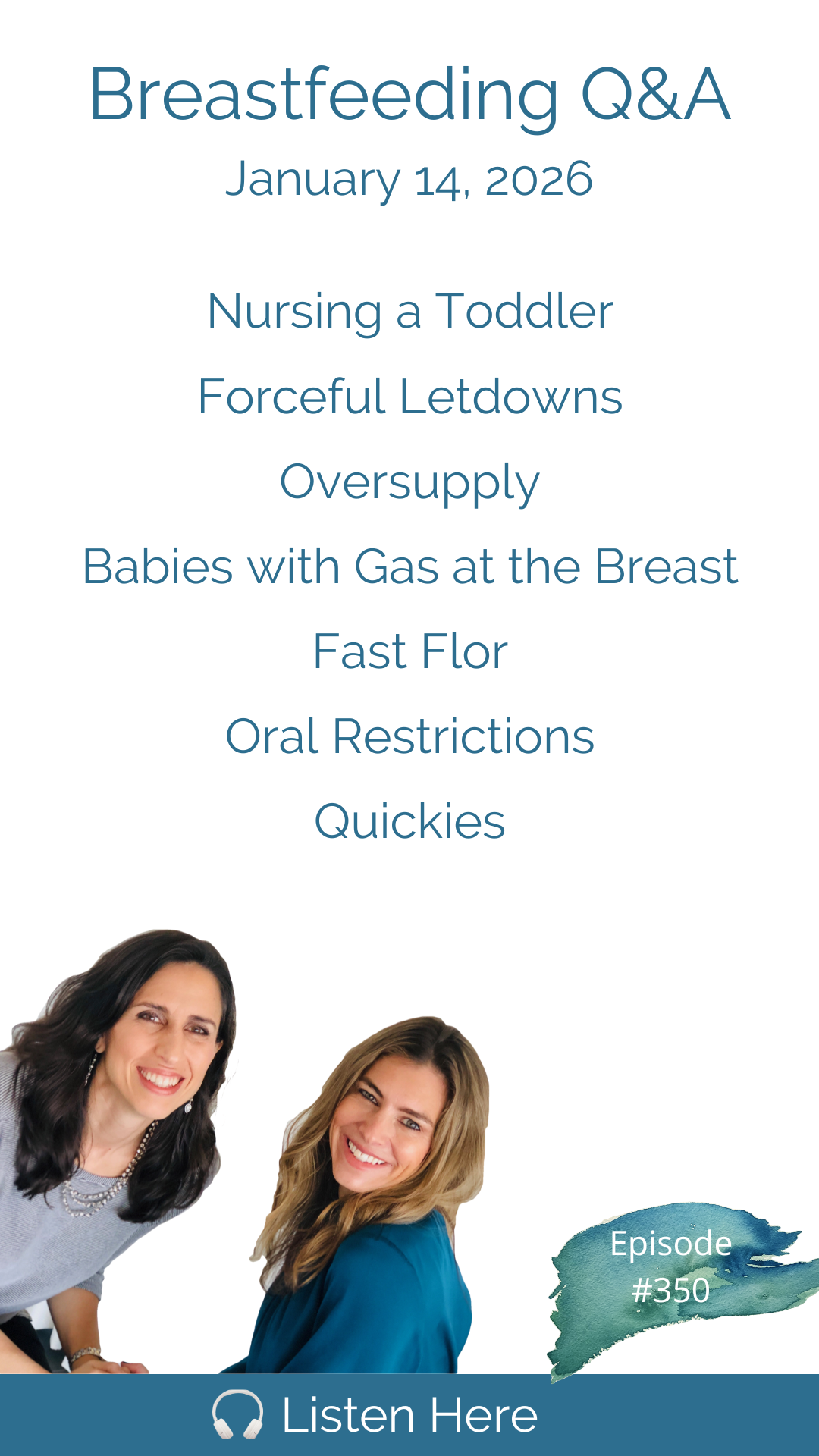
In today’s breastfeeding Q&A, we take calls from mothers facing the challenges that often arise well beyond the newborn phase. We begin with a question about nursing an eighteen-month-old who lifts his mother’s shirt the moment she sits down, and what healthy boundaries can look like when a toddler is still deeply attached to nursing. From there, we address concerns about forceful letdowns, oversupply, pumping routines, and the role of pacifiers when feeding becomes overstimulating for the baby. We also take a call from a mother with a three-week-old who experiences gas and discomfort at the breast, and we discuss the differences between oversupply, fast flow, and the possibility of oral restrictions. Today's conversation highlights how individual feeding dynamics are and why a tailored approach is always necessary. Thank you for your thoughtful questions and for your continued support of the show. To submit your questions for a future episode, call our hotline at 802-438-3696, that's (802) GET-DOWN. ********** Needed <-- this link for 20% off your whole subscription order Join Patreon for our exclusive content Call 802-GET-DOWN Watch full videos of all episodes on YouTube! Please note we don’t provide medical advice. Speak to your licensed provider for all healthcare matters.
DrinkLMNT <-- this link for FREE 8-day supply
Primally Pure: ingredients good for you and the earth. Promo code: DOWNTOBIRTH
Postpartum Soothe: Organic herbal padsicles for healing. Promo code DOWNTOBIRTH
ENERGYBits: <--this link for 20% off
IG @downtobirthshow
I'm Cynthia Overgard, birth educator, advocate for informed consent, and postpartum support specialist. And I'm Trisha Ludwig, certified nurse midwife and international board certified lactation consultant. And this is the Down To Birth Show. Childbirth is something we're made to do. But how do we have our safest and most satisfying experience in today's medical culture? Let's dispel the myths and get down to birth.
All that, I got it, I got it. Yeah, you're a pro. I've done this before time or two. Okay, how you doing?
Well, I am, okay, pretty good, yeah just the usual mom stuff yeah, just little extra usual mom stuff. I mean, you thought it would be so easy when they went to college. I went to college, all will be fine. But, you know, just navigating a few things, and you My lady, have been very busy, very busy playing pickleball these days. What the heck I played this morning?
It's has sucked you in.
It's, it's just too much fun. It's so much. People love it. The craziest thing happened at pickleball, yeah, oh my gosh. So I started playing, you want to match? Haha, thank you so much. Yes, I did. That's not the point. Okay? So I started playing in summertime with lessons, you know, in summertime, and then we had to move to a place in Norwalk indoors for the for the pickleball clinics now, and this really nice couple joined. She had played tennis before. He had never played anyway, we were playing a couple weeks ago, so I've gotten to know them a bit. They're really, really nice, they're fun to play with. And she she was returning a ball, and she fell over and grabbed her leg, and she was like, oh, ow. And something in her, she said, in her calf popped so she couldn't even walk off the court. Her husband had to hold her, and she hopped off the court, and we all gathered around. It was terrible. And we told her, like they were telling her, like, which hospital to go to. And maybe it's this, maybe it's that they have three young children, so it's just, like, so unbelievably unfortunate. And while I was sitting there with her for a little while, she was like, Just this weekend, I was telling someone, I play pickleball, and the person said, like, be careful. You don't pull a calf muscle. And I, obviously, I couldn't help but have the thought like, what beliefs I mean? I didn't want to I was that this was no time to tell her, her subconscious mind did this to her, and obviously coincidences can happen. So that was so terrible, and he drove off with her. He took her to hospital. They checked it. He came back alone, and that was on Monday. He came back alone without her, and we asked about her, and he's like, yeah, she's gonna have to keep off of it. By the way, they have a family trip to Disney planned in two and a half weeks, so such a bummer. And anyway, he's here to play without her, and you're not gonna believe this. You're really not gonna leave this. We were playing with him. He tore his calf. He tore his calf. He hit a ball to me, he hit it. He wasn't even chasing ball. You guys are wearing the wrong shoes. Maybe they're wearing the wrong shoes to play pickleball
anyway, he the same exact thing happened to me. Wow, hobbles off the court, and one of the other women there drove him all the way back to Westport, drove him home because he couldn't drive we were all standing there, like, just wait till you tell your wife. Like, just wait till she gets that phone call. Like, now, I pulled a calf, doesn't it? Does every woman in the world not relate to how angry she would be rather than sympathetic? Like, Oh, of course, you pulled your calf muscle right after I pulled mine. But anyway, it does really make one wonder if it just got into the brain, like, if he came there thinking, Oh, my God, it would be terrible if the same thing happened to me. So the thing that really got me was the guy leading the clinics came over. He's a great player, an older guy, probably 60 something, and he said, I've played for years. I've never even heard of anyone tearing a calf muscle in pickleball. It's always the Achilles. So isn't that a crazy story?
That is crazy. It sort of reminds me. Do you remember when I told you when I when we went golfing on Mother's Day, when I took my kids to the driving range, and we all were hitting balls at the driving range, and nobody in my family is really much into golf, but I had a set of new clubs, and I'm trying to learn how to golf, and Ruby broke my driver, or she hit a ball so hard that she broke the head right off the brand new driver. I had actually never used it. First time using it, she broke the driver, and I was giving her such a hard time. Of course, I'm like my mother's day, my brand new clubs. I've never used the driver before. You broke the head off my driver. Like, what the heck? Like, who does that breaks the driver? Right? Okay. So sweetly for my birthday, Paul purchases me a new, even nicer driver.
So don't tell me you let Ruby pick that one up and play.
No, no. Ruby's off of college now, okay, so I'm working on my golf swing, and, you know, working out the driving range. Lo and behold, No, all right, I break the head off the brand new, very expensive driver. Yes, now that happened to other guys. I don't know. I didn't think so, but apparently it does, because I took it back to the store and I thought, you know, if I'm sweet and nice enough, maybe, just maybe, they'll fix it for me. And the guy was like, oh, yeah, no problem. Let me just see if we have another one here. You can just take a new one home with you. Oh, literally, gave me a brand new driver. And I'm like, Really, it's that easy. It's like, this, I can just, he's like, yeah, if it's within two months of purchase, you can just have a new driver. And I was like, so I can break the driver as many times as I want. I'm gonna come back here and you're gonna keep replacing it in the next two months, if it's within two months, don't tell anyone I said that, but sure, wow. So yeah, you know these things get in our mind, an they were wild.
Yeah, okay, let's, let's get into our questions.
Yeah. Hi. This is Ali calling in from Ontario, Canada. I'm love your show. I'm a doula, and I'm training to be an ibclc, and I have learned so much from your show, and it gave me so much confidence in my first birth. So that sort of leads me to my question, we never really got the hang of breastfeeding. I exclusively pumped for a while. When we finally did get the latch, i He bit me, and I just got really nervous, so I just went back to pumping. I stopped at seven months. So now that I'm more knowledgeable. I'm really planning to do better with my second and get to my goal, which was a year. But I was just wondering if I were to pump and create a bit of an oversupply. My first baby will be two and a half by that time, so I was wondering if it will be beneficial for me to pump a little bit extra and give it to him. He's already on solids and whole milk that I just wondered if that extra nutrition from the breast milk would do anything by that age. Thank you so much, and thank you for the show. It's amazing. Bye.
Well, there's no age limit at which breast milk no longer becomes nutritionally valuable. It's always good for anyone. You could drink it as an adult. There's these men out there today that are using breast I don't want to hear the rest. To hear the rest of that sentence. No, like they're drinking their wives breast milk, pump up their
muscles. Told you I didn't want to hear those. It's just food. I don't anyone else bedroom. Yes, it does. It sounds really weird. If you knew the man, do you know a man who does that? No, I do not. If you did, I don't think you'd be willing to say his name, because it is weird. I mean, in the in the intimacy of a couple, if they do something like that, that's their business. It's
not mine. On the podcast, not drinking it from the tap. They're just like, literally drinking the pumped milk, because it's so rich in, you know, immune properties and fat and, you know, breast milk is very nutritionally dense, very so pointed anyway.
What I wish? I think women get really attached to the idea that breast milk so miraculously changes with the age of the baby. So I think they get very concerned about, like, what if they're drinking the wrong milk at the wrong time? Never mind the grown men drinking milk.
There's no wrong milk at the wrong time. Yes, it changes to meet the baby's growth needs, but the milk is never wrong at any age or any time. All I mean to say is that breast milk is always nutritionally valuable. It's a food in the same way that any chocolate milk is a food. Chocolate milk is a nutritionally valuable food, our endless opinion, ou endless debate that only longtime listeners have heard us talk about so but was that her question?
No, so that was just the that was just the preliminary answer to the question. The question is, should she pump extra to provide for her two year old, and if her intention is to breastfeed this new baby, which it sounds like it is, because she was more on a pumping routine with the first baby, and she wants to breastfeed and keep her baby on breast milk through the first year, which is a great idea, and I think she absolutely should, because breastfeeding is definitely easier than pumping and bottle feeding for a year, the risk You run with producing extra milk is the oversupply symptoms that can happen in the baby. So you really don't want to be producing a large amount of extra milk above and beyond what the baby is taking at the breast to provide it for the toddler, because then you could potentially have oversupply issues like plug ducts and gassiness and fussiness and for milk feeding and all that stuff. So if she wants to store little, my recommendation usually is to store one to two ounces a day. If you want to give that to the baby, you want to make a bath with it. You want to give it to the toddler. You want to give it to your husband, I don't care. Give it to your best
friend, whatever you want to do but drink it yourself, whatever. Yes, I'm open.
You can tell you're open, far more open than I ever knew, but
don't create an oversupply. That would be my advice.
Hi, ladies. First I wanted to say thanks for your show. Thanks for all you do and all the love and support and advice you give all of the women in this world. My question for you guys is, I have a nearly 18 month old who loves to nurse. He's been exclusively breastfed and then started solids and does great on solids. Still loves to nurse. I don't plan on weaning anytime soon, but I'm curious if you have any advice on or give any boundaries to nursing toddlers. He likes to lift my shirt as soon as I sit down or lay down. He, I think he a lot of the times, just likes to nurse for comfort or for he's bored. He's still night nurses, and I'm still okay with it. I'm just curious if there's a way to kind of establish boundaries and establish just kind of a expectation there for that makes both mom and baby happy. Thanks for all you guys do.
I think the key thing she said there is that setting boundaries that make both mom and baby happy, like if she's happy, there's no boundaries that need to be established. It's fine. You just keep nursing. I mean, babies around the world nurse until three, four or five years old. It's a lot less common in the United States and in most sort of modern, civilized countries. It's more like 12 to 18 months, maybe up to two years of age, that children are nursing. And 18 to 24 months is a time definitely when toddlers are looking to assert themselves in various ways. So the lifting of the shirt is probably a little bit of a way of a toddler being like, hey, look, you know, I can just do this when I want to do this. So if that makes her uncomfortable she doesn't like it, then sure she can set a little bit about of a boundary there and just simply calmly say, you know, we you can, you can establish a place where you breastfeed. So maybe if you know you're in the kitchen and the toddler is lifting your shirt, coming up to you and lifting the shirt, whether you're cooking dinner or sitting at the table, you would simply say, you know, we don't do nursings Here. We don't do milkies Here. We do milk on the couch, or we do milk in the bed, or we do we're going to wait and do that at bedtime, just consistent communication about when it is okay or not okay to nurse. Maybe the toddler is just thirsty, and you can offer water instead. You can offer a substitute if you don't feel like breastfeeding in that moment. But there isn't any hard and fast rule on this, and I think it is easiest to set the parameters when you feel that you need them so you don't have to preemptively set them.
The main thing that affects women is their awareness of the judgment of the people around them.
Yeah, so that's where you set those kind of soft but consistent boundaries, where you the toddler can understand we don't have milk time here, when we get in the car, when we get home, when we have a nap, you can pick whatever it is you want to say, then that's when we will have milk time. If you just let them do that over and over, they will continue to do that. If you're okay with that, fine. Some women are totally okay with that. They will just nurse wherever, however, anytime. But if it is makes you uncomfortable, then that is an opportunity to set a gentle boundary with them. I think she just was asking like, do I need to think ahead and start setting boundaries in advance of it potentially getting uncomfortable? And I don't really think you need to do that. You can establish routines where, like, oh, we nurse after we have a bath, not before, or we nurse before we go in the car, not when we're out. Those are kind of setting routines, not strict rules which is easier with an older child. You can't do that with a baby, but you can do that with a toddler. Yeah it's 18 to 24, months the time frame we're in, not with a baby. You got to just nurse them anytime, anywhere when the baby needs to eat, the baby needs to eat absolutely.
Hi, guys, I just got a question. So my now 12 week old has started to reduce the breast because she gets too much milk and still wants to suckle. I have a really aggressive letdown, so she only wants to pass you, and I never use the passive with my first and I'm just kind of not sure what to do. But it's one of those things where I feel like I either let her use the Passy to fall asleep, which is really just for nap time, and only takes two or three minutes, or never scream at me while I try to get depressed, and she doesn't fall asleep as easily or quickly. It's not an issue during night, because we decide lying nursing, and she falls right to sleep then, but yeah, just I can use your help. Thanks.
Well, I would first want to know the source of the aggressive letdown is this a mother who also has a bit of an oversupply. So oftentimes mothers don't ask. Actually realize that they are storing milk, collecting milk, and creating an oversupply. Moms will often say to me like, Oh, I just use a haka once or twice a day when the baby's feeding on one side and I collect a little milk on the other side, and they don't actually realize that they're creating a stronger letdown from having an oversupply by using a collection device. So any type of collection device can create excess milk production, which will make your letdown stronger. The fuller the breast is, the stronger the letdown is going to be. Now some women don't have an over spy at all, and they just really, truly have a forceful letdown that can sometimes be alleviated by side lying, as she said, so it's not a problem overnight, because she side lies to nurse the baby. And you can, you can do that during the day. So if you're putting her down for a nap, instead of sitting up and feeding her, which makes the let down stronger, you can go and lay down on your side in the bed and put her down for a nap that way. There's nothing wrong with using a pacifier. Also, that's fine if she would prefer to suck on a pacifier to go to sleep, if she just needs that extra soothing comfort before going down to the nap, and she doesn't want the milk, because she's going to get that strong let down. That's fine. No problem with that. And also sometimes magnesium, taking 600 milligrams of magnesium glycinate can be helpful for strong letdowns because it relaxes smooth muscle.
Now maybe I don't really understand what a haka is, but I thought it was just a little collection device that doesn't cause any suction. And then, if that's the case, for the life of me, I can't understand how that could possibly lead to an oversupply.
Well, there are various forms of the haka, the traditional Hakka, it does have a lot of suction. It's it. You squeeze it on, you suction it onto your breast, and then it creates a consistent negative pressure on the breast, which draws milk out. And the more you're drawing milk out, the more milk you're just going to release. Then there's the haka shell and there's the haka Ladybug. The shell creates a little bit less pressure, and the ladybug is supposedly not creating any pressure at all, just collecting the milk that's dripping. But if it's in a bra, and your bra is exerting pressure on it, and it's pressing into your breast at all, it is exerting a little bit of pressure, and it can promote more leakage.
Why would anyone use the first one when it's causing a suction and collecting milk? I mean, they're not going to collect as much with a haka as with a haka as with a breast pump, right? They're just getting a little bit, but they're still resulting in oversupply. Probably
some women absolutely can collect just as much with a haka as they can with a breast pump. So they're nursing on one side and collecting the milk on the other side. Okay, which isn't a great strategy unless you're actually trying to increase your milk supply.
Hi, ladies, I have a question about possible oversupply. So my baby is three weeks old, and nurses quite well in general, but I did start out with pretty severe engorgement when he was, like a week or two old. That's toned back a bit, but I still have this crazy let down that kind of floods him out. So for example, when I'm feeding from a full breath, he'll flutter and pull off, gets really uncomfortable and then has a lot of burst and gas over the next hour. I'm wondering, Is that from swallowing air while the flow is too fast to stay latched properly, or is that a lactose overload issue from not being able to digest the amount of lactose he's getting because I have too much milk? Or what would you recommend in my situation? Thank you.
Lot of too much milk and strong let downs today. So once again, I would want to confirm whether or not she has actually has an oversupply. So if, assuming she's not storing or collecting any extra milk and even one to two ounces, for most women, that's fine, but for some women, it's not. But if she's not doing any of that, if she's literally just breastfeeding on demand, supply and demand are essentially in sync, but she has a really strong letdown, and her baby is doing a little bit of choking and sputtering and gassiness in between feeds, that often comes down to two things. Again, oversupply aside, because that would be the first culprit, either a shallow latch that could be just addressed with positional changes in technique, or she should consider the possibility that the baby could have a tongue tie. So sometimes babies who have posterior ties with a high palate will behave this way at the breast, where they sort of have a shallow latch. They swallow a lot of air while they're feeding, and they do more of what's called Four milk feeding, where they do actually get a little bit more of that for milk and higher milk sugars. And they can actually run out of the enzyme to break down the milk sugars, which can make them gassy, as she was describing. So this is why you need an ibcl. See, because there are no clear answers every time to every situation, you really do need to kind of dig in and look at the baby and the mom. There's always two people in every situation, and they're each influencing each other, so you kind of have to look at the whole picture. But I would say that there is a solution to what she's experiencing. The breast milkshake often comes into play in scenarios like this, where we shake up the breast a little bit try to get the baby a little bit more of the fatty milk that settles a lot of the gas that the baby might be experiencing in between. But if it's a palate issue, a tongue tie issue, that's probably not going to solve i completely. All right, that means we're ready for quickies,
I think, all right, as per usual, we have a flood of clickies. Is clicking truly an issue? If the baby is gaining weight, I don't actually worry too much about clicking if there are no other problems. So if a baby is clicking, sometimes they do it intentionally. It does mean that there's something going on. Their breaking suction, but it's a it's kind of like an orange flag. It's like an alert. Let's see what else is going on. But sometimes clicking is fine. Why does my baby prefer one boob over the other one? Is the flow faster on one side, potentially, or it might be slower. Sometimes they like slower flow. Sometimes they like one nipple better than the other. Sometimes one breast produces more than the other. Sometimes the latch is easier on one side. Maybe they have a little torticollis. There's all kinds of reasons, very common for babies to prefer one side over the other.
And they just also like lying a certain way in the mom's arms, which puts them on one breast or No potentially, yeah, especially if they have a little tension. Are there ways to help vasospasm? The ibclc told me, it's genetic and it can't be helped. What is that? Why would disagree? Vasospasm is basically when the nipple goes compressed during a feed, and then it kind of you have restriction of blood flow to it, and then when the baby pops off, the mother will experience a burning sensation in the nipple. The nipple can turn white. There's lots of reasons the latch can cause this. Sometimes an underlying Raynaud's condition can cause this. Sometimes it's a B vitamin deficiency. There are it's not just genetic. There are usually reasons and solutions. I would never just write that off. If a baby has a bad or pinchy latch at seven months in, is it too late to fix it? Oof, it's really hard to change a baby's latch at seven months, they are going to be very resistant, but if they have a tongue tie that needs to be addressed, you might be able to fix that and fix a latch, but just getting them to positionally use their mouth in a different way, very tough at seven months, breastfeeding while pregnant. Question mark, yes, go for it. Please review the difference in treating mastitis and block ducts, which to use heat on. Great question. So the old, the old method, was always to use heat first for a plug duct and mastitis. The new method today is to use cold, because mastitis, whether it's bacterial or inflammatory, is an inflammatory process, so we want to use an anti inflammatory approach, heat can sometimes help get the milk moving, but it actually can create a worse plug duct, because it causes milk to pool in behind the plug. So generally cold, unless you are truly engorged. Then a little bit of heat to get the milk flowing, then cold.
The complexities in your field of work just never ceases to amaze me. This is
why you can't take breastfeeding advice from Google, because I the exact thing can mean one thing in one scenario and the complete opposite in another. I
just can't believe how much there is to know and to learn.
Yeah, but yeah, but after a while it's all kind of the same. Yeah.
Because there's two people you're telling, like, two people all the time, and they all, you know, they they influence each other, right?
Is the six month frozen rule even true? I've used my milk way past that. Yeah, I don't think it's true, honestly. I mean, the principles of freezing something should stand whether it's breast milk or meat or anything we're talking about. I mean, you don't throw away a frozen steak after six months because it's frozen. Nothing has changed.
I've thrown away plenty of frozen things after enough time because it starts to look different, like fish or something, if it gets too weird looking or icy looking, or well, icy, that would mean it has defrosted a little bit. So if you've had some freezer burn because it's been exposed to warmer temperatures, then sure. But if something's truly, truly frozen and stays frozen, there should be no real change in it.
So what would be the cue to you that it's been too long.
I don't know the answer to that. Really, I would, I would, if I had stuff that was beyond a year, I'd probably taste it myself and make sure that it seemed okay. And if I wouldn't drink it, I wouldn't give it to my kid.
Would you give it to your husband, since you brought that up earlier if he wants to drink it, fine. I. Oh, okay, this is more of a comment than a question. I think I push in my opposite nipple like a play button while breastfeeding to stop the flow. Call me a VCR. Is she referencing a video cassette recorder, like the old VCR says, like some term that we don't know about, that millians use no, it has to be VCR. Don' right? I think so. It's actually a great technique. And I teach this to moms if you're worried about leaking, when you're feeding on one side and you're worried about leaking, because mothers will say, that's why I use a collection device, because I leak so much, and then those creating an oversupply will just press into your breast, press into the nipple and it will stop the leaking. Are there any breastfeeding products or purchases that are truly needed? That's a great question.
I mean, not really, right? The word needed makes the answer no, but how about reframing it? How about the most helpful breastfeeding products that, other than a breast pump, a jar of coconut oil? Okay? Trisha nipples, yeah, okay. We
also love silverettes. But yes, those are great. I mean, I do think a breast pump is going to be helpful at some point, but you, if you're not planning on going back to work, maybe just a manual hand pump. The medulla harmony is awesome. Probably going to need some breast pads. You're going to need a nursing bra. I mean, truly, you could get away with nothing. You could get away with nothing. You just need your breast and your baby. I like that question.
All right, let's see if there's anything else in here. What is your favorite cold weather dinne recipe. Did not see this one coming?
Oh, just pick one. Oh, okay, doesn't have to be your just pick one.
Perfectionism is, yeah, miserable quality. Gosh, well, the first thing that came to mind is eggplant. See, chileanna. That's probably my favorite. Okay, say that again, eggplant Siciliana. So it's like, just eggplant, like diced and grilled with pasta in a marinara with cold, not melted, but cold, mozzarella, mozzarella, that's, that's one of my favorites.
Okay, mine is chicken curry. Oh curry dishes are great. And then I do have a favorite cold weather dessert, which is partly what distracted me and took a while. My my, my incredible chocolate chip meringue cookies that everybody knows and loves. They don't really work in the summertime. You can't have humidity. So as soon as I have weather like the late fall weather, I start to think, oh, I can then start to make my meringue cookies again, because they work all winter long. And those are great. Okay, okay, well, I guess that's a wrap for the breastfeeding Q and A. Thank you, Trisha, and you can send in your questions through our hotline at 802-438-3069, 802-438-3696 I don't know why Trisha always prefers spelling it out rather than saying 802 get down. But you got me in the habit now of sayin all the numbers I know, because who wants to go look for the letters and yeah, it' easy to remember. That's the whole thing. Is easy. They never How else will they possibly know the number after listening to the episode. So 802, get down. And 3696, and for quickies, you can submit them through Instagram.
Thank you, as always, for all your wonderful questions, please remember to pop on over to Spotify or Apple podcasts and give us a quick five star review. If you love the show, super helpful you guys. It only takes you a second. You don't have to write a message. You can if you want to. You guys always are writing us so many nice messages in Instagram. Put them out there on the podcast so other people can read them. It's really good for the show. The show keeps moving up the ranks, and we are grateful for that help and support.
We should also do a thing on we should do a thing on Instagram to see if anyone's husbands have tried breast milk. Probably a lot have but drinking it. I think drinking it in the kitchen, the way you talked about it is just that's just another level. Okay so keep your eye out for a quick poll over there on our Instagram page to find out who is giving their husband their breast milk. We want to know all the details.
I don't want all the details. Oh, yes, you do. Come on. I made that very clear. No, I don' I definitely it's food. You you would drink a cow's breast milk. What the heck.
Thank you for joining us at the Down To Birth Show. You can reach us @downtobirthshow on Instagram or email us at Contact@DownToBirthShow.com. All of Cynthia’s classes and Trisha’s breastfeeding services are offered live online, serving women and couples everywhere. Please remember this information is made available to you for educational and informational purposes only. It is in no way a substitute for medical advice. For our full disclaimer visit downtobirthshow.com/disclaimer. Thanks for tuning in, and as always, hear everyone and listen to yourself.
Recent Episodes
Between episodes, connect with us on Instagram @DownToBirthShow to see behind-the-scenes production clips and join the conversation by responding to our questions and polls related to pregnancy, childbirth and early motherhood.
You can reach us at Contact@DownToBirthShow.com or call (802) 438-3696 (802-GET-DOWN).
To join our monthly newsletter, text “downtobirth” to 22828.
We'd love to hear your story.
Please fill out the form if you are interested in being on the show.
Subscribe to The Show
Follow Us On Social