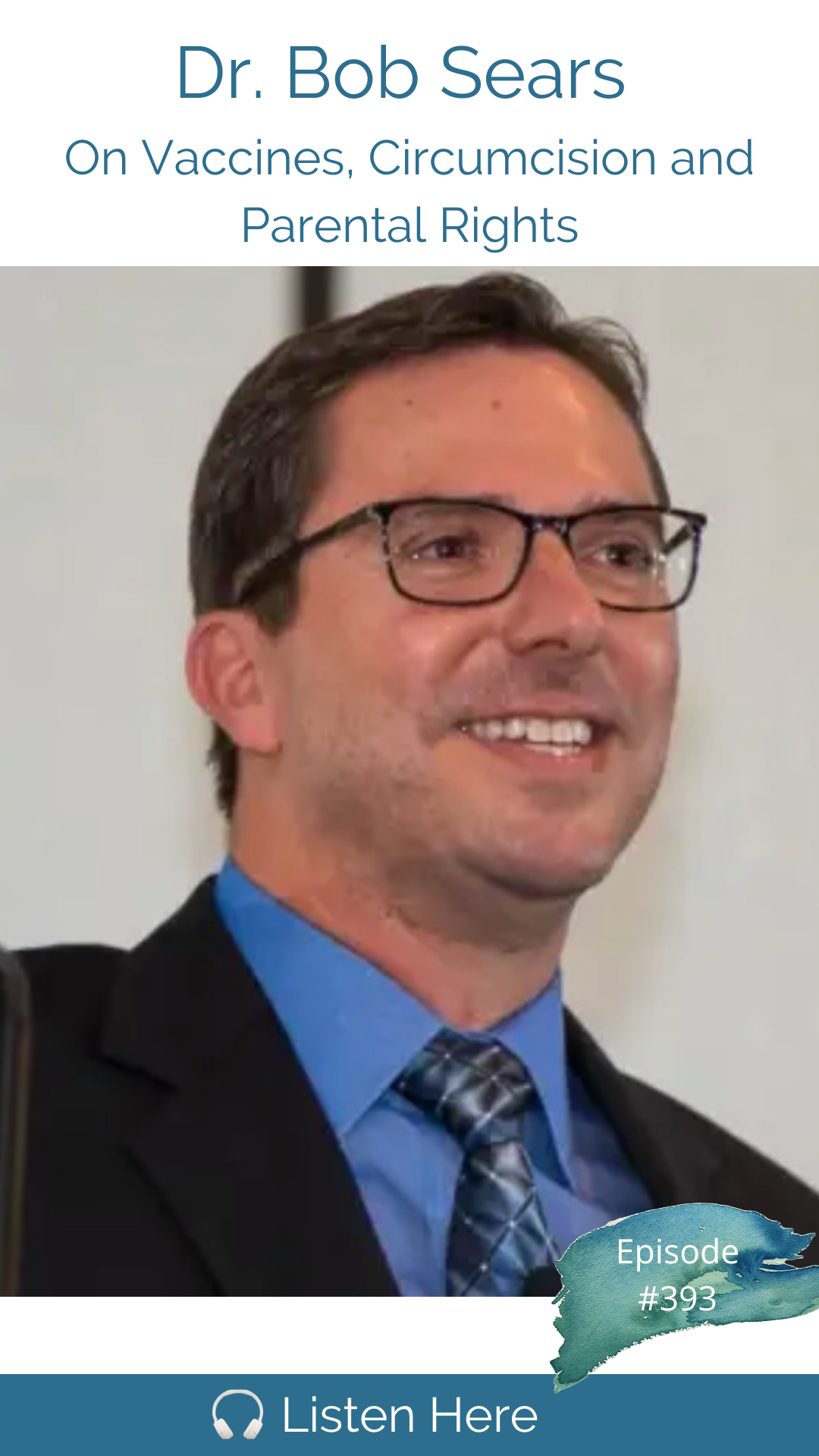
What happened to medical freedom, informed consent, and the right of parents to make healthcare decisions for their own children? And how did vaccination become one of the most divisive issues in modern parenting? This week, we're joined by pediatrician and bestselling author Dr. Bob Sears, whose groundbreaking The Vaccine Book has helped countless parents navigate one of the most controversial decisions they face. Drawing on nearly three decades of pediatric practice, Dr. Sears challenges conventional thinking about childhood vaccines, vaccine mandates, and the risks and benefits of natural immunity. We discuss whether vaccines prevent infection and transmission, the argument that vaccination protects immunocompromised children, and why Dr. Sears believes vaccine mandates have ultimately backfired. We also examine vaccines during pregnancy, the role of breastfeeding and the infant microbiome, and why so little attention is given to supporting children's immune systems naturally. Dr. Sears shares which vaccines he considers particularly unnecessary, his perspective on measles, chickenpox, and whooping cough, and what he's observed among the largely unvaccinated children in his practice. Finally, we turn to another deeply personal parenting decision: circumcision. Why are American attitudes changing, and how can parents navigate disagreement when one wants to circumcise and the other doesn't? It's a candid, wide-ranging conversation about medical freedom, bodily autonomy, informed consent, and the importance of questioning conventional wisdom rather than surrendering our decisions to authority. Find Dr. Bob Sears: drbobsears.com | Instagram: @drbobsears ********** Access our workshops: Have a Physiologic Birth in the Hospital and Ultrasound: The Research vs Rhetoric Needed <-- for 20% off Call 802-GET-DOWN.
DrinkLMNT <-- for FREE 8-day supply
Primally Pure Skincare: Use code DOWNTOBIRTH
Postpartum Soothe: Use code DOWNTOBIRTH
ENERGYBits Superfood<--for 20% off
Join Patreon here
IG @downtobirthshow
Watch us on YouTube! Please note we don’t provide medical advice.
I'm Cynthia Overgard, birth educator, advocate for informed consent, and postpartum support specialist. And I'm Trisha Ludwig, certified nurse midwife and international board certified lactation consultant. And this is the Down To Birth Show. Childbirth is something we're made to do. But how do we have our safest and most satisfying experience in today's medical culture? Let's dispel the myths and get down to birth.
Hello, I'm Dr. Bob Sears, a pediatrician and author. I'm a podcaster, a speaker, a vaccine educator, and a medical freedom rebel. I like to say, I've been in this fight for many years, and it is awesome to see how many more people are now in the medical freedom world? You know, it's not fringe anymore. Now it's actually become very mainstream. So it's fun to be surrounded by you know so many people in this fight to help educate about natural medicine and medical freedom. So I'm super excited to be on your guys's podcast today.
Well, it's truly our honor to have you on the Down to Birth Show. We love to talk about controversial topics here, but more importantly, it's an honor because your father, your mother, and you have been very influential in the lives of both me and Cynthia in raising our children, and we just learned something new when we met you today that you, in fact, are the author of the vaccine book and not your father. So we had been kind of attributing all the credit to your father on that fantastic book that guided a lot of both of our decisions in how we navigated things and with our young babies, but it's you.
Yeah, you know, my dad really pioneered attachment parenting, promoting breastfeeding, co-sleeping. That was kind of his niche, and he loved it, and he thrived in it, and it was his greatest passion, and when I joined him in his writing, when did I join him? 1998 or so. I started kind of co-authoring his parenting books, and then I thought, hey, I should write the vaccine book. And he actually he didn't want me to. He was worried for me. He was worried about my career, my reputation, my safety, and he thought, you know, Bob, if you write this book, it's you know, you're you're kind of going down the very alternative-minded path. And I said, you know what? I have to. I got to do it. So I did it. I'm super excited that I did it because it's definitely shaped my career and it's it's the one topic I could talk all day about. So how nice is it to work in a world about something that you never get tired about of talking about?
It's very nice indeed. We're all very grateful for that ourselves. Absolutely. I always tell my kids that I say, look, figure out what you want to do, and then worry about how to become successful doing it. But you first have to find what you love to do. That's just a must.
Yeah.
So you said you know when you introduced yourself and you described yourself as a medical freedom rebel, which is wonderful. It's like our kind of person for sure that we respect the most and gravitate toward the most. You know, I just couldn't help but realize we were all medical freedom was the default up until like maybe Jenny McCarthy and the late '90s. I mean, medical freedom was the norm. I grew up in the New York metropolitan area. Not one soul ever discussed vaccines. Asked if you were vaccinated. Asked if your kids were vaccinated. I mean, we now have grandparents, new grandparents who have a little baby born in their family who are not allowed to see their grandchild sometimes unless they're vaccinated. I mean, no humans ever lived like this. A mass brainwashing occurred. We have grown to become terrified of each other. On the pickleball court this week, I heard two people discussing vaccines, and one woman said to the other, "They were not arguing. They were everyone was great, had a nice sense of humor." But one of them said, "Why should I go to the store and pick up and consider buying an orange after you were there a few minutes before me, and touched the same orange, and I was just like, I mean, find one person in American history who touched a piece of produce and died because of who touched it before them. The fear is unbelievable.
Oh yeah, yeah, yeah. You know, I think the biggest mistake the pharmaceutically funded medical establishment made about 1015 years ago is to mandate vaccines, and of course those mandates go back way longer than that. There has always been four states that mandated vaccines: New York, California, no New York, Mississippi, West Virginia, West Virginia.
But I want to say, Doctor Sears, I have to jump in. That you said always, but that began with California under Governor Brown in 2015.
Yeah, yeah, yeah. So, so the other state, New York, Mississippi, and West Virginia. They've had mandates going way back. California didn't have mandates until 2015, and I feel like that's what is turning people away from vaccines. Just as you said, this wasn't even a conversation. You just everyone respected each other's decisions, and you know people could make their own choices, and nobody really cared. They mandate vaccines now. Fewer people are vaccinating. Fewer people in California are attending public school. Public school enrollment is way down. Private school enrollment is down, but independent private school enrollment is way up. Where it's a school that doesn't mandate vaccines, and of course, homeschooling has skyrocketed in California because they mandated them because they made it an issue. And I even heard one doctor say, like, there is a it was a news interview. I think I was even on the news show with this other doctor, and they said, well, why is this so controversial? And the doctor stepped in and said, "It's not controversial. There's nothing to talk about. There's no decision to make. You vaccinate. So there's nothing controversial about it." And that doctor was very naive, of course, because now everyone is talking about. So yeah, I feel like it's interesting how things have shifted simply because mandates. They thought mandating vaccines would cause more people to vaccinate. It's it's had the opposite effect.
And what really is the reason behind mandating vaccines? I mean, what is the purpose of creating mandates and trying to get every child born vaccinated with all of these different vaccine preventable illnesses and vaccines.
Yeah, well, it's it's it's just like Cynthia said. So you don't have to be afraid of going to school and picking up a pencil and worried about you know what other kid touched it before you before your child. Now that's that's not the reality, but that's the fear. Basically, the medical establishment and they've gotten a lot of the public to believe this, and many legislators believe that unvaccinated kids are not safe to be around. They're contagious. They will endanger your fully vaccinated child, which is ironic. So they don't deserve equal rights. They believe it's it's not your child's body, your choice. It's it's their choice, and they truly believe that. Honestly, I don't think they're just doing this because pharma funds them. That might be an underlying issue, but I believe the public has bought the lie that unvaccinated kids are dangerous, and now the number of unvaccinated families has skyrocketed. This you know this dangerous group of families is now everywhere. I feel like the public is now realizing that's not true anymore. Like, like all everyone's you know safe and healthy to be around, no matter their vaccine choices. I feel like a lot of the public now understands that. In my experience, talking to people now, now the legislators, more and more legislators are understanding that too. And so I think we're seeing a shift in the public acceptance of mandates simply because California passed mandates in 2015. I think only two more states have passed mandates since then. I think Connecticut and Maine, and two states I think lost their mandates: Mississippi and I think West Virginia was on the verge of losing their mandate, something like that. So there's no like if everyone believed the lie that Californians believe that these kids shouldn't be in school, more and more states would have passed mandates, and they didn't. That's why I feel like the public is now aware that is not true. That you need mandates to keep school children safe, and the very opposite might be true. And so, hopefully, moving forward, legislators will understand this better.
Let me explain for our audience first of all. When you say mandates, the way they go about that is they remove the religious exemption. So there are some states that even have a philosophical exemption, which is I think a beautiful thing and a necessary thing, and then others have medical exemptions, which, to my knowledge, they've never been able to strike, but they've really cracked down on the nerve, like to access doctors' records and such, which was always private. And then they're going about it by removing the religious exemption. Right. And I want to have you respond to the pro-vaccine skeptic, the one who's skeptical of our conversation, because I'm extremely acquainted with this debate, and I could answer this question, but I'd much rather have you do it. You'll probably answer it better. The when you say it's simply not true that unvaccinated children do not pose a greater risk, I'm with you. I know how. I know what you know, I'm sure, and you probably know some more. How would you how would you address the person who says, never mind that they tend to be much healthier, and it's about the immune system fending off disease, not vaccines and all of that, and efficacy and side effects are a different conversation. But how would you respond to the person who says the greater good, and not every child can be vaccinated because they have compromised immune system. So it's your job as a citizen; it's your job to vaccinate your child. And yes, it won't be 100% effective. But if we all do our part and we all get vaccinated, we'll reduce. We're protecting those people who can't get a vaccine. Please respond to that person because they always seem to think they have the trump card on that argument.
Right, right, right. Why is that false?
Yeah, well, let me address the people who are immunocompromised and maybe they can't get a vaccine. Let me address that because that's an important issue to realize. First of all, if someone is immunocompromised severely, then they're not going to be at school because they'll catch tons of things that we don't even have a vaccine to prevent. Okay, so if you're if you're that susceptible, you're not even at school. Almost everyone who is immunocompromised has previously been vaccinated, like they already got all their childhood vaccines. Now maybe they're going through chemotherapy, or maybe they're on immunosuppressive medications. But they had all their vaccines. The vaccines they had will still be working, regardless of their immune status, to the extent that they ever were going to work.
To the extent that they would work. You're right. You're right. Which is which is interesting. So that's part of the answer. the broader answer, where you're talking about everyone else who is not immune compromised. Let's just talk about because in almost every class in any given school, there is not an immunocompromised child, and the number of immunocompromised kids in any really large school you could probably count on one hand. And yet, if you're in a class with a child who's immunocompromised, yeah, maybe like if your kid wakes up with a fever, don't send them to school that day. You know, kind of makes sense in my thought, regardless of what they have, but for everyone else, most vaccines we use don't stop you from catching an infection and being contagious and passing it to other people. All right, they don't work that way. We wish they worked that way, and one or two vaccines may work that way, but the vast majority of vaccines don't actually work that way. So it doesn't matter if an unvaccinated kid is in your immunocompromised classroom, because if a infection enters the classroom, if someone gets sick with something, both vaccinated and unvaccinated kids will both catch that infection, develop some symptoms, and be contagious to everybody. That's true for most infections. I'll highlight the ones we know we know it's true for. We know it's true for the flu vaccine and COVID vaccine. We know it's true for the polio vaccine, although we don't see polio, so it's not like polio is going to happen. But if it were to happen, it'll happen to everybody, vaccinated, unvaccinated, alike, because polio vaccine doesn't work that way. The whooping cough vaccine for sure does not work that way. Everyone gets whooping cough equally, regardless of your vaccine status. Same is true for diphtheria. Let's see what else we have. There's certain pneumonia vaccines that aren't aren't really going to protect you from getting sick. Meningitis.
Yeah, meningitis vaccines. One of them, the high school college one we use, doesn't really protect you from getting the germ in you and becoming contagious. What else I was going to say? There was another one. Chicken mumps vaccine doesn't doesn't protect you. So let's make a shorter conversation. Is what does protect you? What might actually make you not get an infection and be contagious to others? The main one that might do that actually is the measles vaccine, and everyone likes to, you know, everyone who's who's kind of is trying to talk against vaccines and doesn't want anyone to vaccinate and thinks all vaccines are bad. It's interesting when you talk about measles because that's the one vaccine that they wished didn't or they wish they could say doesn't work, but it kind of seems to work. It doesn't work very well. It only works for several years, but it might actually make someone less likely or pretty unlikely to, if they're exposed to measles, to come down to symptomatic measles and infect others. Now, it's not always going to work. Fully vaccinated kid could come down with measles. In fact, they can actually come down with mild measles symptoms and not even know they have measles, which makes them spread it more because they're not staying at home with a high fever and the rash. Right, so people can get these mild cases as a fully vaccinated person, walk around school all day, and infect other people, so it's interesting. But the measles vaccine, the one reason why I feel like there's no argument for mandate is number one, if you're vaccinated, you should feel pretty secure it's going to help. Number two, if you're immunocompromised severely, you're not even in school, so it's okay to have an unvaccinated classmate. Number three, the measles vaccine is wearing off in the teenage years for almost everybody. So every teacher at school, every adult employee, every sports coach, every adult that walks through that school has almost no measles immunity. So they're a big reservoir for measles as well, and that's why we'll never get rid of measles. No matter how many kids vaccinate, we'll always have measles because there's always going to be adults that spread it. Now, if you actually contract measles, not because you had the vaccine and you have a mild case because you had the vaccine, but you actually didn't have the vaccine and you got a full blown case of measles, does that give you lifelong immunity?
It does. Yes. Yeah, you're lifelong immune. Yeah, yeah. So, so there is. So, what I just said, more and more people are understanding that. I think that's why more and more people are agreeing that mandates are not necessary. But there's still some people that will believe no. You're gonna bring polio to our school. You're gonna bring measles. You're gonna bring mumps. You're gonna bring chickenpox. You're gonna bring rubella, whooping cough, a flu, COVID. You're gonna bring all this disease to the school because your kid's not vaccinated, and it's just such a lie because our medical community sold that to the public many years ago.
I don't think parents even understand that if they get their children vaccinated, their children can still contract the illness. I think that they believe that when they get these vaccines, their child is completely immune to this illness. I'm not sure that pediatricians really explain it very well.
What really upsets me immensely is when people get a vaccine and then they get to the disease. They never say, "Hey, hold up a second! I had this vaccine." The doctor then convinces them, "Oh, but you know, the vaccine took the edge off. Oh, believe me, it would have been much worse without the vaccine." And that, to me, is the biggest, most foolish lie of all. The vaccine is not designed to like take the edge off, and you have a lower case of it. If it didn't work, it didn't work. And it's my understanding that the bacteria can actually form a mutation that is even more severe in someone who's vaccinated because the human genome was is anticipating a certain bacteria, but now all of a sudden we have these mutations that can form. So there's a whole other side of this that I think doesn't ever get addressed.
I think we need to clarify that about the vaccines. I mean, some of these vaccines truly are meant to reduce the severity of the illness. Is that true or not true?
I feel like some of them do work that way if you believe in you know in the in their the general principles.
I am so not convinced on that point. Yeah, yeah, yeah. So it just sounds like it. It sounds like a very comfortable excuse when it doesn't work.
I feel like they've done pretty good research on the measles vaccine, and have found it really does seem to prevent severe and symptomatic cases of measles. It might not stop you from getting like a what's called a subclinical infection or a very mild symptomatic infection. That's one that does seem to work that way, but that's a minority. You know, I think Cynthia, I think you're right. For the majority of vaccines that we think they reduce the severity and we wish they would and we want so badly for them to, but a lot of them really don't or they haven't proven that they do. So the argument used to be it'll protect you from getting the disease, right?
And now the less effective they get, the more and more they're saying, "Oh, it'll just it'll take the edge off." Like you might get it still, but and it's like, look, is this about preventing it or not? And I saw with COVID when they first announced they had the vaccine, they were saying it had a 99 to 100% protective rate. Then they reduced it to 90. Then they reduced it to like 54, and then the whole narrative changed. It's like, oh, get the vaccine, you'll get a milder case of COVID. Well, actually, COVID morphed into what was an Omicron that was in fact mild, and it just, I just feel like the constantly changing narrative is there's something deceptive at play, and these mandates, as we call them, was really not even stemming. From concerned parents, it was stemming from really forceful lobbyists. It was coming from the pharmaceuticals. Now, what I what I wish for is to parents for parents to feel empowered on focusing on your child's immune system. Like we don't talk nearly enough about keeping your child's immune system strong and not living with such fear. And that's the conversation I wish parents were more interested in having because it's actually empowering.
Oh yeah, no, it's it's so true, and because almost all of my patients don't vaccinate, especially not their babies, I get to see all these babies start off with a with a natural, healthy immune system, and it all starts with birth. It all starts with having a healthy pregnancy and a healthy natural delivery, avoiding antibiotics, unless there's a real extreme situation. If you can get that baby's immune system to start off right with mom's healthy vaginal flora, and getting that baby's immune system to start off naturally, and not disrupting it with antibiotics, the whole key to the beginning, and then you don't disrupt it with you know pharmaceuticals, artificially you know generated vaccines. You just keep the baby's immune system naturally, naturally young. That's the whole start to life, and if and that's that's really what I promote and what I get all my patients when they do you know prenatal consults with me or they watch my prenatal you know consult information. They I try to really stress how critical that is to get that right start.
This isn't a critically important point, and I don't think that the data differentiates between infants who were born vaginally, had a healthy microbiome seeded at birth, started off on colostrum, were exclusively breastfed, versus babies who are formula fed. I mean, there has got to be a difference in how babies contract and deal with these illnesses between those two groups, right? Right. There's definitely a difference between breastfeeding and formula feeding groups. They've done a lot of research on that, and showed immense benefits of being breastfed and how it reduces the severity of infections. It's it's very considerable. I don't know. I imagine they have researched, say C-section babies versus babies born vaginally, or researched babies born to moms who had you know IV antibiotics during labor. There probably is research on that. I'm just not as familiar with it at the top of my head.
Do you have any concerns about the babies in your practice who are not breastfed, or are all your babies in your practice breastfed? But if you do have a couple who comes in and they aren't planning on breastfeeding for whatever reason, do you feel more inclined to support vaccines in that family, or do you treat them the same?
No, I treat them the same. Yeah, I feel like in all my 28 years of doing this and being the pediatrician for families that don't vaccinate, I've never seen one single case of a severe infection, whether the kid was vaccinated or not. Not one single case where they had to have like a prolonged hospitalization, or get in the intensive care unit, or be rushed by ambulance and get their life saved at the ER, or a kid who got a bad infection ended up with a permanent disability. I've never seen anything severe happen to any of my patients, which is awesome. Now I've certainly seen cases of some of these infections, but they were all manageable. They're all treatable, so no one's ever regretted not vaccinating. And so the reason I don't differentiate between formula-fed and breast-fed anymore, like I used to, you read the first version of my vaccine book. I think I probably even did say, "Yeah, vaccines might be a better idea in a baby who's not breastfed." But because I haven't seen any babies harmed by these infections, I've come to believe that the risk of infection is so tiny for everybody that I think you know. If it's your choice as a parent to raise your formula-fed baby without vaccines, I think the risk you're taking with infection is so small. It might be bigger than the breast-fed baby's risk, but both risks are so tiny to begin with, that I think that's that's an okay decision to make as a parent. So I don't differentiate anymore like I used to.
One thing that's changed in the narrative that concerns me, I think, more greatly than anything else, and something I have observed because I have been an adult for a few decades now, and we can we can appreciate these things when we are adults for a few. Decades, we see how much changes over time that the younger generation just simply doesn't know. And what really concerns me is that it's no one's damn business what healthcare decisions you make. I can't believe we're living in a time where people think it's appropriate to say to someone, "Have you had the vaccine? Are your kids vaccinated?" It offends me immensely. Just as if I meet a woman, even in the field of work I'm in, if I meet a woman who has a newborn and I'm chatting with her, and she says, "Oh, he was just born three weeks ago," I would never, in a million years, say to that woman, "Was it a C-section or a vaginal birth?" It is not my business, and we lived in a time up until 1015 years ago where no one would dare ask someone if they were vaccinated, and in fact, no one cared. No one even thought about it.
No, for sure, it's for sure it's not. But you know, we're this isn't the first time we've done this. I mean, we've for centuries we have looked at people not like ourselves, people making different you know decisions, people being raised differently, and decided, hey, you know, those people, you know, and doctors used to tell, you know, our communities and our government officials. Well, these people over here, they're they're contagious. They're dangerous. They're unhealthy to be around. They transmit disease more than we do. So, we shouldn't let them have equal rights in our society. We should, you know, make them live somewhere else or put them in different schools or, you know, we've done that. We've done that for hundreds of years, probably 1000s of years. Decided that other people are unhealthy, and it is our business to keep ourselves healthy. So we gotta isolate them from us. So I don't think it's anything new, and I think it's just as wrong back then. It was just as wrong 50 years ago, and 100 years ago, and 1000 years ago, as it is today, I feel like is a huge equal rights issue, and I think you know governments love to divide their people, and have power over their people. I feel like I feel like this is one way they've now screwed up because I feel like a large group of our population now believe that all humans on our planet are equal and certain types of people's rights shouldn't be taken away.
Are you just being an optimist? Is that is that do I am very much an optimist? Yeah, do you really believe? I hope you're right. But do you really believe this has been backfiring on those heavy-handed policies and policymakers? Do you really believe it's backfiring? I hope you're right. But is it?
Well, because they haven't made any more mandates in many, many, many years. You know, Connecticut just barely passed. Maine just barely passed. But I feel like you know when something happens in California, the saying is whatever happens in California is going to start happening everywhere. It hasn't, and it's been over 10 years in California. So many, many state attempts to mandate vaccines in schools have failed. So I, that's what I feel like, and then I feel like with our current federal administration, they've they've you know created even more momentum in this, and they've raised even more awareness. And another reason I can say this, Cynthia, is I feel like obviously this is a political issue where it should not be.
Right.
Vaccine decisions should have nothing to do with whether or not you're a Democrat or Republican, right? Of course.
Somehow, in this last election, and in state elections, it has become a Democratic platform to mandate vaccines and a Republican platform to allow medical freedom. It shouldn't be that way. It could just as easily be the other parties, you know. I mean, Democratic Party they get they could all be for you know, you know, personal health and freedom just as much as Republicans. But I don't even know why one party chose us over the other. But that momentum, Cynthia, I think will stay with us no matter who has the next administration? I think in the public's eye, and another way to say it is: 20 years ago, most Republicans would have said, "Yes, you should vaccinate your kids," and "No, I don't want your unvaccinated kid," and you know, in school next because vaccines work. Now, so many more Republicans understand that vaccines don't work that way. Now they're on our side in that in that respect.
Well, the entire world the entire world went through something that opened everybody's eyes to the lies. I mean, that changed, and I don't think that momentum is going away. We might not have had great strides on the policy. Level, you know, or the government level, or actual laws, but we are making strides there. There's all kinds of momentum all over the country.
One interesting thing that seems to be happening as parents are pushing back more on the vaccines for their infants, pregnant mothers are getting more pressure to get the vaccines for them. What do you think about that? And is that even a good strategy?
Yeah, yeah. I um, I this is something that I did not have in the vaccine book in the initial versions of it. Um, I've since actually created a vaccine book companion podcast, where everything I wish I'd put in the vaccine book, I put into a podcast episode, so I have four episodes on pregnancy vaccines. The four vaccines that are offered to pregnant women: COVID, flu, whooping cough, and RSV vaccine. I have a full episode on each. I am very hesitant about vaccinating pregnant women. I don't know that they work really well in protecting the baby. But even if they did work some, I have huge safety concerns with vaccines during pregnancy. I mean, you two know how sacred the months of pregnancy are, and you won't do anything unnatural. You know, you won't you won't even take, you know, Tylenol without calling your midwife or your doctor to ask them if it's okay. Not that you should even be taking that anyway, but you're so careful. Yet you'll inject vaccines, right? And I'm preaching to the choir here. I know, but um, but I have big safety concerns because not that the not that we know that they're dangerous, but there's there's literally no way to do safety research on a not yet born baby to know what the vaccine they're doing.
We don't know that they're not dangerous, right? So oh, you don't know that they're not. We don't know one way or the other. So the default is if you don't know if they're not dangerous. Seems like a fairly easy decision, but then mothers are convinced that because they're slightly immunocompromised during pregnancy, that they too are at much greater risk of the flu, of COVID. Of okay, but let's let's look at one thing. This is something I've had this. I don't when women ask my opinion on whether they should be vaccinated, I have no idea. But I do say, listen, it will change your health. It will change your body. This is not saline solution. You have to believe that there is something lacking or faulty in you, and you can save it with a vaccine, or you can believe you are whole and able, and then you are modifying your health. We know for a fact the ingredients are neurotoxins. So for a woman to go pick out organic peaches over conventional peaches, and then say, "But shoot right into my bloodstream neurotoxins," that's kind of ironic to me. Now, what I tell women is, "Look, the flu is crummy. I had the flu last. I got 22 years ago. It was brutal. It was brutal. I was in bed.
22 years ago. Yep.
Last time I had the flu, and yeah, I was working at Mastercard at the time. It was a full week out of work. I could barely lift my head, and I don't. I just got like emaciated because I couldn't eat for a week. It was it was brutal, but no one wants that. But for a pregnant woman who, heaven forbid, gets the flu, she gets the flu. Her baby gets the antibodies. That's what her baby gets. She feels crummy. She feels weak. She's debilitated. She has she alone has a fever. Her baby is sitting back collecting the antibodies and is born safer as a result. So it is a worthwhile discussion, and it should never be black and white to these women. And being told, "Well, Joe, you don't want to get the flu." It's just rhetoric. They're throwing that at her because no one does want the flu. What is really the impact? And by the way, how about saying if you don't get the vaccine, now be smart, keep sugar low because that takes down your white blood cells. Have a lemon a day because that is for just one lemon a day in your water or however. Like, what a boost to your immune system. There are ways to actually stay healthy and well, get enough sleep. We never have that conversation. It's always it's always about vaccines or no vaccines. We've forgotten to talk about health and immune systems.
Yeah, yeah, I know, and I like what you said, Cynthia, about the immune the immunity is going to the baby. Because when you vaccinate, not only are some of those chemicals going to the baby, but mom's immune response is going to the baby. You might think that's a good thing, but the immune response that vaccines induce in you is very artificial. It involves not just a natural antibody immune response. It involves all kinds of inflammatory chemicals. You know, it revs up your allergic immune system, and the immune response. So the germ components of the vaccine is very artificial because the germs in the vaccine are artificial, they're modified, they're they're not natural germ components. So your body sees them differently and has a strange immune response. All of that is going to the baby, and I think that's potentially very problematic. And I think that might contribute to a baby's immune system being out of whack when they're born, and so it's yeah, it's it's it's very interesting. I think more and more people are understanding that, and I really emphasize that in my in my pregnancy education now, just the beauty of the natural body and doing everything as naturally as you can, and avoiding pharmaceuticals unless you feel like it's really important for you.
I just want to ask a question about vaccines in general. I mean, the idea and the concept of a vaccine makes a lot of sense. Give the body a very minute exposure to something in a safe amount that's not going to amount a full blown illness, and instead mount a strong, healthy immune response protective. Now, obviously, with vaccines, you can't have most of the vaccines can't be live. I mean, they're not; they have to be preserved. They're, as you said, they're genetically modified. They're not the same germ. Is that what the real problem is with vaccines? Is that how it's teaching the immune system to respond. Like, if we could actually dose people with a teeny bit of each illness in a safe amount, without all the preservatives and additives, and directly into the bloodstream, would vaccines be a lot safer? Is it just the way we're giving them that creates the risk?
Yeah, yeah, I do think that's a huge part of it. It might even be a bigger part of the problem than the neurotoxic chemicals. I mean, obviously, you know, aluminum is not good for anyone's brain, and that you know directly is neurotoxic. The mercury that used to be in the vaccines and still is in some of the flu shots. That's very neurotoxic. People always used to think that was the big problem, but no, I actually believe babies' immune systems are so malleable. They're so you know immature and developing and growing. They're trying to find the right path through natural exposures. You hit a newborn baby. You hit a yet to be born baby with all that artificial stuff, and then a day one you give them a vaccine. Two months you give them eight or nine vaccines. Four months and six months and 12 months. You know, every year moving forward, you give them more and more vaccines. You're that repetitive artificial bombardment of the immune system that's trying to function, I really do think that might be a bigger problem and a bigger thing that is wrong with vaccines. Yeah, could we find a way to naturally do this? It's called it's called life. You know, right? Just live your life, and you'll get natural exposures to these things. Now, you might get exposures to things you don't want exposure to, like meningitis, or live in a country with polio. It's not like you want to get exposed to polio, but everything that's not very severe, yeah, you're going to get natural exposures to it and get natural immunity. Could we come up with a way to make this all natural? If there's money in it, probably, probably someone could come up with a way to do that. The closest thing I can think of is homeopathic vaccines, but I think the dose in those is too minute. I think it's probably too small to induce a natural immune response that's going to give you some good functional natural immunity. I could be wrong, but interesting question though. So maybe someday in the future we'll have something more natural, but not anytime soon. Don't expect us to green our vaccines anytime in the next, you know, few decades, because I don't know that it can happen that quickly. It's a really slow process.
Well, the pharmaceutical industry approached Ronald Reagan in the '80s and said, "We can't, we can't afford this line of work anymore."
Yes, and we're sued too much. There are too many injuries, and we're sued too much, and we're losing more money than we're making. And most unfortunately, what Congress did about it was to indemnify vaccine makers. I mean, there should be no body in our country that's indemnified from anything, let alone something where they're trying to rob us of choice. I mean, those two things together are an absolute outrage, and it's un-American. I mean, informed choice and freedom over our own bodies is exactly the freedom we need to protect in this country.
Yeah, that's what concerns me. That's really, really what worries me. How do you lose the choice over what to do with your own body and the nerve of either political? Party to declare that they have sovereignty, that they're speaking for us, like about our choices and our freedom. The Democratic side for saying my body, my choice, the nerve of them because of trying to enforce COVID vaccines, and the Republican side of talking all about freedom. I mean, they're trying to manipulate the public when really they're just it used to be that the Republicans were a little more the pro corporation and California was known to be the crunchy natural people in this country.
It flipped before our eyes. I remember when Obama was running. I prayed when he was asked about vaccines. I just wanted him to be the be-all, end-all of what we needed, you know. And I prayed for him to be that person, and I prayed Bernie Sanders would be that person. And I said, no, no, it's it has officially flipped. They sit there with their rhetoric and say, well, I think Obama said, well, vaccines work. Like you're gonna get out, you're gonna get away with this that easily. And then the rhetoric: it's safe and effective, safe and effective, like robots, safe and effective. Like, just stop. Speak to us like intelligent people. Don't try to brainwash into the safe and effective thing. It's always the same two adjectives in the same order. It's never effective and safe. It's always safe and effective. It's mindless. It's robotic, and I really resent that because it's a worthwhile debate, and they're trying to shut the debate. Yeah, and you know they probably had a giant focus group on comparing effective and safe to safe and effective, and try to see what you know what sells better. You know they are they are that smart. What's catchier? That's so true. Yeah, Cynthia, I appreciate your hesitation. I think to acknowledge that we have tons of momentum and we made all these changes. And you're I think you're a little leery about that. And I agree with you in the mainstream medical community, in our main policymakers and the establishment. I agree with you that they are not budging on any of this on the safe and effective, and for some of the stuff I'm hearing, you know, second and third hand, you know, from the federal government is we haven't been able to, you know, create lots of change in this on the federal level because even though someone at the top of a federal agency might want to create some change, the 10,000 people working underneath him that have been working there for the last 2030 years, they don't want change, and to create change in these entrenched places is very difficult because the optimism I was talking about earlier that doesn't exist or that shift towards medical freedom and understanding rights and getting rid of man that doesn't exist in the established government you know medical policy making institutions they're just entrenched and sitting back and saying, "Nope, it's all pharma and vaccines and mainstream medicine, and we got to keep doing things the way we're doing." So, so because they truly believe the safe and effective message. So I understand your frustration on that. So I don't know that we'll see a lot change on that level. But again, I keep going back to the public. We wouldn't have been having this conversation 20 years ago. You guys wouldn't be doing this podcast 20 years ago. You might even thought vaccines were great 20 years ago. I mean, how many podcasts are there that now talk about vaccines? How many? How many books? How many websites? Everyone's talking about, and that's what we've achieved, which I'm super excited about.
Speaking of vaccine safety, do you have any black and whites? You know, I know I'm sure you get this question all the time from parents. Like, if I were to get just a few vaccines. Are there some that you think yes? Well, it sounds like no for you. Pretty much, most of the families in your practice aren't getting vaccinated. But are there some that you are a hard no on, and some that you're more like, okay, you know, that one probably is okay.
Yeah, I feel like I certainly find myself giving vaccines to school-age children who feel like they can't find an alternative way to school, and so then they want to you know get the vaccines required for public school especially. And so I find myself doing a lot of that. And so we give vaccines in my office. I would say that there's nothing that for me is a hard yes. Like parents will ask me, "Yeah, well, what's the vaccine I should get?" I don't know that I ever use those words. Yeah, well, you should get this one. I might say you can get this one, but I don't know that I ever use the words "you should get this one." As far as. Because I think the ones that some of my patients end up opting in for because they believe their baby really needs it would be whooping cough vaccine and infant meningitis vaccines. Those are the kind of the three that people tend to want if they want anything. Now that's a minority. I might have like one or two families a year that want to give their babies those vaccines. So it's definitely a minority.
And those vaccines are only effective for a short amount of time, or there or those illnesses are only potentially very seriously dangerous to very young infants. Correct. So if they if they make it through the first three four months without these vaccines, they don't necessarily need to catch up with many of those.
That's true for whooping cough. It's it's only dangerous in the first several months of life, but meningitis can be serious. I think no matter what age you catch it, and it's typically infant meningitis is typically happens in the first couple years of a baby's life, and those vaccines, I think, do give you some measurable immunity during those years. However, I balance that with the fact I've never even seen infant meningitis, not even once. That kind of gives parents pause on, well, then do I really need that vaccine? And I don't tell them yes or no, but they often will conclude they feel like they don't need that vaccine, even though the disease is there and it'd be really bad if they caught it. They don't need it because statistically, the chance they're going to catch it is very, very, very low. I will say a few hard no vaccines, like one vaccine I've never even bought in my office to give people as the HPV vaccine for teenagers. Good for you. I've never, never bought. I've never had anyone ask for it. So I'm kind of a hard no on hepatitis B vaccine for newborns because they just don't need it. I have. I've had probably five babies born into my practice in the 30 years or 28 years, where mom or dad have hepatitis B as a chronic infection, and then those parents have opted into that vaccine in those unique situations because, because they you know they weigh the pros and cons. But for everyone who doesn't have hepatitis B living in their house? For me, that's kind of a hard no. I never bought the COVID vaccine to give everybody. I had a few patients that got it at an urgent care because they feel like they really wanted it, but didn't have any takers for that vaccine either. I don't know that there's any other hard nos that I would tell people, but chickenpox.
Yeah, I'd say it's a very unnecessary vaccine. I don't know if it's a hard no, but I'd say there might be not might. There probably is benefits to catching chickenpox and getting your lifelong immunity. It's interesting. There's even some benefits with measles. If you catch measles, you're less likely to have certain cancers the rest of your life. If you catch measles, you're less likely to have some autoimmune problems. What else? There's a one more benefit of measles. It's interesting. They've actually done research on a number of infections and showing that hearty and natural influence on your immune system gives you a much stronger immune system later. So to protect you against all these adult onset not infections but health conditions, things you wouldn't even think a vaccine would be good for. But they make your immune system healthier, so you don't have as much cancer and other immune-related problems.
And wasn't measles back in the day once a very considered a very kind of mild illness? It was something that you might stay home from school for a few days, but you certainly weren't rushing off to the doctor emergencies. I mean, it was treated sort of similarly to many communicable illnesses today. Is that right? It was. It was a Brady Bunch episode, and they laughed about it. I remember. Yes. Yeah. Yes. They tried to remove it. Actually, in that episode, every single one of the Brady Bunch family members got the measles, and there was a line where Alice was all worked up and nervous. And mrs. Brady, America's favorite mom, said, "It's all right, Alice. It's only the measles. So why are we so afraid of the measles today?"
Well, what I think happens is we're not afraid of a disease until there's a vaccine for it, exactly.
A case in point is the RSV vaccine. No one ever heard of RSV disease until two years ago. I mean, doctors knew about it because we see it left and right all winter long. RSV was everywhere. No one talked about not a. Single news story, you know, it was you know complete silent. RSV vaccine comes out, and suddenly everyone's going to die left and right of RSV.
Same with HPV. No one ever heard HPV till 2007, when the governor of Texas passed that mandate, required everyone to get it, and then got campaign contributions in response because his chief of staff went to work for Merck. I mean, no one ever heard of HPV, and now everyone believes it's the way to get their child to prevent cancer. And you know, my joke is like, look, in my day, parents were afraid their kids would get pregnant or an STD. Now parents are afraid their teenager having sex is going to catch cancer. Boy, did they change the narrative on that one? Boy, did that one change.
I know, I know. Yeah. So as soon as there's a vaccine behind something, then the medical community really has to paint that infection as really severe and dangerous. Something we all have to do our part and work together to get rid of, and you know they did that with measles all those years ago, and they're doing that with every new vaccine that comes out. So it's nothing new, Trisha, for them to paint it that way. And I think you know that already. But um, but yeah, measles. What's interesting, just so people actually know the actual truth about measles and how dangerous it is or isn't, we actually have some pretty good research that shows if you are a healthy child who is well nourished who has enough vitamin A in their diet, your chance of dying from measles is about one in 93,000. So if you if you infect, you know it takes about 93,000 healthy kids to catch measles to have one of them have a surprise fatality from it. Like you wouldn't have expected them to die because they're really healthy, but somehow some complication went wrong and they died. It's a very low fatality rate. However, balance that with what the CDC used to say until they rewrote their information in the last couple of years. But what the CDC used to say is one in 1000 kids die of measles. One out of every 1000 cases die. There's such a big disparity between one in 93,000 dying and one in 1000 dying. The disparity exists because the CDC's number there's a little asterisk by it. So you go down to the fine print and read what they really mean. What they really mean is, out of all the kids that are sick enough to be hospitalized or go to emergency room or see their doctor and have their case reported to the public health department, out of all of those kids, about one in 1000 die.
You're kidding me. Meanwhile, 92,000 other children are at home recovering just fine and going back to school a few days later.
Right. So, so, so what they discovered is only about 10% of people get reported as a case. So, so the CDC has said probably out of all cases, it's about one in 10,000 will die of measles. But then we've actually taken a step further and found if you if you look at only the healthy, well-nourished vitamin A kids, it's even lower. So it's interesting to look at measles. It's it's not a dangerous disease for the general healthy population.
Interesting about vitamin A, I recall that was quite protective against COVID as well, or for people who were very sick with COVID, vitamin A was one of the really important nutrients to really increase in their diets. What is it about vitamin A?
Yeah, and I got to add though, as soon as people started talking about that during COVID, what did the media do? They published a story of a child admitted, I think, to a Texas hospital with vitamin A poisoning.
Oh, of course they did. They made people afraid of the people started talking all about the dangers of vitamin A overdose. Don't overdose your kid with vitamin A. Turns out the kid who was hospitalized didn't have vitamin A poisoning. Like they talked to a doctor, and the doctor's like, "Well, we don't know why this kid's liver is destroyed. There's many, many reasons, but you know, it could be that they took too much vitamin A. We don't know. We'll find out." So the media jumped on that, and yeah, so yeah, they're quick to downplay any of the non-pharma alternatives to these treatments. That's a great question. I honestly not sure that I know what vitamin A does to the immune system and how it fights infection. I don't think I've ever stored that in my brain. That's that's probably one of those things I felt like I didn't need to know. I just know it's good for you because it's rare. It comes up rarely. We hear about zinc all the time and vitamin C, but we really don't. About vitamin A, so it was interesting hearing you mention it. Yeah, it's very important. I started telling all my patients since we have more measles now over the last couple of years. I've been telling all my patients to give their kids cod liver oil every day as a good natural source of vitamin A, so their body is better prepared to fight infection.
Well, surely we could talk endlessly about the vaccine conversation, but there must be some other topics that come up. There are a few more controversial topics in around parenting and early childhood, and as a pediatrician, what are some of the other issues that you commonly have to counsel parents on, or topics that might be a little bit debatable.
Yeah, I feel like every parent that comes and sees me, almost all of them already know they don't want to vaccinate, so they don't even have a lot of questions there. I steer them towards my educational materials if they need to know more people want natural childbirth they want a natural start to life that the one topic I still see a lot of people aren't sure about or there's a lot of debate and discussion on is circumcision I would say the majority of my patients no longer circumcise and. it's it's an interesting shift not just in my practice but nationwide. There's some actually good published statistics that show on the West Coast and on the East Coast only about 25 percent of people now circumcised, and in the Midwest it's the opposite. About 25 percent. of people don't circumcise around a lot of the midwestern states.
That's really interesting. I didn't realize the rates were so low on the coast, but that's very good, promising news because that will infiltrate toward the center of the country over time.
Yeah, and I think in my naturally minded population of patients because they seek me out because they don't want the pharmaceutical model for their baby. I would probably say 95% don't circumcise now, and that's kind of a recent switch. Ever since we figured out that there's really no significant medical benefits to doing it. You're not you're not cleaner. You're not healthier. It's not easier to take care of. There's nothing that benefits you by circumcising. Now you could you could argue or discuss how important it is as a religious decision for Jewish and Muslim people. Very important to them. Most of the world, though, doesn't circumcise, and now most Americans are not circumcising. It's becoming a minority who do circumcise, and so that's what I like to tell my patients: don't do it if you just think you're supposed to do it. In fact, oh my gosh! I had a patient a few weeks ago. They came in. Mom did not want to circumcise, and Dad did. And we're kind of done with the appointment. And I call it the doorknob question. I have my hand on the doorknob. I'm about to leave. Like, oh yeah, one more question. Who should we go to for a circumcision? I could have easily just have said, "Oh yeah, I know this doctor. You know, nearby. He does a great job. I'll give you his name and be done with that." Because I was on my way out the door, right? And the next patient's waiting. But this is something that's important to me that parents make a decision that feels right to them. So I took the time to turn around and say, "Well, tell me why you want to circumcise," and then it came up. You know, mom wanted to, dad or mom didn't want to, but dad did. I asked the dad why. He's like, "Well, that's just what you do." Turns out, after talking for another couple of minutes, he didn't really want to circumcise. He wasn't even circumcised himself. What? I'm the circumcised dad, and thought, no way, you just have to circumcise your baby boy because that's what everyone does. As soon as I enlightened him, he was so relieved. He's like, "Oh, thank you for telling me that," and that was probably the best two minutes I spent in the office that day because yeah, I spared that little baby an unnecessary procedure, and so I, I mean, I, I, I have an opinion about this, as you can probably tell. That I think it's probably, you know, better for babies to be left intact. There's no health benefit to doing it. You could argue: Do parents have the right to make this choice for their kids or not? You know, legally they do, but that's kind of an interesting ethical question. Do you have the right to alter your baby physically like that? We'll leave that you know for other people to discuss. But I'm very open and upfront now with talking to people, and I share this. My prenatal consult video as well. In fact, I forgot to put it in. I have this prenatal video I shot where I talk about everything prenatal. I got done. I'm watching it. I'm editing it. I'm like circumcision. I got forgot to talk about circumcision. It's like I cut in a 10 minute piece into there because there's a lot to talk about with circumcision.
Do you have a specific argument that you pose to parents when one parent is adamant that the child is circumcised and the other one is pretty adamant the other way. I mean, how do you help them decide and who wins?
Well, I just, I mean, usually the one that doesn't want to do it wins because they both have to agree to do it. Exactly.
Happen. Yeah. Everything I just said, I get rid of the stigma. You know, no one's going to be teased in the locker room. You know, if people are going to tease each other about how their penises look, it's going to be 50-50.
They're going to really. Or if you're in California, you're going to be the majority if you're not circumcised. People don't group shower in sports anymore, anyway. You know, they don't have that whole, you know, naked group shower thing in the locker room anymore, like they did, you know, back in the day. So people aren't seeing each other naked nearly as much in the in the like the you know high school settings, and people don't care as much about it. So I get rid of the stigma about not being circumcised, and once dads hear that, and I tell them there's no medical benefit, most dads jump on board with the idea of leaving their kids as they are.
I mean, it's quite easy to be. I've had this conversation with hundreds of couples, including Jewish couples who opted against circumcision as well. And you know, it really can be quite a simple thing. I've heard Dad say, "Well, I want my son to look like me." I'm like, "Really? You want to have your penises look like really? Like you think that's really?" I always joke with them. Like every little boy at some point says, "Daddy, how come you have a big penis and I have a little penis?" Like I've heard that one many times, but I haven't heard of the little boy yet who says, "Why is yours shaped a little differently?" Or the little girl, "My daughter has a different hair color. She never said to me, "How come you have dark hair, mommy, and I have lighter hair?" So, I mean, to me, when a couple doesn't agree, like there are certain things where one person in the couple should just get veto power, and that boy can always grow up, and if he wants, have at it. Go have part of your penis amputated. I'm gonna guess he's going to opt out. The other, the other thing is informed consent. If we respect informed consent, we respect it. And finally, your own paradigm just comes down to like: Do you believe God goofed or nature goofed? Do you or do you not believe it? If you think God goofed and you need to intervene, thank God you can like go chop this off because nature really messed up on this one. Then you, I guess, need to circumcise. But if you leave your son intact, there is some kind of reverence for how we were made, which is so much of what our community already is coming into this with. So it's so ironic to support one model and then immediately not the other. And the reason is culture. That's it. That's how powerful culture is.
That's right. It's just cultural norms. And once people become educated, they open their eyes and see something different, and then culture shifts and changes. But I do want to ask you: Is it a requirement that both parents must they both sign a consent form for the baby to be circumcised, or can it be just one? No, no. But just you're just saying they both have to agree; otherwise, they're going to have bigger problems. Yeah. Yes.
Okay. Exactly.
Well, it was a delight and an honor to talk with you. It was so wonderful. I am surprised it's been so long since we've met, and I'm so happy that Trisha arranged this because really, it's wonderful to speak with you. Your clients are lucky to have you. Where do you practice out of?
I'm in Orange County, Southern California.
Wow, that's really great. It's really wonderful. Can you just tell everyone some of the best resources for following you, learning more from you? Just tell us where they can find all of your good work.
Yeah, I think I think Trisha, you reached out to me on Instagram. I think it was. Yeah, I'm in Instagram. All my social media handles are at drbobsears. So at drbobsears, I have drbobsears.com. My website. I do I do a lot of stuff on the website. I'm always putting new stuff, changing things. I think my favorite resource is my video consultations. You buy like a video on a topic and you watch it and you learn tons of stuff and then you email me your questions and you get on a once a month Zoom call with me to you know, ask me your questions, you know, live back and forth, and so it's it's fun to be able to do that. I enjoy doing that, and of course, there's my books and other podcasts that you can find. It's all on my website. So it's been a lot of fun to be in that arena and get back into Instagram after. Not doing it for so many years.
Well, we're very thankful that you're out there. We're very thankful that you're spreading this message, and we're very thankful to have had you on the show today.
No, I appreciate what you guys do. I'm glad that you have this outreach to people, and yes, I'm glad that you contacted me.
We'd love to have you back anytime. It was really great. There's so much more we could ask you about, but thank you so much for making the time for us. Yeah, really a pleasure. We'll have another conversation.
Thank you for joining us at the Down To Birth Show. You can reach us @downtobirthshow on Instagram or email us at Contact@DownToBirthShow.com. All of Cynthia’s classes and Trisha’s breastfeeding services are offered live online, serving women and couples everywhere. Please remember this information is made available to you for educational and informational purposes only. It is in no way a substitute for medical advice. For our full disclaimer visit downtobirthshow.com/disclaimer. Thanks for tuning in, and as always, hear everyone and listen to yourself.
Recent Episodes
Between episodes, connect with us on Instagram @DownToBirthShow to see behind-the-scenes production clips and join the conversation by responding to our questions and polls related to pregnancy, childbirth and early motherhood.
You can reach us at Contact@DownToBirthShow.com or call (802) 438-3696 (802-GET-DOWN).
To join our monthly newsletter, text “downtobirth” to 22828.
We'd love to hear your story.
Please fill out the form if you are interested in being on the show.
Subscribe to The Show
Follow Us On Social