
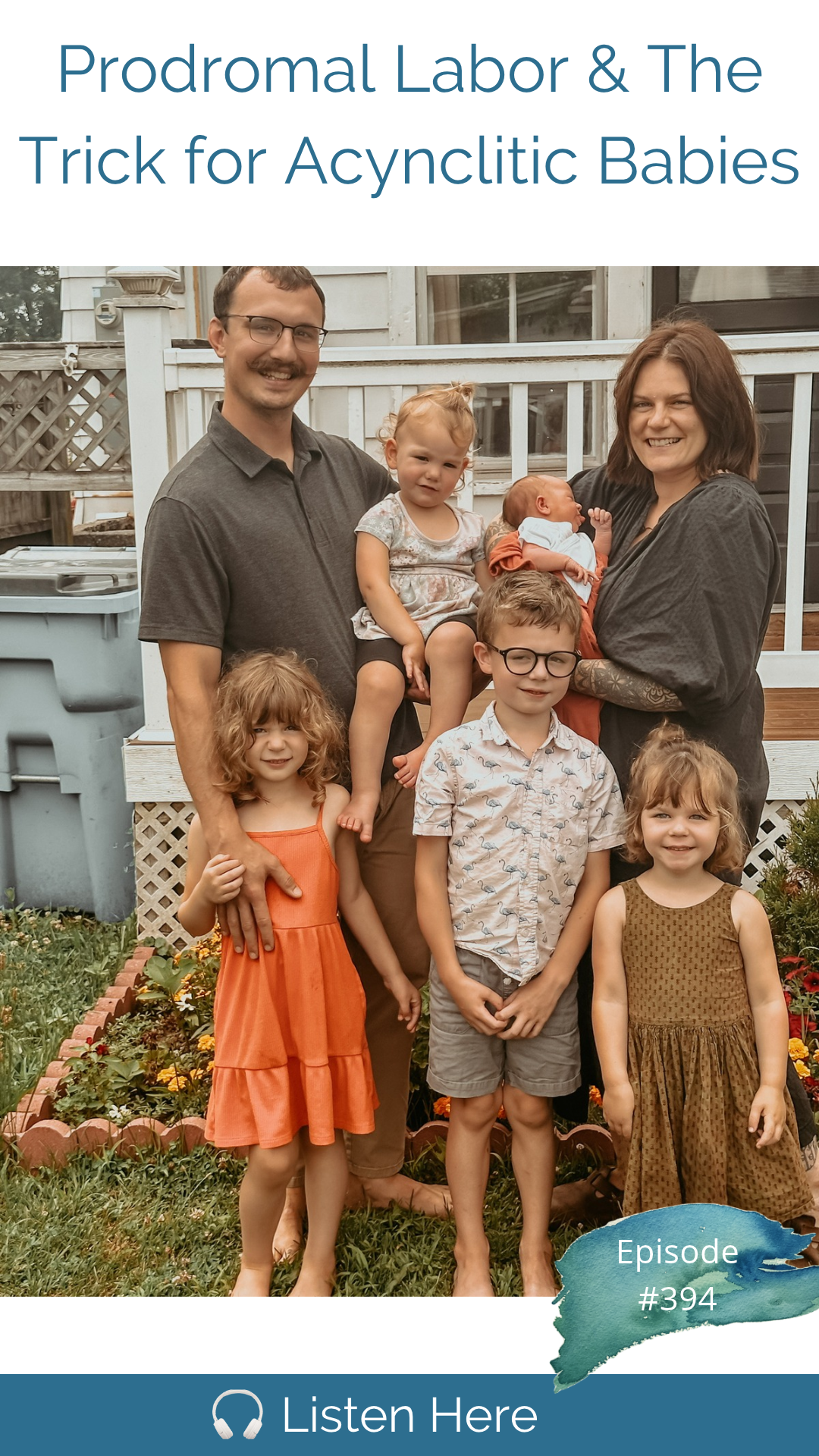
After two hospital births, Kimberly Salayer was preparing for her first home birth when she encountered two weeks of prodromal labor, an asynclitic baby, and the growing fear that labor would never progress. In this episode, Kimberly shares how she navigated an exhausting final stretch of pregnancy, why her baby's positioning mattered, and how Spinning Babies exercises, creative movement, and her husband's remarkable support helped turn things around. She also recounts an extraordinary spiritual experience during the most intense part of labor, when her pain suddenly disappeared and was replaced by an overwhelming sense of peace. Minutes later, her baby was born on her bedroom floor, caught by her husband. Together, we explore why positioning can make such a difference in labor, the value of having a midwife who understands physiological birth, and the freedom to follow your body's instincts without the constraints of a hospital setting. We also discuss one of the most overlooked advantages of home birth: the ability to recover in your own bed, with your baby in your arms, without interruption. ********** Access our workshops: Have a Physiologic Birth in the Hospital and Ultrasound: The Research vs Rhetoric Needed <-- for 20% off Call 802-GET-DOWN. #54 | Spinning Babies: Optimal Fetal Positioning with Gail Tully
DrinkLMNT <-- for FREE 8-day supply
Primally Pure Skincare: Use code DOWNTOBIRTH
Postpartum Soothe: Use code DOWNTOBIRTH
ENERGYBits Superfood<--for 20% off
Join Patreon here
IG @downtobirthshow
Watch us on YouTube! Please note we don’t provide medical advice.
I'm Cynthia Overgard, birth educator, advocate for informed consent, and postpartum support specialist. And I'm Trisha Ludwig, certified nurse midwife and international board certified lactation consultant. And this is the Down To Birth Show. Childbirth is something we're made to do. But how do we have our safest and most satisfying experience in today's medical culture? Let's dispel the myths and get down to birth.
Hi, my name is Kimberly Salayer. I am in Michigan. I'm married to my high school sweetheart. We have five kids together, and I'm going to be talking about my third birth today, which is actually my first out-of-hospital delivery, so my first home birth. And I'm very excited to be talking about that. I never thought I'd be in this position, listening or on the Down to Birth Show because I spent most of that pregnancy actually listening to you guys. So it's so funny that I found you guys then, and now here I am talking to you about my home birth with my third. Her name is Selah. She was born in November of 2022. So, yes,
awesome. We're excited to hear your story. I always imagine it's difficult for a woman with five children to single out one particular birth she wants to talk about. So there must be something about that birth that really affected you. Yes. And when we booked this, you were pregnant with your fifth. So you just had your fifth baby.
Yes, I did. That was my third home birth now. So and all of their stories are very unique. I could definitely do an episode on all of them because I've had different things come up in every pregnancy. But specifically, the third was special. I had an asynclitic presentation. I was told by several of my friends that have had C-sections that they had C-sections for that reason, and so I didn't realize how peculiar the fact that I was actually able to have her at home, no complications, was. So yeah, I'm excited to talk about it today.
Can we just have Trisha explain what asynclitic positioning means for our listeners first?
Well, basically, it's the head position of the baby, so the baby has to make some very specific. They're called cardinal movements as the baby moves down and through the pelvis, and that involves tucking the head, flexing downward the back of the head, ideally sort of presenting first. But also as the baby is coming through the pelvis, the head is transverse at one point. If the head kind of goes left or right to the side, rather than being sort of straight and down and tucked, that can create difficulty passing through the pelvis. So it is actually normal for a baby to pass through the pelvis with slight asynclitic position. That is a normal part of the birth process. But if they don't kind of come out of that as they're continuing to descend and coming out of the lower portion of the pelvis, they can get a little bit stuck, especially if the head is quite tilted to the side. Is that about right for what happened for you? And who was who was telling you this. I mean, I guess your midwife was examining the baby's head position. Yeah.
I don't want to. I don't want you to jump too far ahead into the story, but you seem like you really understand that this was a very specific yes position that your baby had to work through to be born vaginally.
Yes. So I had prodromal labor for about two and a half weeks with that pregnancy. This was my first experience with prodromal labor, and so when I really was legitimately in labor, my body was trying to move her, and she just would not move. And my midwife said she could tell just based on the pattern of the contractions and how hard my body seemed to be working to try to get her to move. It's almost like my body was in labor, but she kind of wasn't shifting at all. She was kind of just stuck in that little position. So she did some suggestions on how to get her out of that position, and I was actually able to use Spinning Babies to get her out of that position.
And this was before you were in labor. You used Spinning Babies to help get yourself into labor.
So I used Spinning Babies throughout my pregnancy. Thankfully, I actually went into midwifery practice at 20 weeks. I actually started my pregnancy in normal OB care, and it was actually at my first OB appointment for that pregnancy that I realized something wasn't right. I think that I need to figure out a different way to do birth because the experience that I had just wasn't sitting right with me, so I decided to go over to a midwife thanks to the suggestion of my husband, and was able to work with her. And she suggests doing Spinning Babies around the third trimester, really, and then I was able to continue the Spinning Babies, but I did the stretches a particular amount of times and in a particular order in order to get her to shift the day that I went into labor.
How how do you know that it shifted the day you went into labor?
Yes, so the night before I went into labor, my midwife came over in the middle of the night. I was having terrible contractions. I was experiencing that prodromal labor, and she actually measured me. She, I asked her to check me, and she said that they normally don't. But if it was my request that I be checked, that that was totally fine with her. She did, and she said I was around two centimeters, but she said her. Head is really stuck. It's really stuck sideways. I I'm trying to kind of manipulate with my fingers, and I can't. I it's pretty stuck.
Let's just take a step back for a second. First of all, how many weeks pregnant were you when she came over this this particular night?
I was 40 weeks and six days.
Okay, 40 and six. Yeah, and you'd been having prodromal labor for almost two weeks. I do want you to sort of describe to our audience a little bit about what that experience was like, because people have a lot of questions about prodromal labor. But then also, you were two centimeters, and your midwife did a vaginal exam to determine your cervical dilation and position, and your baby's head position. Now, was she using her hands abdominally to try to figure out her baby's head position, and and that's how she determined that your baby. She thought your baby's head position was a little bit misaligned, and that you needed to use some techniques to help get your baby's head position more aligned with your cervix because if the baby's head is not pressing on the cervix, then that that can impede dilation. Yes. So, all right. So, explain a little bit about the prodromal labor.
Yeah. So, for the prodromal labor, I was experiencing a lot of downward pressure. I would experience consistent contractions. Timing wise, they would last for five to six hours, about like five to six minutes apart. They were about a minute long, and they started to get pretty intense. And that would ramp up going into the evening, and then as soon as evening would hit, they would die down, and I would get a break, if you will, in the evening, and then it would kick off again in the morning, and that went on for yeah about two weeks, which was really intense.
Right. So, did you think every single day for two weeks that you were in labor after a couple hours of this, and then disappointed every night when it would go away and you weren't in labor?
Yeah, I was very disappointed, and I'm a stay-at-home mom, so I was obviously concerned. Like, what am I going to need to call my husband to come home? Who am I going to line to watch the children? I was just like very thrown off every day when I woke up, and I was like, okay, another day of this. So, yes.
Okay, keep telling us about when the midwife was examining you. What happened? What she determined and what you did next.
Yes. So when she was examining me, she did an internal vaginal exam as well as an abdominal exam. And when she was doing the abdominal exam, she was really kind of trying to manipulate the baby with her hands just to get a feel as best as she could for where the head positioning was. And so she told me that she could definitely feel an asynclitic position. She said that this was not her first experience feeling that the internal exam. She said I was about two centimeters. She said that for someone having prodromal labor for that long, as far along as I was, she was a little bit surprised that that active labor wasn't kicking in. So that also led her to believe that the baby's head position was off because she wasn't putting pressure on my cervix correctly. So after that is when she advised me, okay, now that the contractions are starting to die down because they did actually die down after she had gotten there, which was very frustrating. Happens all the time.
Yes. So I was very concerned that maybe I'm not going to be able to do a home birth because my body's just not going into labor. This is my third baby. Everyone's telling me your third baby. It goes so quick. They're practically going to fly out. Like, be careful. Where's the wild card?
I know. I was like, of course. Here I am. You know, two weeks prodromal labor, and my midwife's over, and I'm all of a sudden not in labor, maybe. So I was definitely disappointed, and so she left. She told me to rest, drink lots of fluids. I was able to do that thankfully, and then she advised in the morning to do the Miles Circuit and my Spinning Babies stretches. But she advised us to do the Spinning Babies back to back, which normally I would just do it once throughout the day. I would do all three stretches. So, she said to do it back to back right after the Miles Circuit and see if that kind of engages baby's head in my pelvis. After that, it was the next morning. I woke up feeling pretty normal. Went about my normal day. My husband was off work, thankfully, so we were just kind of hanging out around the house, and I started feeling those contractions again. And I was thinking, obviously, this was just more of the same. So I was just doing a lot of walking around, bouncing on my ball.
I did my Miles Circuit, which I had been doing for since I was about 39 weeks. I started doing the Miles Circuit, so that was not new to me. It was a good time for me to be able to relax too after having those days of prodromal labor. So I did that, and then I started to feel a little bit different. I started to feel kind of just different contractions. It felt more like they were wrapping around. Unless like they were just strictly in my back, like they were for the padroma labor, which was odd. Most of the contractions were in my back and just kind of stayed there. And today they were starting to wrap all the way around to my abdomen. And so I noticed that change and thought, okay, like I wonder if this is different. So we called my mom and went about 30 minutes to her house to drop the kids off, and when I got there, I know I noticed that something was really picking up. I was like, okay, these are. I remember these from my previous two births. These are legitimate contractions. This I think is the real deal.
I didn't want to get my hopes up after those long two weeks, so I was just riding with them. But I'm dropping my kids off, and I'm on all fours, just breathing. And my my mom has never had a natural childbirth. She had three children, and all of them were in a hospital with epidurals. So she was a little bit thrown off too. How do I help you? And that was very fascinating to see because this is the first natural birth that my family has witnessed or heard of, so I was kind of the guinea pig for that. And then after going to her house, we went home quickly, knowing that this seems like it's picking up here. So I was bouncing on the ball. I had forgotten about the Spinning Babies, to be honest. I was in labor land. I was just trying to focus on. Okay, I've never done this out-of-hospital before, so I need to really prepare myself. And I had been preparing myself since 20 weeks to do a natural birth.
I was working on meditation, trying to get the right frame of mind to be able to slip into, and just trying to learn how to trust my body because I feel like that's even after having had two kids already, that's not something that I felt like I really knew how to do. Oddly enough, I did the coached pushing, I did all of that stuff in hospital. So to truly learn how to trust my body was something that was very very paramount. I feel like in this labor,
especially especially after you had two weeks of feeling sort of tricked by your body because you thought you were in labor. No, you're not in labor. I think I'm in labor. What? What's? It was hard for you to believe that your body actually knew how to kick into gear and do this. But interestingly, when you did go into labor, your contractions were different. If you look back, and you would only recognize that as different after the shift happened, but you can now see that the prodromal labor contractions were quite different than your actual labor contractions, and you had that mental shift. Whereas in those two weeks of prodromal labor, you didn't get into that headspace of like describing yourself as being in labor land. You just knew when you were actually getting into labor, contractions were building in a different way, and your mind went to it into a different place. Yes, I think that's a key distinction.
Yes, definitely. And I did notice the mind shift. I was like, okay, I am no longer able to listen to the sounds of the TV or listen to different sounds going on outside. I was very distracted by those things, whereas before they just were kind of going on in the background while I had my prodromal labor. So that was definitely a shift mentally for me. So after I had noticed that change, I was just kind of bouncing on the ball. I was hanging over it, and my husband was putting pressure on my back, which was very helpful. I didn't have back labor. I had that with my first, so I was just very happy to not experience that again. It was the normal, you know, back to front contractions, and I was riding along okay. And then I think just everything got to me because of the prodromal labor. I got into this weird zone mentally where I was like, I don't, I don't think that I can do this. The pain is a lot. I've not experienced a full natural birth before.
With my first, I had an epidural at eight and a half centimeters, and my second, I had an epidural, but it failed at nine centimeters. So it was working, and then I experienced the urge to push and everything that I'd never experienced before, just all in one go. So to be able to experience this from beginning to end, it was it felt like a lot. I didn't have a break. Like I said, that prodromal labor mentally just really got to me. So I just turned to my husband and started bawling and was like, "I cannot do this. I think I'm going to need to go to the hospital. I don't know how to do a natural birth. I know I've prepared all of these weeks for it, but I feel like now that I'm faced with it, I'm so intimidated, and I'm intimidated that this isn't going to be it, and I'm going to be sent there anyway. And I thank God for my husband because he looked at me and just said, "Hey, your midwife told us to do some Spinning Babies exercises. We should probably do those just in case.
In case this is prodromal labor, we can kind of help things out a little bit. And so that was very helpful. He didn't play into my mentality of let's go to the hospital. He knew very much that this was the plan. We were going to ride this out and do our home birth. He was the. That suggested it in the first place to do a home birth, so he was very excited to do one, which I feel like is rare. Sometimes it's the woman that's convincing the husband, but he was very, very much wanting a home birth. So I went along with it. We did our stretches, and after about 30 minutes of doing those, I got back on the ball, and I was kind of just riding on, you know, on my knees, just hanging onto the ball over the ball, and I felt a very distinct drop. And I've I'd never experienced this before. It was a very distinct lack of pressure in one of my hips, and then almost like a forcefulness down. And I turned to my husband and said, "I think that she just dropped.
I think that somehow she shifted position because I just felt the weirdest feeling in my body happen, and I'm pretty sure that's what that is." And so he got very excited, and you know, he was like, "Okay, we are doing this. See, you can do this, and we're not going to give up. We're going to keep going, and we're gonna see this through to the end. So I started getting excited too, and I was like, okay, well, I gotta find a different position because I've been riding in this position for a little bit now, and I want to see if we can try to engage her more and keep her down on my cervix to keep me dilating.
I just had this fear that she was gonna float back up there and lock back in now. I know that's not quite how that works, but I was like, you know, maybe that's what's going to happen. So let's make sure that doesn't happen. So my husband actually had the genius idea of using our our kids have a sensory swing. I don't know if you've seen those, like the fabric sensory swings that they you can like get inside and they wrap all the way around you like a hammock, kind of
yes, very similar. And so we have one of those, and it was actually set up in our bedroom because our kids were using it to jump on the bed. So we had it set up in our bedroom. He said, "Why don't you like I'll I'll raise the swing up so that you can rest your arms in the swing, and it'll pull your abdomen up, and then you can sit on the birth ball to create that space. I think that he should be a midwife. Let me let me just let me just stop you right there. Yes,
that is the best position for helping labor progress, and it is so underutilized. Hanging something from the ceiling that you can pull on, yeah, stretching your arms up over your head, expanding the rib cage, lengthening that space in your torso. So incredibly helpful. Every woman giving birth at home, and you can do this in the hospital. It's harder because they don't really have the ceiling set up for it. They should all have hooks in the ceiling for something like that. I always used a long, like Maya wrap, a baby wrap, one of those. Can't be one of the stretchy, soft jersey cotton ones. It has to be have more substance to it and less stretch. You can hang it from the ceiling, and you just hold on to that. And when you're having a contraction, you let your bottom sink down, and you pull upward with it, and it's so hugely helpful. And he just intuitively knew that.
Yeah, I don't know how he's obviously never had experience with a natural birth in that way. So I was, I was like, okay, I guess you probably know more than I do that that's what should happen. He also did research, thankfully, when we decided to do home birth, he was just right along with me, very supportive. So I was like, okay, maybe it's something he's seen. I'll give it a go. And so I was. I was hanging in it. I was holding on to it as well. Like you said, my bottom was just sinking down onto the birth ball, and every contraction I would actually rotate. So I had the swing hanging like this, and I would rotate on the ball, and I would make sure my bottom was going back. So I was like elongating, making sure there was enough room, and it was the strangest thing because I could feel her kind of like bobbing and weaving, and then going down a little bit every few contractions, which was very fascinating to be able to pay attention to my body and to see what she was doing in there was super fun. Yeah, one of the main reasons that I tell all my family and friends try to experience a natural birth because it's so cool just to feel just how your body's made to do this and how your baby's made to do this.
Well, let's just imagine this scenario, but you were in the hospital at in transition. That moment, maybe you were in transition, maybe you weren't. But you did describe that moment where you felt like you couldn't do this anymore. And that is usually when women are approaching or entering or in transition. Imagine if you were in the hospital in a bed with an epidural, and this is what your baby needed to get in the proper position, and you wouldn't have that line of communication between your baby and your body to know how to make these little adjustments. Sometimes they're just so minor: lifting a leg, adjusting a hip, letting your bottom sink, pulling your torso upward. All these tiny little signals that come from the baby. To your brain, to your body, telling you how to adjust and move so that your baby can fit. And when you're in a bed with an epidural, while sometimes we know an epidural is necessary, but if that is the the position you're forced into, of course it's not going to work. This is why so many women have failure to progress, failure to descend, you know, births that result in C-section because there that line of communication is cut off.
Definitely, yeah. And I I very much felt that. I know with my two previous hospital births, it did feel very much like I was just kind of laying there waiting patiently to see what was going to happen. And I know with my daughter, after I had a failed epidural, everything in me wanted to move with that pain that was just so instant, but I couldn't because my legs were still not working. So that was so hard for me mentally. Just knowing you can't move, you want to move, but there's nothing you can do. So I was very happy to have this workable space with the home birth that I had. Being able to move on that ball and be able to change my positioning depending on what I felt like my body needed in that moment was very very helpful.
I feel like home birth deserves so much more credit than it gets as far as providing additional resources that women don't really get in the hospital. Never mind when women are not necessarily coerced, but often encouraged to get epidurals. I mean, almost always encouraged at minimum. That that can cut off communication, as Trisha was saying. It can make your legs feel numb. It can really disassociate you from your whole experience and from your baby. But I think what doesn't get enough attention is the fact that midwives are trained to be more creative to make vaginal birth successful, and they have resources that they simply don't have in most hospitals, like the bar on the ceiling that allows you to put a sheet through it or something to like create that tension and that lift for your body, and the ball. And like sometimes women show up with these things because they've had to do their own reading on their own, and they're like, think I might need this. I might need this special pillow if I do side-lying.
I might need this ball to bounce. I might need this thing from a ceiling. But midwives are trained, and there are. I always think about this: like, how many home births would have been C-sections in the hospital because those women didn't have the smoothest path through birth, they did face an obstacle, and it was only in the home birth setting that the ability to address that obstacle was present. There are like there's a reason there is a higher vaginal birth rate. It's not just that women go into this conveyor belt sort of thing. They're pushing them, pushing them. Interventions cause these sections, and they do statistically. But actually, there's this gray area of births that require a more creative approach, and it's in the hands of midwives and the tools of midwives to make those births happen.
I just think that doesn't get enough of the conversation when women are evaluating whether to have a home birth, that there are more resources there when we think the hospital has more resources, but they do when significant medical intervention is required. But what about all the births that really could be vaginal with a little more creativity in space and time?
It's not even just the resources; it's also the trust. It's that the midwife has seen this before. They've seen and worked through it enough times to know this isn't your baby. Just is too big. Your baby just isn't going to fit. Your pelvis is too small. We have an alternative. Let's just get this baby out a different way. Midwives see this all the time. This is their job: is to help support the woman's and her baby finding the best possible way out. That's what they do. So it's the the resources and the trust and the time and the space they they give the woman to allow that to happen.
Definitely. And I'm so thankful I did a home birth because I come from a very medicalized family. My dad's a fireman. I've got paramedics. I've got nurses. I've got a lot of medical background in my family, and so everything stereotypically would say hospital, hospital for everything. That's the way to go, and that that is what I did. And honestly, I have absolutely nothing against my hospital experiences because I actually had phenomenal, phenomenal nurses that were a little bit more naturally geared, thankfully, and that wanted to work with me, especially like my first birth. I went all the way until till eight and a half centimeters, and honestly got the epidural because I was terrified of the feeling of pushing. So I just had a good experience with a lot of people that wanted to help and wanted to push me and knew I wanted a natural birth, and then in the end, just acquiesced to me saying that I wanted an epidural. So yes, I definitely am very glad I decided to step away and just see.
Hey, I think that there's another way to do this, and I think that we don't all have to be hospital births. It's totally fine to be a home birth or a birth center. Birth or just something different from this the stereotypical model is very fun to experience, even if you just do it once or able to do it once.
So, so what happened after you were pulling on the hammock from the ceiling? We kind of got a little sidetracked. Let's get back to how this baby came out.
Yes, so I was pulling on the hammock. I definitely started to feel a shift in my contraction pain. It was very intense. I started to feel again like, oh no, like I don't, I don't know that I can do this for much longer. I think I was hanging on the hammock for about two and a half hours at that point, just consistently hanging there and doing my thing. And I had another feeling where I was just like, I honestly don't know that I can do this. And I had a moment where I closed my eyes, and I'm a Christian, so I just prayed. I said, God, please help me. Like I, I don't know that I can go any further. I can't do it on my own strength for sure. Like I need assistance because this is getting really hard. And I didn't want to say that out loud to my husband because I knew he was just so excited to have a home birth, and I just did not want to cause any fear or doubt that I was going to change my mind again.
And so I just prayed, and I had the most beautiful experience where I saw myself just at someone's feet in a robe in front of me, and there was a crowd around me, and I knew that this person was Jesus. And I don't know how I knew. I had a feeling, and I just felt very warm in that moment. I had never experienced anything like this, and so I was very taken back at what was happening because I was in the middle of all this pain, and there was nothing else I could focus on. And then I had this vision, and I pleaded with Jesus, "Just please, please help me. I don't know if I can do this anymore. This is so difficult, and I cannot do it on my own." And I just remember this feeling of warmth came over me, and I did not feel a single pain the rest of my labor. I don't even know how to explain what happened, but when I tell people, they're shocked because I was on the brink of quitting, and I don't think I can emphasize that enough. I know myself. I was pretty pretty close to just calling it quits based on how the pain was.
And after that moment, I opened my eyes. My contraction was over, and I remember just feeling like, "What just happened?" That was so bizarre, and just sitting on the swing. And another one came over me because they were about every two minutes at this point. And I remember hearing my husband say, "I'm going to call the midwife." Like she she lives pretty close to us, so we knew we weren't going to call her too early. We wanted to make sure I was really in labor, just due to the last two weeks. So we gave her a call, and while that was happening, I was experiencing my next contraction. I was like, "Okay, it's going to be a lot of pain. Let's see if I can do this." And I remember clenching on that hammock, just really thinking, okay, I don't know if I'm ready for this. I'm going to give it a go, and I remember feeling no pain. I remember feeling pressure, and just like there was a lot going on, obviously, like down low, but I felt no sharp pains like I had been feeling before.
I didn't feel like I had to dig my feet into the floor just to deal with the pain. I felt like my body was so relaxed, and it was just so overcome with peace and just willingness to take whatever was happening, and that is how I did the rest of my labor. Every contraction, I would hold on tighter, expecting to feel another wave of intense pain, and I would not. I would feel pressure and peace, and I was able to just sink into this place where I was eyes closed, listening to my body. But between contractions, my husband and I are joking. We're looking out the window, laughing at birds and squirrels outside, and just taking in this moment of just us because we had other kids, so we're not used to being just us a lot of the time.
So we're taking it in and just experiencing it, and that was a shock to me that I was able to just enjoy labor. I never thought I would say those words, and I really did enjoy the latter half of my labor, which I feel like in the past has been a time that's been very scary. So we were just laughing, joking along. The midwife got there, and she was not thinking I was as far as long as I was. She was like, "Okay, you're like very jovial. Let's see, you know what's going on." So I was wanting to do a birth pool, and so she and my husband were trying to get it set up and get the water to it, and I'm just sitting there and I looked at my midwife and I said, "Hey, can I be checked again? Because I know myself and I need to know numbers. I'm bad that way. I can't just kind of trust my body because I'd never experienced fully trusting my body and what that.". Like, so I really wanted the the numeric value to it. Like, I need to know so that I can prepare myself if I'm less far along than I think.
And so she did check me, and she had her fingers in there and just said, "You know, I actually can't feel anything but the baby's head. She is right there, so whenever you're ready to push, have at it. And I was shocked, like very, very shocked. My husband and I looked at each other, and we were like, "Are you kidding me? Like this feels like there should be more happening when I'm ready to push." And my midwife kind of joked that she thinks because I was on the ball, I was like plugging, plugging her, keeping her in there because she was just so far down that she was like she she would have probably came out already, but you've just been hanging out glued to that ball, and so it was like my safety birthing ball. But I um I got up from the bed and I was like okay when I'm ready to push I guess I'm ready to push. So I walked back over to my ball and I sat down, got back in my position, trying to get back into the mental space.
Everyone's rushing around me, setting up the birth pool, and all of a sudden, I just got this deep, deep feeling inside that I needed to push. And obviously, it's a unmistakable feeling. I knew instantly, even though I never completely experienced it all the way, I knew what was happening. So, I yelled to my husband and my midwife. I was like, "I I need to push right now." And she was like, "Okay, get on the floor, get on the floor." So I'm on the floor at the footboard of my bed, holding onto my bed frame, and they're trying to put the Chux pads underneath me as quickly as possible because I did not prepare to give birth on the floor. But here we were. So they're shoving Chux pads under me. I'm sitting there, and I just had a thought like I need to tell my family that I'm pushing. Like no one even knows that I am truly in labor because the last anyone heard, I dropped my kids off and sailed away, and everyone's gonna think I'm still in prodromal labor. And my husband laughed at me and was like, "Are you kidding me?
Like you're not about to text your family while you're pushing that you're pushing, and I was like, they need to know that I'm you know far along, and he was like, no. So he took the phone away from me. We still joke about that. He thinks that's quite funny, but um,
it's just so female, you know, like multitasking, taking care of everyone, updating everyone. You're right about to push your baby out. Like, hey everyone, just an update. Baby's head is out. Not going to be able to make dinner tonight. I think I'm pushing. Yes.
Thank goodness for husbands.
Very realistic. Yeah, he was like, absolutely not. That is not what you need to be doing right now.
Good. So
I'm pushing, and she came out in like half a push. I wow push. Wow.
Never heard that one. It was less than five seconds, and no one was prepared because I was on all fours, and I was like, "I think I'm gonna throw up. Is it okay if I throw up?" Which also very female, but I'm like, "One, if I'm gonna throw up, like just be prepared." And my midwife was like, "Totally fine. That's that happens in labor. Like, if you need to throw up, there's Chux pads right there. Go right ahead, and instead of throwing up out of my mouth, I threw up a baby, and she came shooting out. My husband caught her barely, but he caught her, and yeah, it was so beautiful. the The biggest difference for me between that and my hospital birth was honestly the postpartum. Being able to sit in my bed with my baby on my chest, we're watching the first snowfall of the year outside, and it had just gotten dark. We're watching the snow. There's light music playing. The lights are dim.
My midwife is cleaning up and putting laundry in the laundry machine, and I'm just sitting there like I cannot believe that I just did that, but also I'm snuggling my baby in my own bed, and we're able to FaceTime our family and show them the baby, or you know talk to our kids on FaceTime. And I was like, wow, this is so addicting. I know I'm going to be addicted to this at this point because this feeling is like a high I've never experienced. Just all of the endorphins sitting there in my own home, the comfort of my home, just undisturbed. I had a night of undisturbed sleep, which was something I had not experienced in my other hospital births, and woke up just feeling like a million bucks. I had to have my husband convince me that I could not get up and start cleaning the house and doing things because I just felt so good, and that was something I had never experienced before. So, just all in all, such a remarkable experience doing a home birth and having it end that way.
And I totally thought the whole time I'm probably going to have to go to the hospital. So the fact that I actually was able to go through with it and do it was so shocking to me in the best way.
This is one of the under-discussed benefits of home birth. Most people talk about the benefits of home birth because it's low intervention. You you know it's all under your own control in your own space, more comfortable. But man, to me, the beauty in home birth is what you just described. Giving birth, climbing into your own bed, surrounded by your family, looking out your own window, whether the sun is coming up or the moon is out, whatever it is, the rain is pouring, snuggling with your new family, your new baby in your bed, and then waking up and having breakfast or having dinner and going to bed, whatever it is, it's just that it's that after part of giving birth at home that is so incredibly beautiful and special, and just I think an an under discussed part of the benefits of home birth.
Definitely, yeah. That postpartum experience, like I said, it it just fixed something in my brain that I was like, any baby after it has to be at home. Obviously, I'll accept if something happens and I've got to go to the to do a hospital birth again. But I was addicted. I was like, this is the most amazing feeling. Just being in the comfort of my own home. It felt very ancestral. I don't know how else to describe it, but I did feel like this alignment with people that came before me that did this without doctors. Like I was like, this is what they would have done. Obviously, a healthy birth, they would have sat there, snuggled their babies in their own beds, and with people you love around.
It does allow for a deeper spiritual experience. I think not that you can't have a spiritual birth in a hospital, but there's a lot more interference there, and there's so much less of that interference at home that I do think it it can feel more connected to another realm.
Yeah, I totally agree.
What stands out from your story for me is something that I've I've heard so many times before, but I never really gave much thought to until you said it. Was you had a moment where you said to your husband, I can't do this no more. I think I need to go to the hospital. That's it. I'm always amazed at how little it takes for that woman to be persuaded to just keep going a little further. Because we can have very hard boundaries and be like, nope, no more, not another millimeter, not another second. I'm done. That's it. I'm out. Whether you're doing push-ups and your body's like nope, or you're getting a massage and they go a little too deep in that knot, you're like nope. And you hear about women in labor at home like nope. I want to go to the hospital, and it's like well, just go a little further. And they're like okay, fine. So I think for a woman who's never given birth, I remember feeling this way. I was always like analyzing every little detail of comments like that, like oh no, why did she say she has to stop?
Why did she say she has to give up? Why did she say she can't take it anymore? Is it that bad? Is it that bad? Like it really fed my anxiety. And if only I could have seen how many women are just given that loving, gentle nudge, like let's just go a little longer, and she completely relaxes into it. That's very interesting. Your husband is a little bit of the unsung hero in this. He really came through at very interesting points, even postpartum, to keep you on track and to like get out of that thinking mind, and to just say no. Just stay as you are. Stay in bed and rest after, or try this position. There are supportive partners, and there are supportive partners. And for a lot of women, the supportive partner, and it's wonderful enough in its own right, is the husband who's like whatever she wants. It's her birth. Like this is up to her, but she's reading all the books, she's doing all the prep, she's teaching him everything she feels he must know.
And your husband was supportive in a much more hands-on, intuitive sense, which is really special. And this home birth brought you so much as far as your experiences, but it also showed you this side to your own husband you never would have otherwise experienced.
Yes, definitely. I it definitely made me love him that much more. I was very impressed by just his ability to think quickly in the moment. He's always very cool, calm, and collected. I'm like the opposite. If something's going on, I'm the person that's like everything's on fire, and he's the person that's like, no, let's think about this logically. Just very calm, level-headed. And I knew he'd be that way in birth, but I also thought, oh no, what if he's like, what if I'm saying I gotta go? I can't. We gotta go to the hospital. And he's just like, "Okay, get in the car." I'm very glad that he is the type of man that was like, "You know what? No, I know what you want. I know what we've talked about, and I know your capability. You can go more. I know that you can do this." He probably would have known if you really did mean it. Yes,
you really, really needed to go. I think he would have also intuited that he would have respected that and said, "Okay, I hear you." He wouldn't be pushing. You know, he he has to know you well enough to know the difference from one to the other.
Yes, it does become pretty clear when a woman really truly taps out. Yeah, yeah, and also just from a midwife's perspective, Cynthia, to to make a comment on what you said about you know fearing that how could it be that uncomfortable that a woman feels like she has to leave exactly what she wanted did this was what she was most dedicated to and now she's saying the opposite is it really that bad that's actually when a midwife smiles because she knows in that moment the woman is close and that's why when you were describing it. I said you were probably in transition, and it sounded like that was true because when by the time your midwife got there and checked you, you were ready to push. But that's actually a really that's the moment where we're like, yes, she's there.
Yeah, the minute she wants to leave and run from her body, from her home, from the feeling, you know she's at that that edge, and she's gonna just come down the other side and be fully dilated, and it's time to push. And we need the midwife or the husband or maybe it's the doula, somebody who's there, not having that experience and has that objective view to say, "You're good. I'm watching you. This is good. We're staying right here." And it becomes clear when that is no longer the case, and you truly need to make a move. So I do want to ask you because you described three exercises that you did, or stretches you called them, that were from Spinning Babies. And I know that everybody is going to want to know what specifically those exercises were that helped adjust your baby's position. Can you just describe them briefly?
Yes. So the first one is the forward-leaning inversion, and so for that, essentially, you have your knees on a couch or other elevated surface, and you are going down onto the ground on your forearms right here, and so your head's kind of between your arms. You're at like this kind of an angle with your with your legs on a couch. Obviously, if people are watching on video, and then your back tipped this way, and so what my midwife said is that just kind of brings the baby out of the pelvis, helps them to reposition if they need to, and then the other movements kind of help them settle back into the pelvis and inform that correct posture in there. So you're doing that forward-leaning inversion, and then after that would be the side-lying release, and so for this we had to do it on my dining room table because my bed is a little bit lower to the ground. But some people can do it on their bed if it's higher up, obviously.
And so you're laying on your side with a support person helping you, and you have to have your leg dangling off the side of the bed or the table, wherever it is, you're able to do it, and you have to have enough clearance that your leg can fully fall without hitting the floor or being dragged down by something. So you have a support person kind of holding your midsection, allowing that leg to fall down, and kind of supporting your your shoulders. So you're laying on your side with your leg leaned over your body, dangling, and so that kind of stretches your hips out, and you do that on both sides, and you can do it for however long is necessary until your leg is fully relaxed.
So they want to look for the fact that your leg's not stiff, but it's it's relaxing down as far as it can stretch out, and then after that, I would do the I called it like shuffling, but essentially you have like a blanket or some sort of long scarf wrapped around your stomach, and you're on all fours, and your support person is shifting your stomach like this with a little bit of pressure pulling up, just to kind of help settle that baby into the correct position. And so it's just like a little belly massage, kind of. They're just kind of wiggling your baby while you're kind of laying there. I know it's on the Spinning Babies website, but yeah,
you're kind of jostling your baby out of the locked-in position so they can reposition. Yeah. So all of those exercises are about getting the baby's head disengaged from the kind of kinked or locked position, then stretching the hips, opening the hips more to create space, and then jostling the baby into out of or into the correct position.
Yes. So, any final thoughts, takeaways?
Yeah, I would say I'm just so grateful for the Down to Birth Show. First of all, actually, because I found you guys when I was about 18 weeks, and I decided I'm going to go for it. I'm going to listen to myself. I'm going to hear everyone else, and I'm going to listen to myself. And my instincts told me to to go with a home birth. And thankfully, I was able to have two more home births after that. They were beautiful in their own in their own way, and I am just so thankful that there's podcasts like you guys out there that exist. Just informing people of your options, not even just telling you what is the best to do or what you should do, but just giving us the options and ability to look in and research on our own and see that we do have options besides what is pushed out there. There's options besides that that you can do that will hopefully have a better outcome if that's obviously something that aligns with you, and it's just such a beautiful experience to be able to have a home birth and to be able to experience that.
Thank you for joining us at the Down To Birth Show. You can reach us @downtobirthshow on Instagram or email us at Contact@DownToBirthShow.com. All of Cynthia’s classes and Trisha’s breastfeeding services are offered live online, serving women and couples everywhere. Please remember this information is made available to you for educational and informational purposes only. It is in no way a substitute for medical advice. For our full disclaimer visit downtobirthshow.com/disclaimer. Thanks for tuning in, and as always, hear everyone and listen to yourself.
Recent Episodes
Between episodes, connect with us on Instagram @DownToBirthShow to see behind-the-scenes production clips and join the conversation by responding to our questions and polls related to pregnancy, childbirth and early motherhood.
You can reach us at Contact@DownToBirthShow.com or call (802) 438-3696 (802-GET-DOWN).
To join our monthly newsletter, text “downtobirth” to 22828.
We'd love to hear your story.
Please fill out the form if you are interested in being on the show.
Subscribe to The Show
Follow Us On Social